Want to be in the loop?
subscribe to
our notification
Business News
AGRICULTURAL EXPORT MARKETS DIVERSIFY
Vietnam is stepping up efforts to boost agricultural exports as it seeks to diversify its overseas markets and deepen economic ties with key partners.
During a bilateral meeting on the sidelines of the 150th Assembly of the Inter-Parliamentary Union in Uzbekistan last week, Vietnamese National Assembly Chairman Tran Thanh Man met with Vice Chairman of the Standing Committee of the National People’s Congress of China Losang Jamcan.
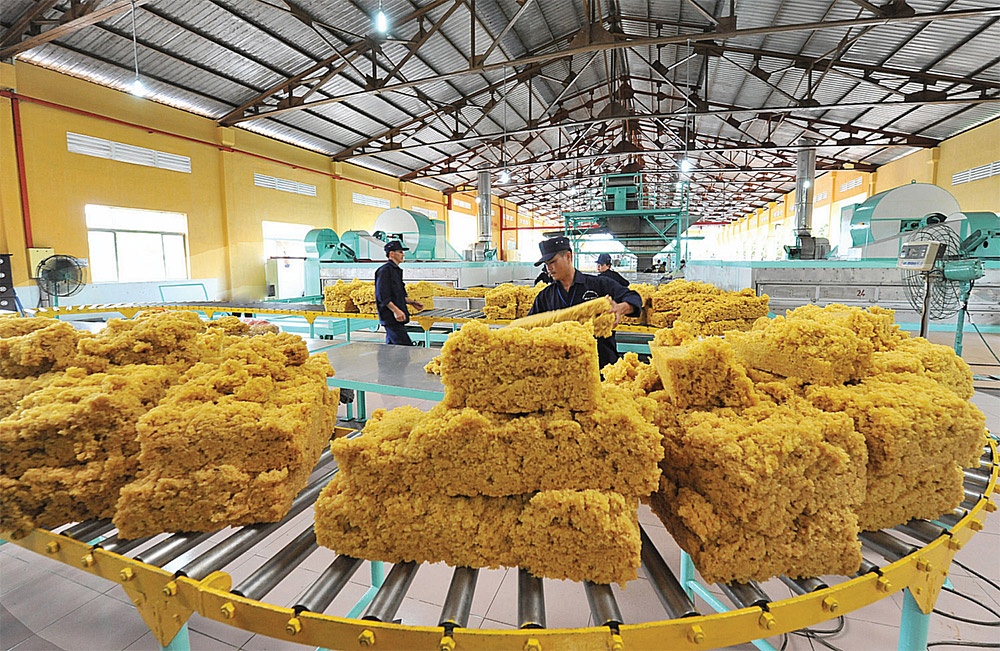
Agricultural export markets diversify, photo Le Toan
Chairman Man proposed that China further open its market to Vietnamese goods, particularly agricultural and seafood products, highlighting the need to implement large-scale, symbolic projects that reflect the growing cooperation between the two nations.
The Chinese official added that China was willing to import high-quality products from Vietnam, including agricultural products, and hoped that Vietnam would send delegations to participate in China’s import-export fairs, including the ASEAN-China Expo.
China agreed to import products from 11 dairy plants and nine bird nest enterprises in Vietnam. China also approved the import of 48 types of live aquatic species and 128 processed seafood products, and approximately 600 Vietnamese seafood enterprises are licensed to export to its market.
In terms of other markets, Vu Ba Phu, director general of the Vietnam Trade Promotion Agency under the Ministry of Industry and Trade, told local media in Hanoi on April 4 that the agency was collaborating with ministries, sectors, localities, and agricultural industry associations to focus on key tasks to boost the consumption of relevant products.
“The agency will continue to closely coordinate with the Vietnamese trade offices abroad and international trade promotion organisations to support businesses in participating in major trade fairs such as Fruit Logistica Berlin, Biofach, and Foodex Japan. These events help businesses secure contracts and enhance the position of Vietnamese agricultural products in the global market,” Phu said.
The agency will continue to work with major retail corporations such as Walmart, AEON, Lotte, and Central Group to organise Vietnamese Goods Week programmes in these markets.
“This is a good opportunity for Vietnamese agricultural products to add more international consumers, expand market outlets, and increase export value. The agency will try to improve the efficiency of negotiations, market opening, trade promotion, and addressing trade-related issues,” said Phu.
In its 2025 action plan signed in early April, the Ministry of Agriculture and Environment outlined a key solution: developing a market classification system to set export targets by sub-sector and region, with a focus on high-potential markets. The plan also includes preparing detailed market reports and responding to changes in taxes, origin rules, and technical standards in key destinations such as the US, EU, and China.
The analysis of each product will be linked to the demands of the importing markets. For example, Japan, China, and the EU are targeted markets for wood products; China, Japan, the EU, and South Korea are targeted for aquatic products; while cashew nuts are exported to the EU, China, UAE, and the UK. Regardless of the market, quality, design, and standards must be standardised at the highest level to avoid dependence on any single market.
The potential to expand export markets is clear. Enhancing productivity and quality while reducing costs to improve competitiveness and access more markets is a necessity. However, to achieve this, the business community needs support and policies to bolster the competitiveness of goods, collaborating with state management agencies to expand export markets.
Nguyen Van Muoi, deputy secretary-general of the Vietnam Fruit and Vegetable Association, said that most of Vietnam’s agricultural products were exported fresh or minimally processed, resulting in large export volumes but low-value and high risks when markets fluctuate or policies on taxes change. Therefore, businesses are waiting for mechanisms to encourage them to invest in deep processing,
“The incentive policies encourage businesses to invest in science and technology for deep processing to increase the value of exported agricultural products and arrange raw material zones linked to processing plants to reduce production and logistics costs. This is especially critical as many businesses currently have factories located far from raw material zones – for example, raw materials are grown in Dak Nong province, but factories are in Ho Chi Minh City, and the southern provinces of Long An and Binh Duong.
Currently, the country has 51,000 enterprises related to the processing industry, but only 7,500 facilities and enterprises process on an industrial scale, and in the fruit and vegetable sector, only 150 enterprises use high-tech processing.
“Meanwhile, transportation costs are very high, so businesses need to plan raw material zones linked to production plants. There are large raw material zones without nearby factories, leaving businesses vulnerable in securing production materials. This is also an opportunity to reorganise raw material zones and factories to reduce transportation costs,” Muoi said.
Nguyen Tri Ngoc, vice chairman of the Vietnam Fertiliser Association, argued that amending the Law on Standards and Technical Regulations and the Law on Product and Goods Quality is crucial, as these are two foundational laws.
“We have consistently advocated for the abolition of conformity certification and conformity announcements as these procedures are unnecessary, overlapping, and have burdened us for years. Maintaining them means indebting the country, businesses, and more than 10 million farming households,” Ngoc said.
Source: VIR
Related News

CHARITY / EXHIBITION / OTHER EVENTS
INVESTMENT OPPORTUNITIES IN CA MAU PROVINCE: 96 PROJECTS AND 20 STRATEGIC PROJECTS
We are pleased to share with you information on investment projects currently seeking investors in Ca Mau Province. Should your esteemed company or association be interested, we kindly invite you to review the project information and complete the registration form via the links provided. The Ho Chi Minh City Investment and Trade Promotion Centre (ITPC) will consolidate the expressions of interest and facilitate connections with the leadership of Ca Mau Province at a meeting tentatively scheduled for 13 November 2026 in Ho Chi Minh City.

MEMBER CORNER / PROMOTIONS
BẰNG KIỀU LIVESHOW - A SYMPHONY OF LOVE UNDER THE GOLDEN GLOW
A masterclass in live music that takes the audience on a soulful journey through immortal love songs, guided by the peerless artistry and emotive storytelling of renowned singer Bằng Kiều. The highlight of the night is his seamless musical chemistry with special guest Triệu Hồng Ngọc, promising passionate and deeply resonant duets inside the magnificent Grand Ballroom.

INFRASTRUCTURE / CONSTRUCTION / LOGISTIC / PORT
ĐÀ NẴNG GREEN-LIGHTS US$105 MILLION THAI DEVELOPMENT DEAL
The central city has approved an investment proposal by Thailand’s WHA Group to develop infrastructure for the 400ha WHA Đà Nẵng Industrial Park project on two communes of Thăng Bình and Đồng Dương, with an investment of more than VNĐ2.7 trillion (US$105 million). The city said it approved WHA Industrial Development International's status as an investor in the project, which is expected to take place between 2027 and 2034.

VIETNAM ECONOMY INVESTMENT
MOBILE PHONE EXPORTS RISE 20% TO $51.8 BILLION IN FIRST NINE MONTHS
Exports of mobile phones and components rose 20 per cent year-on-year to nearly US$51.8 billion in the first nine months of 2026, with China, the US and Republic of Korea accounting for more than half of the total. Shipments to the three markets reached a combined $26.18 billion, or 50.6 per cent of total exports of the product group during the period, according to data from the Vietnam Department of Customs under the Ministry of Finance.

INFRASTRUCTURE / CONSTRUCTION / LOGISTIC / PORT
VIỆT NAM-CAMBODIA TRADE GATHERS PACE TOWARDS $20 BILLION TARGET
Trade between Việt Nam and Cambodia continues to grow, remaining a bright spot and a key pillar of bilateral cooperation as the two countries aim to raise two-way trade to US$20 billion in the coming years. After setting a record of more than $11.3 billion last year, bilateral trade reached about $8.7 billion in the first eight months of this year, up 8.3 per cent year on year.

VIETNAM ECONOMY INVESTMENT
FRUIT AND VEGETABLE EXPORTS POISED TO HIT $10 BILLION IN 2026
Fruit and vegetable exports are on track to reach nearly US$10 billion in 2026, after rising 19.9 per cent year on year to nearly US$7.4 billion in the first nine months, driven by strong seasonal demand and abundant tropical fruit supplies. The Ministry of Agriculture and Environment said the growth reflected stronger international demand for fresh produce and processed agricultural products.
Events Sponsors






















