Want to be in the loop?
subscribe to
our notification
Business News
CAT LAI PORT TO HANDLE 1.6 MILLION TONS OF CARGO OVER TET
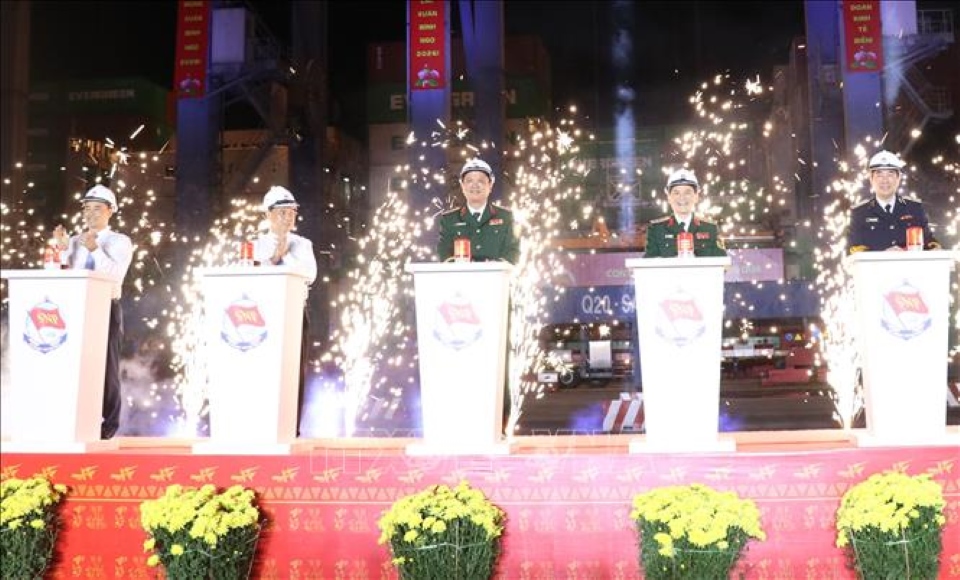
Delegates perform the ritual to officially launch the first cargo handling operations of the Year of the Horse 2026 at Tan Cang - Cat Lai Port in HCMC - PHOTO: VNA
HCMC – On Lunar New Year’s Eve (Feb. 16), Tan Cang–Cat Lai Port in HCMC processed approximately 11,200 TEUs, equivalent to 155,000 tons of goods, marking a strong start to Lunar New Year operations with a combined throughput of 1.6 million tons of cargo.
Following this start, the Marine Economic Corps (Corps 20) under Saigon Newport Corporation (SNP) officially launched its first cargo handling ceremony for the Year of the Horse 2026 on the night of Feb. 16. During the transition, the port welcomed seven container vessels, with the first shipment consisting of electronic components loaded onto the vessel Ever Brave.
The Ever Brave, operated by Evergreen Line, has a deadweight of 36,972 tons and a capacity of nearly 3,000 TEUs (Twenty-foot Equivalent Units). Its route spans Cat Lai (Vietnam), Laem Chabang (Thailand), Singapore, Port Kelang (Malaysia), and onward to Chennai and Vizag (India). The shipment of electronic components highlights a key export sector that helped drive HCMC’s total export turnover to more than US$98 billion in 2025.
To ensure smooth operations during the Tet holidays, more than 1,000 employees per shift are stationed at Cat Lai to manage production and serve import-export clients. The port is expected to handle 70 vessels during the holiday period, with a projected throughput of 112,000 TEUs, or nearly 1.6 million tons of cargo.
Major General Ngo Minh Thuan, Commander of Corps 20, said that in 2026 the corporation aims for a 12% increase in revenue and profit, with labor productivity rising by more than 8.5%. The logistics segment, in particular, is targeted to grow by over 20%. The company’s strategy remains focused on five core business pillars: port operations, logistics, maritime services, free trade zone investment, and renewable energy.
In 2025, the corporation’s total container throughput reached 11.4 million TEUs, equivalent to nearly 160 million tons of cargo, contributing significantly to the national budget.
Speaking at the event, Bui Xuan Cuong, vice chairman of the HCMC People’s Committee, said the city will accelerate infrastructure projects—including Ring Road 3, the Ben Luc–Long Thanh Expressway, and the An Phu and My Thuy intersections—all scheduled for completion in 2026. These projects are expected to form strategic transport corridors, ease gateway congestion, and enhance trade capacity.
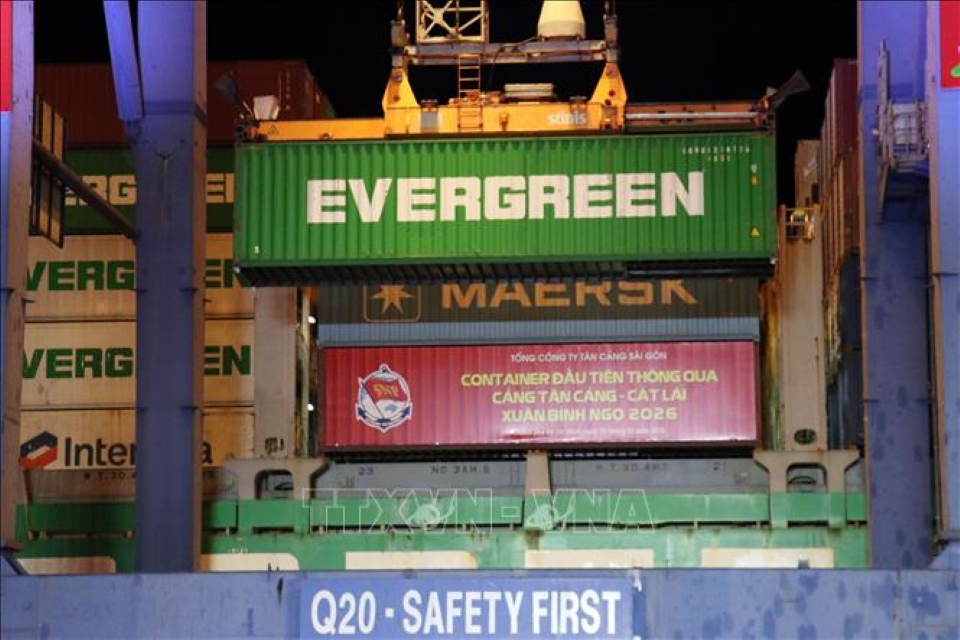
The very first containers being loaded onto the container vessel in the Year of the Horse – PHOTO: VNA
In the longer term, the development of Ring Road 4 and dedicated roads linking Cat Lai and Phu Huu ports will further strengthen the competitiveness of the Southern Key Economic Region, supporting the city’s goal of achieving more than 10% growth in 2026.
During the ceremony, Corps 20–SNP also donated VND5.4 billion (US$200,000) to the HCMC Fund for the Poor, the national sea and islands fund, and local communities.
Source: The Saigon Times
Related News
MEMBER CORNER / PROMOTIONS
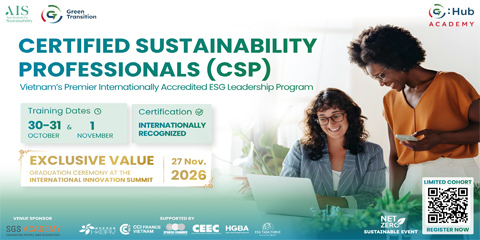
HCMC | CERTIFIED SUSTAINABILITY PROFESSIONAL (CSP) TRAINING | REGISTRATION OPEN
As sustainability becomes deeply embedded in corporate strategy and supply-chain operations across Vietnam, Hong Kong Business Association Vietnam is pleased to endorse the upcoming Certified Sustainability Professional (CSP) training program by the Asia Institute for Sustainability (AIS) - a premier internationally recognized ESG credential in Vietnam.
VIETNAM ECONOMY INVESTMENT
HCM CITY SAYS HOW IT PLANS TO ACHIEVE 10-11% ANNUAL EXPORT GROWTH FOR REST OF DECADE
The southern economic hub aims to strengthen its role as the country’s largest import-export centre while developing into a regional transhipment centre in Southeast Asia, supported by green and digital transformation and a circular economy. HCM City has outlined measures to expand production capacity, cut logistics costs, diversify export markets, and help businesses meet increasingly stringent international standards as it targets average annual export growth of 10-11 per cent through 2030.
VIETNAM ECONOMY INVESTMENT
HCM CITY LEADS ECONOMIC RESTRUCTURING IN SOUTHEAST REGION
According to Associate Professor, Dr Vũ Tuấn Hưng, director of the Institute of Social Sciences of the Southern Region, the Southeast is a strategically important socio-economic space in Việt Nam’s development given its advantages in location, industry, trade, services, logistics, science and technology, urbanisation and human resources.
TECHNOLOGY
DIGITAL TRANSFORMATION TURNED INTO PRACTICAL TOOLS FOR PEOPLE, BUSINESSES
Việt Nam is moving its digital transformation agenda beyond policy frameworks and individual technology platforms towards practical applications that address everyday needs, as authorities seek measurable outcomes from science, technology and innovation. Under Politburo Resolution No. 57-NQ/TW issued on December 22, 2024, the implementation is increasingly shifting from simply completing assigned tasks towards developing concrete products and services for citizens and businesses.
TECHNOLOGY
APPLYING TECHNOLOGY FOR ECONOMIC TRANSFORMATION
Having completed its new rural development program, Hanoi is shifting its focus toward improving development quality and building smart, sustainable rural areas. The transformation of Dong La orchid-growing village in An Khanh, a western commune of Hanoi, shows how digital technology is becoming a driver of production, market expansion, and higher incomes for local residents.
MEMBER CORNER / PROMOTIONS
VIGLACERA HONORED AS THE "LEADING GREEN INDUSTRIAL REAL ESTATE DEVELOPER 2026"
Organized by the Vietnam Investment Review, this prestigious awards program recognizes industry pioneers advancing eco-industrial parks, clean energy transition, and rigorous ESG standards. Outperforming competitors through a rigorous evaluation, Viglacera Corporation – JSC proudly ranked among the Top 5 highest-positioned enterprises in the Leading Green Industrial Real Estate Developers 2026 category, reinforcing its premier position in Vietnam’s industrial real estate sector.
Events Sponsors






















