Want to be in the loop?
subscribe to
our notification
Business News
CAUTION AND STABILITY DRIVE VIETNAM’S WORKFORCE TRENDS
Amid economic uncertainties, selective hiring and cautious career planning are reshaping the labour market.

According to the Salary Guide 2026 by Adecco Vietnam on March 19, Vietnam’s economy demonstrated solid momentum in 2025, with GDP growth of 8.02 per cent, driven by services and industrial sectors. Exports grew by 17 per cent, while business remained active despite ongoing market adjustments.
Hiring activity remained cautious but stable. Organisations prioritised efficiency and critical roles, focusing on experienced professionals who can deliver immediate impact. Leaner team structures became more common, while competition for skilled talent, especially in digital, technical, and leadership roles, remained strong.
Based on research involving 10,000 professionals in Vietnam, primarily mid- to senior-level, the report highlights a shift towards more sustainable, people-centric workplaces.
Mental health and wellbeing have emerged as the top trend influencing work life, followed by economic and business uncertainty. This reflects growing awareness of burnout risks and the need for resilience, prompting organisations to place greater emphasis on employee support and workforce stability.
In 2025, salary growth remained moderate, with 33 per cent reporting no change and only 18 per cent seeing increases above 10 per cent, mainly in IT and digital roles. However, expectations for 2026 are more optimistic, with 38 per cent anticipating increases above 10 per cent, highlighting the mportance of compensation in attracting and retaining talent.
At the same time, professionals are becoming more cautious in their career decisions. While 62 per cent are open to new opportunities, a notable 37 per cent prefer stability. Workplace relationships continue to be a key retention factor, with strong satisfaction levels towards colleagues (72 per cent) and line managers (60 per cent).
Although AI was not ranked among the top trends this year, its adoption in daily work continues to grow. Employees are increasingly using AI to streamline tasks and support decision-making, with 73 per cent confident their employers will support the development of AI-related skills, reflecting a strong commitment to upskilling and continuous learning.
Looking ahead, Vietnam’s GDP is forecasted to grow by around 9 per cent in 2026, supported by continued foreign investment, infrastructure development, and expansion across key industries. As businesses adapt to technological advancements and shifting global supply chains, demand for highly skilled, adaptable talent is expected to remain steady.
Organisations will need to strike a balance between operational efficiency and long-term workforce development, while those who invest in digital capabilities, cross-functional skills, and continuous learning will be best positioned to capture emerging opportunities.
Source: VIR
Related News

INFRASTRUCTURE / CONSTRUCTION / LOGISTIC / PORT
VIỆT NAM-CAMBODIA TRADE GATHERS PACE TOWARDS $20 BILLION TARGET
Trade between Việt Nam and Cambodia continues to grow, remaining a bright spot and a key pillar of bilateral cooperation as the two countries aim to raise two-way trade to US$20 billion in the coming years. After setting a record of more than $11.3 billion last year, bilateral trade reached about $8.7 billion in the first eight months of this year, up 8.3 per cent year on year.
TECHNOLOGY
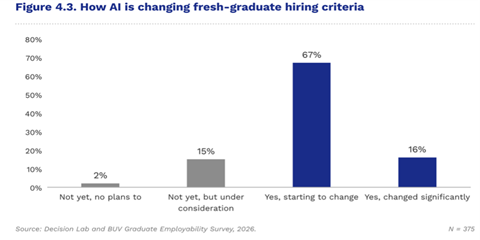
AI BEGINNING TO RESHAPE RECRUITMENT CRITERIA
Digital literacy is the only capability area in which fresh graduates meet employers’ expectations, according to a new report. Yet, it is also the standard rising fastest, as businesses increasingly expect new hires to use AI effectively in the workplace. Some 83 per cent of employers say AI has changed, or is beginning to change, their hiring criteria, while 94 per cent report higher expectations for digital and AI capabilities than they had two to three years ago.

INFRASTRUCTURE / CONSTRUCTION / LOGISTIC / PORT
ĐÀ NẴNG GREEN-LIGHTS US$105 MILLION THAI DEVELOPMENT DEAL
The central city has approved an investment proposal by Thailand’s WHA Group to develop infrastructure for the 400ha WHA Đà Nẵng Industrial Park project on two communes of Thăng Bình and Đồng Dương, with an investment of more than VNĐ2.7 trillion (US$105 million). The city said it approved WHA Industrial Development International's status as an investor in the project, which is expected to take place between 2027 and 2034.

VIETNAM ECONOMY INVESTMENT
MOBILE PHONE EXPORTS RISE 20% TO $51.8 BILLION IN FIRST NINE MONTHS
Exports of mobile phones and components rose 20 per cent year-on-year to nearly US$51.8 billion in the first nine months of 2026, with China, the US and Republic of Korea accounting for more than half of the total. Shipments to the three markets reached a combined $26.18 billion, or 50.6 per cent of total exports of the product group during the period, according to data from the Vietnam Department of Customs under the Ministry of Finance.

VIETNAM ECONOMY INVESTMENT
FRUIT AND VEGETABLE EXPORTS POISED TO HIT $10 BILLION IN 2026
Fruit and vegetable exports are on track to reach nearly US$10 billion in 2026, after rising 19.9 per cent year on year to nearly US$7.4 billion in the first nine months, driven by strong seasonal demand and abundant tropical fruit supplies. The Ministry of Agriculture and Environment said the growth reflected stronger international demand for fresh produce and processed agricultural products.
GARMENT / TEXTILE
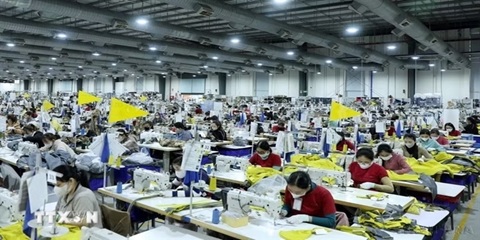
TEXTILE EXPORTS FACE DUAL CHALLENGES OF SUSTAINING ORDERS AND BOOSTING EFFICIENCY AMID GROWING COMPETITION
Data shows that the textile and garment sector maintained its growth momentum in the first nine months of this year. The industry's total export turnover reached an estimated US$35.721 billion in the first nine months of this year, up 3.3 per cent year-on-year. Despite posting encouraging export figures, Vietnamese textile and garment enterprises continue to navigate unpredictable market variables.
Events Sponsors






















