Want to be in the loop?
subscribe to
our notification
Business News
COVID-19 PANDEMIC CHALLENGES GARMENT AND TEXTILE BUSINESSES
Many Vietnamese garment and textile businesses have received notices from their US and EU partners that they will temporarily stop receiving goods for three weeks to one month.
According to Phạm Xuân Hồng, Chairman of the HCM City Association of Garment Textile Embroidery and Knitting, customers said they needed to stop receiving goods due to the rapid spread of COVID-19 in the US and EU, prompting governments to declare states of emergency and tighten border controls.
“They asked Vietnamese businesses to suspend orders, including those being transported until borders are reopened,” Hồng said.
He said the US and EU are two important textile export markets of Việt Nam. Half of all textile exports from HCM City go to the US, while the EU accounts for 15-18 per cent of annual exports.
“Partners in these markets announced the suspension of receiving goods, meaning that nearly two-thirds of the market of textiles and garments narrowed,” Hồng added.
Chairman of Việt Thắng Jean Co., Ltd Phạm Văn Việt, said evidence from China can be used to estimate that it will take at least two months in the US and EU to control the pandemic. When life becomes stable and the retail industry restarts, import businesses will reopen warehouses and import goods for distribution.
As for Việt Thắng Jean, Việt said the US accounts for 30-35 per cent and the EU for 20 per cent of the company's total export turnover.
“Our products are seasonal fashion products. Imported materials were prepared six months ago. At this time when the partners announced that they would stop imports, meaning all the materials prepared for sale this summer must move to next year, making them unfashionable. About 40 per cent of existing fabrics will be abandoned or sold at low prices,” he said.
In addition, Việt said suddenly stopping imports forced enterprises to store many containers of products which were on the way to US and EU ports.
“This makes businesses spend a lot of additional expenses, while its cash flow is ‘frozen’.”
He said the most urgent problem for textile enterprises is not the delivery of orders but how to protect workers.
"Textiles is one of the industries using the highest number of workers, most of them are unable to switch to other jobs in the current situation. Therefore, maintaining employment and income for workers is not only a vital business problem but also a great impact on society,” Việt said.
“If enterprises let workers go, where will hundreds of thousands of workers go? What will businesses do to recruit workers to recover production when the pandemic is controlled? Such questions are not yet answered," Việt added.
Textile enterprises have proposed the Government quickly disburse approved economic stimulus packages, and consider partial use of the unemployment insurance fund and social insurance fund to help businesses continue paying their workers.
They also hope the Ministry of Finance and the banking system will lower interest rates or give interest-free loans, which could be used to pay workers until production activities and trade return to normal.
Embassy support
Ambassador of Việt Nam to US Hà Kim Ngọc said the US government has not announced a policy to suspend imports of Vietnamese garment and textile products.
Ngọc said the embassy has spoken with the relevant American agencies to dismiss false rumours that the US had suspended imports of Việt Nam’s garment and textile products.
He said due to the complex developments of the COVID-19 pandemic, a decline in trade activities, including the textile sector, was inevitable.
“In order to comply with the US government’s direction to the prevention of COVID-19, many businesses and large retailers such as Macy's, TJ Maxx, Walmart and Target have announced temporary closure or reduction of the opening time of stores until the end of this month,” Ngọc said.
“With the economy facing more difficulties, decreased purchasing demand of US consumers will also affect the import of products. Therefore, if the pandemic lasts for a long time, our exports of goods will be affected,” he added.
In this difficult context, Ngọc said that businesses need to be very calm while continuing to take every opportunity to maintain production and exports.
The US is a large market for Việt Nam’s garment and textile industry. In 2019, the country’s export to the US reached nearly US$15 billion, about 45 per cent of total garment and textile export turnover.
In the first two months of this year, garment and textile exports to the US hit $2.25 billion, up 5.3 per cent year-on-year, accounting for nearly 48 per cent of the country's total textile export value.
Ngọc said the embassy will continue to discuss with local authorities to support Vietnamese businesses.
“When the COVID-19 pandemic is controlled, the market demand will recover and this will be a good opportunity for Vietnamese businesses to boost exports to foreign countries, including the US,” he said.
Source: VNS
Related News

INFRASTRUCTURE / CONSTRUCTION / LOGISTIC / PORT
VIỆT NAM-CAMBODIA TRADE GATHERS PACE TOWARDS $20 BILLION TARGET
Trade between Việt Nam and Cambodia continues to grow, remaining a bright spot and a key pillar of bilateral cooperation as the two countries aim to raise two-way trade to US$20 billion in the coming years. After setting a record of more than $11.3 billion last year, bilateral trade reached about $8.7 billion in the first eight months of this year, up 8.3 per cent year on year.
TECHNOLOGY
AI BEGINNING TO RESHAPE RECRUITMENT CRITERIA
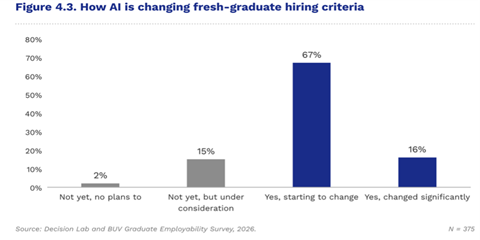
Digital literacy is the only capability area in which fresh graduates meet employers’ expectations, according to a new report. Yet, it is also the standard rising fastest, as businesses increasingly expect new hires to use AI effectively in the workplace. Some 83 per cent of employers say AI has changed, or is beginning to change, their hiring criteria, while 94 per cent report higher expectations for digital and AI capabilities than they had two to three years ago.

INFRASTRUCTURE / CONSTRUCTION / LOGISTIC / PORT
ĐÀ NẴNG GREEN-LIGHTS US$105 MILLION THAI DEVELOPMENT DEAL
The central city has approved an investment proposal by Thailand’s WHA Group to develop infrastructure for the 400ha WHA Đà Nẵng Industrial Park project on two communes of Thăng Bình and Đồng Dương, with an investment of more than VNĐ2.7 trillion (US$105 million). The city said it approved WHA Industrial Development International's status as an investor in the project, which is expected to take place between 2027 and 2034.

VIETNAM ECONOMY INVESTMENT
MOBILE PHONE EXPORTS RISE 20% TO $51.8 BILLION IN FIRST NINE MONTHS
Exports of mobile phones and components rose 20 per cent year-on-year to nearly US$51.8 billion in the first nine months of 2026, with China, the US and Republic of Korea accounting for more than half of the total. Shipments to the three markets reached a combined $26.18 billion, or 50.6 per cent of total exports of the product group during the period, according to data from the Vietnam Department of Customs under the Ministry of Finance.

VIETNAM ECONOMY INVESTMENT
FRUIT AND VEGETABLE EXPORTS POISED TO HIT $10 BILLION IN 2026
Fruit and vegetable exports are on track to reach nearly US$10 billion in 2026, after rising 19.9 per cent year on year to nearly US$7.4 billion in the first nine months, driven by strong seasonal demand and abundant tropical fruit supplies. The Ministry of Agriculture and Environment said the growth reflected stronger international demand for fresh produce and processed agricultural products.
GARMENT / TEXTILE
TEXTILE EXPORTS FACE DUAL CHALLENGES OF SUSTAINING ORDERS AND BOOSTING EFFICIENCY AMID GROWING COMPETITION
Data shows that the textile and garment sector maintained its growth momentum in the first nine months of this year. The industry's total export turnover reached an estimated US$35.721 billion in the first nine months of this year, up 3.3 per cent year-on-year. Despite posting encouraging export figures, Vietnamese textile and garment enterprises continue to navigate unpredictable market variables.
Events Sponsors






















