Want to be in the loop?
subscribe to
our notification
Business News
DAIRY MARKET REMAINS RIPE FOR NEW EXPANSION
Rising consumer demand, combined with a shift towards premium products and tech innovation, is giving domestic dairy producers an edge to scale up and consolidate their position in the market.
At a conference a fortnight ago on the dairy industry’s development strategy, Assoc. Prof. Dr Tran Quang Trung, chairman of the Vietnam Dairy Association, stated that dairy remains one of the industries maintaining stable growth with ever-increasing consumption demand.
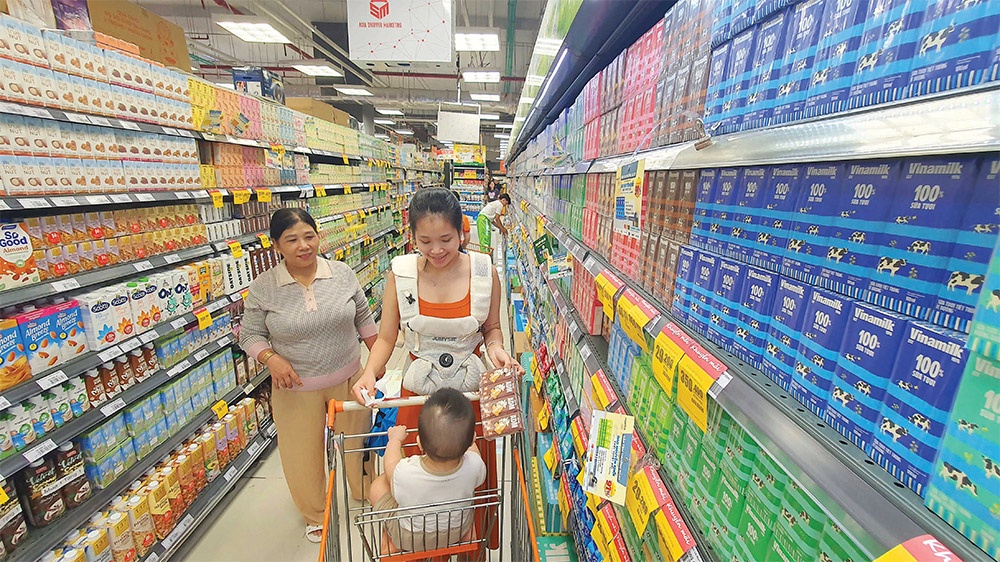
The average milk consumption of Vietnamese people is lower than the likes of Thailand and Singapore, Photo: Le Toan
Vietnam’s average milk consumption is around 27 litres per person per year and is forecast to grow by 7-8 per cent annually. Industry revenue is projected to grow from $5.7 billion in 2024 to $13.37 billion by 2033, with a compound annual growth rate of around 9.5 per cent during the period 2025-2033.
“Although the conditions and potential for development are significant, Vietnam’s dairy industry still relies heavily on imported raw materials, while domestic raw materials only meet about 40 per cent of demand. This is paradoxical for an agricultural country like Vietnam, which relies greatly on dairy ingredients from abroad,” Trung said.
According to figures from the Ministry of Agriculture and Environment (MoAE), Vietnam spent more than $1 billion on importing milk and dairy products in 2024, mostly powdered milk. In the first seven months of 2025 alone, Vietnam spent nearly $2.6 billion importing livestock products, with milk and dairy products accounting for more than $860 million. This dependence, according to experts, not only creates pressure on costs and foreign currency but also poses risks.
Dr. Nguyen Xuan Duong, chairman of the Vietnam Livestock Association, said that Vietnam’s system of standards and technical regulations is still lacking in uniformity, and the management of imported milk is not strict enough, allowing cheap reconstituted powdered milk to easily overshadow fresh domestic milk.
“The average milk consumption of Vietnamese people is about 26-28 litres per person per year, lower than many other markets, such as Thailand at 35 litres, Singapore at 45 litres, and Europe at up to 100 litres per person per year,” he said.
Duong added that the prerequisite for sustainable dairy industry development is to master domestic raw material sources, develop dairy farming linked with value chains, and apply high technology from breeding and care to processing.
“It is necessary to plan pasture areas, be proactive in animal feed sources, and apply a circular economy model with a ‘from grass to glass’ closed-loop management system. This will help improve productivity and product quality, while increasing the competitiveness of domestic milk,” he said.
As of 2024, Vietnam’s total dairy herd had grown by an average of 4.6 per cent per year, reaching 335,000 cows and producing more than 1.2 million tonnes of raw fresh milk, according to data from the MoAE.
The development strategy for the dairy industry to 2030, with a vision to 2045, sets a target of raising the dairy herd to 650,000-700,000 cows by 2030, with fresh milk output reaching 2.6 million tonnes, of which 60 per cent will be raised on high-tech farms meeting Global G.A.P standards, towards carbon neutrality.
By 2045, Vietnam aims for an output of 6.2 million tonnes, being 80-82 per cent self-sufficient in raw materials, with per capita consumption reaching 70 litres per year. In the context of rapid demand growth but limited domestic raw materials, dairy enterprises are pushing product strategies and restructuring market share.
Nguyen Quang Tri, marketing director at Vinamilk, said that actively securing raw material sources not only helps the brand meet growing domestic market demands but also expand strongly in overseas markets.
“Vinamilk has developed lactose-free milk, nut milk, and fermented yoghurt to ensure nutrition and reduce indigestion symptoms for consumers. We are also licensed to export condensed milk products to the Chinese market, opening up growth potential in the largest consumer market in Asia,” Tri said.
Vinamilk’s consolidated revenue in Q2 reached $669.8 million, up $3.1 million from the same period last year. In terms of exports, Vinamilk recorded a record result in Q2 with net revenue reaching $75.4 million, up 8.5 per cent on-year, and continued positive growth for the eighth consecutive quarter.
In traditional markets, Vinamilk is gradually upgrading its product portfolio based on its strengths in the mass segment, in order to enhance export value and brand equity.
Vinamilk remains the giant dominating Vietnam’s dairy market, holding nearly half of the industry’s total market share as of the end of 2024, according to Data Factory VIRAC. The brand is present in almost all segments.
Meanwhile, TH true MILK currently accounts for about 30-45 per cent of Vietnam’s packaged fresh milk market share, positioning its products in the clean, organic, and premium fresh milk segment, with a strong focus on origin and international standards in farming.
Also, FrieslandCampina Vietnam, the Dutch dairy company owning the Dutch Lady brand, currently holds about 25 per cent of Vietnam’s dairy market share.
According to the Vietnam Dairy Association, the country aims for 60 per cent self-sufficiency in raw materials by 2030 and per capita consumption of about 70 to 100 litres of milk per year by 2045.
Source: VIR
Related News

CHARITY / EXHIBITION / OTHER EVENTS
INVESTMENT OPPORTUNITIES IN CA MAU PROVINCE: 96 PROJECTS AND 20 STRATEGIC PROJECTS
We are pleased to share with you information on investment projects currently seeking investors in Ca Mau Province. Should your esteemed company or association be interested, we kindly invite you to review the project information and complete the registration form via the links provided. The Ho Chi Minh City Investment and Trade Promotion Centre (ITPC) will consolidate the expressions of interest and facilitate connections with the leadership of Ca Mau Province at a meeting tentatively scheduled for 13 November 2026 in Ho Chi Minh City.

MEMBER CORNER / PROMOTIONS
BẰNG KIỀU LIVESHOW - A SYMPHONY OF LOVE UNDER THE GOLDEN GLOW
A masterclass in live music that takes the audience on a soulful journey through immortal love songs, guided by the peerless artistry and emotive storytelling of renowned singer Bằng Kiều. The highlight of the night is his seamless musical chemistry with special guest Triệu Hồng Ngọc, promising passionate and deeply resonant duets inside the magnificent Grand Ballroom.

INFRASTRUCTURE / CONSTRUCTION / LOGISTIC / PORT
ĐÀ NẴNG GREEN-LIGHTS US$105 MILLION THAI DEVELOPMENT DEAL
The central city has approved an investment proposal by Thailand’s WHA Group to develop infrastructure for the 400ha WHA Đà Nẵng Industrial Park project on two communes of Thăng Bình and Đồng Dương, with an investment of more than VNĐ2.7 trillion (US$105 million). The city said it approved WHA Industrial Development International's status as an investor in the project, which is expected to take place between 2027 and 2034.

VIETNAM ECONOMY INVESTMENT
MOBILE PHONE EXPORTS RISE 20% TO $51.8 BILLION IN FIRST NINE MONTHS
Exports of mobile phones and components rose 20 per cent year-on-year to nearly US$51.8 billion in the first nine months of 2026, with China, the US and Republic of Korea accounting for more than half of the total. Shipments to the three markets reached a combined $26.18 billion, or 50.6 per cent of total exports of the product group during the period, according to data from the Vietnam Department of Customs under the Ministry of Finance.

INFRASTRUCTURE / CONSTRUCTION / LOGISTIC / PORT
VIỆT NAM-CAMBODIA TRADE GATHERS PACE TOWARDS $20 BILLION TARGET
Trade between Việt Nam and Cambodia continues to grow, remaining a bright spot and a key pillar of bilateral cooperation as the two countries aim to raise two-way trade to US$20 billion in the coming years. After setting a record of more than $11.3 billion last year, bilateral trade reached about $8.7 billion in the first eight months of this year, up 8.3 per cent year on year.

VIETNAM ECONOMY INVESTMENT
FRUIT AND VEGETABLE EXPORTS POISED TO HIT $10 BILLION IN 2026
Fruit and vegetable exports are on track to reach nearly US$10 billion in 2026, after rising 19.9 per cent year on year to nearly US$7.4 billion in the first nine months, driven by strong seasonal demand and abundant tropical fruit supplies. The Ministry of Agriculture and Environment said the growth reflected stronger international demand for fresh produce and processed agricultural products.
Events Sponsors






















