Want to be in the loop?
subscribe to
our notification
Business News
E-CARS SET FOR NEW FEE EXEMPTIONS
With the current exemptions coming to an end this month, the Ministry of Finance supports continuing a reduction in registration fees for all electric cars from March 1.
The move came as the ministry (MoF) last week asked key ministries, sectors, and agencies for their feedback on a draft dispatch with two options for exempting and reducing registration fees for electric cars to encourage green transformation.
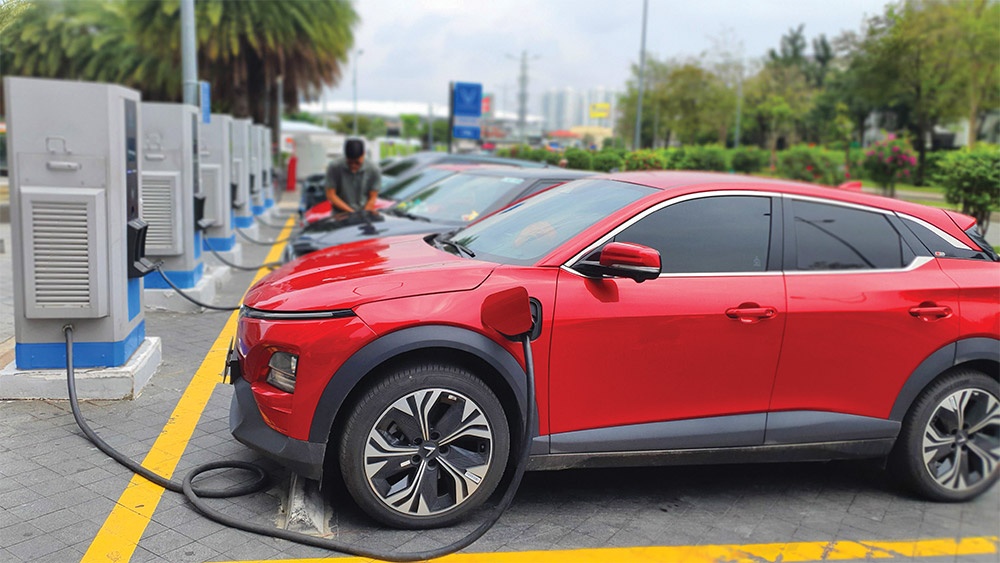
E-cars set for new fee exemptions, Photo Le Toan
Option 1 is to continue to reduce the registration fee by 50 per cent for battery-powered electric vehicles (EVs). Option 2 is to look at a 100 per cent exemption of registration fees from March 1 to the end of February 2027.
Under Decree No.10/2022/ND-CP on registration fee that took effect from March 2022, for three years the first-time registration fee is zero and in the next two years, the first-time registration fee is 50 per cent as the fee rate for petrol cars with the same quantity of seats. By the end of February, battery-powered EVs will no longer be 100 per cent exempt from registration fees.
According to the MoF, option 1 ensures policy stability and does not affect state budget revenue, especially local budgets. According to the MoF’s calculations, the budget revenue reduction will be about $2.5 billion per year if the proposal to extend the incentive period continues.
The Ministry of Industry and Trade (MoIT) has requested the MoF to evaluate the effectiveness of exempting registration fees for battery EVs. In addition to those, the MoIT also requested the MoF to study the policy of exempting and reducing this fee for other types of motor vehicles using clean, green, and environmentally friendly energy such as self-charging hybrid vehicles, externally charged hybrid vehicles and pure fuel cell EVs to encourage green transport.
The MoIT noted that the issue of introducing preferential policies for battery EVs could allow foreign car companies to take advantage of the opportunity to increase exports and penetrate the Vietnamese market.
The Vietnam Automobile Manufacturers Association forecasts that Vietnam will reach the milestone of one million EVs by around 2028, and about 3.5 million by 2040.
According to market research organisation 6Wresearch, the size of the Vietnamese EV market is expected to reach a compound annual growth rate (CAGR) of 22.9 per cent from 2020 to the end of this year. Another study by Mordor Intelligence noted that the size of Vietnam’s EV market is estimated to have reached $2.48 billion in 2024 and could hit $5.67 billion in 2029, growing at a CAGR of 18 per cent.
Currently, there are at least five new energy vehicle brands from China operating in Vietnam. Most Chinese EV brands set up joint ventures with companies in Vietnam to implement distribution plans. The General Motors, SAIC Motor, and Wuling joint venture cooperates with TMT Motors, while Haima is working with Carvivu, and Chery has a joint venture with Geleximco Group, with several dozen dealers involved.
BYD also said that it will boast 12 dealers this year. Most Chinese car models entering Vietnam recently are in the mid-range or high-end segment. Tasco last year continued to heat up this segment when it cooperated with Zeekr, a high-end EV brand from Geely, in Vietnam.
Source: VIR
Related News

CHARITY / EXHIBITION / OTHER EVENTS
INVESTMENT OPPORTUNITIES IN CA MAU PROVINCE: 96 PROJECTS AND 20 STRATEGIC PROJECTS
We are pleased to share with you information on investment projects currently seeking investors in Ca Mau Province. Should your esteemed company or association be interested, we kindly invite you to review the project information and complete the registration form via the links provided. The Ho Chi Minh City Investment and Trade Promotion Centre (ITPC) will consolidate the expressions of interest and facilitate connections with the leadership of Ca Mau Province at a meeting tentatively scheduled for 13 November 2026 in Ho Chi Minh City.

MEMBER CORNER / PROMOTIONS
BẰNG KIỀU LIVESHOW - A SYMPHONY OF LOVE UNDER THE GOLDEN GLOW
A masterclass in live music that takes the audience on a soulful journey through immortal love songs, guided by the peerless artistry and emotive storytelling of renowned singer Bằng Kiều. The highlight of the night is his seamless musical chemistry with special guest Triệu Hồng Ngọc, promising passionate and deeply resonant duets inside the magnificent Grand Ballroom.

INFRASTRUCTURE / CONSTRUCTION / LOGISTIC / PORT
ĐÀ NẴNG GREEN-LIGHTS US$105 MILLION THAI DEVELOPMENT DEAL
The central city has approved an investment proposal by Thailand’s WHA Group to develop infrastructure for the 400ha WHA Đà Nẵng Industrial Park project on two communes of Thăng Bình and Đồng Dương, with an investment of more than VNĐ2.7 trillion (US$105 million). The city said it approved WHA Industrial Development International's status as an investor in the project, which is expected to take place between 2027 and 2034.

VIETNAM ECONOMY INVESTMENT
MOBILE PHONE EXPORTS RISE 20% TO $51.8 BILLION IN FIRST NINE MONTHS
Exports of mobile phones and components rose 20 per cent year-on-year to nearly US$51.8 billion in the first nine months of 2026, with China, the US and Republic of Korea accounting for more than half of the total. Shipments to the three markets reached a combined $26.18 billion, or 50.6 per cent of total exports of the product group during the period, according to data from the Vietnam Department of Customs under the Ministry of Finance.

INFRASTRUCTURE / CONSTRUCTION / LOGISTIC / PORT
VIỆT NAM-CAMBODIA TRADE GATHERS PACE TOWARDS $20 BILLION TARGET
Trade between Việt Nam and Cambodia continues to grow, remaining a bright spot and a key pillar of bilateral cooperation as the two countries aim to raise two-way trade to US$20 billion in the coming years. After setting a record of more than $11.3 billion last year, bilateral trade reached about $8.7 billion in the first eight months of this year, up 8.3 per cent year on year.

VIETNAM ECONOMY INVESTMENT
FRUIT AND VEGETABLE EXPORTS POISED TO HIT $10 BILLION IN 2026
Fruit and vegetable exports are on track to reach nearly US$10 billion in 2026, after rising 19.9 per cent year on year to nearly US$7.4 billion in the first nine months, driven by strong seasonal demand and abundant tropical fruit supplies. The Ministry of Agriculture and Environment said the growth reflected stronger international demand for fresh produce and processed agricultural products.
Events Sponsors






















