Want to be in the loop?
subscribe to
our notification
Business News
EXPORTERS SPEED UP DIVERSE STRATEGIES
Vietnamese manufacturing enterprises are capitalising on pivotal opportunities to chart methodical, long-term growth strategies across both traditional and emerging markets.
At the government’s regular monthly meeting on May 6, Minister of Finance Nguyen Van Thang acknowledged that the current US path towards retaliatory export tariffs caught most economies off guard and immediately impacted global investor and business sentiment.
“However, Vietnam has been far from passive. We responded proactively and early,” Minister Thang said, highlighting that Vietnam engaged in effective diplomatic outreach across all levels that helped secure Vietnam’s position among economies that were granted priority in upcoming tariff negotiations. The first round was set for May 7.
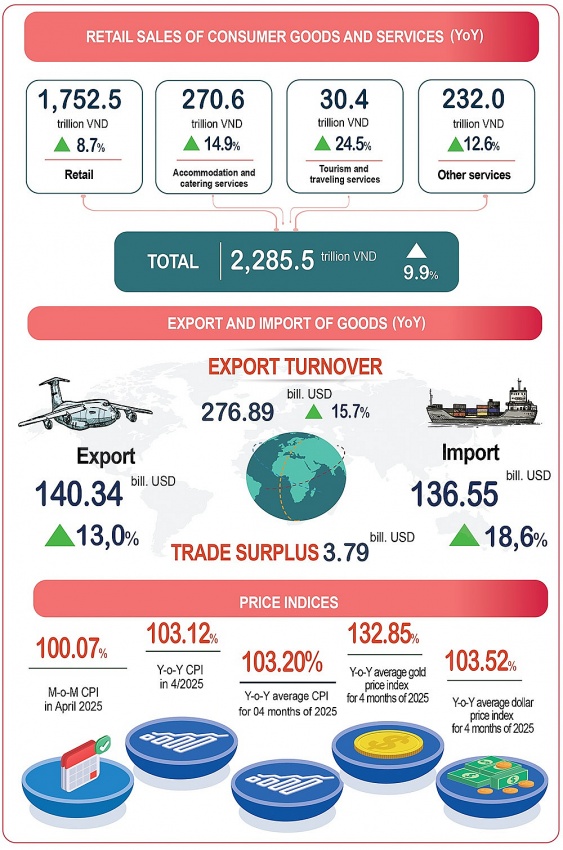
According to the National Statistics Office (NSO), April export turnover hit $37.45 billion, up 19.8 per cent on-year, contributing to a cumulative total of $140.34 billion for the first four months of 2025, up 13 per cent from the same period last year. Seafood exports reached $3.21 billion, accounting for 2.3 per cent of total export value.
Among Vietnam’s most responsive sectors is seafood. Exporters are moving swiftly to fulfil orders ahead of the July 9 tariff enforcement deadline from the US. Le Hang, deputy secretary general of the Vietnam Association of Seafood Exporters and Producers (VASEP), forecast a 10-15 per cent surge in exports to the US in May and June, thanks to last-minute deals and price adjustments.
Nguyen Ngo Vi Tam, CEO of basa fish exporter Vinh Hoan Corporation, confirmed robust second quarter exports. “We are neither overly optimistic nor pessimistic,” Tam told VIR. “We are committed to the US market, but we remain realistic. The real test will be how American consumers respond to price changes. Any tariff level will take time to reflect its full impact. Importers and consumers may eventually push back if costs rise significantly.”
Tam also noted that while the US remains a priority, the company is ensuring stable supply to other strategic markets. “We are not placing all our eggs in one basket. The strength of our operations lies in our flexibility,” she added.
In the textile sector, TNG Investment and Trading is showing similar agility. The company has secured US orders through August and EU contracts through October, with ongoing negotiations for additional year-end contracts. “We are working closely with long-term clients who understand the challenges. Trust and transparency are key during this phase,” a senior TNG executive said at the company’s AGM.
TNG is also transitioning to more complex, higher-value garments to offset the impact of lower volumes. “Our buyers are currently absorbing the 10 per cent tariff hike to maintain retail stability. But if rates increase further, pricing pressure will likely cascade down the supply chain,” the executive said. “We are staying grounded and proactive.”
The company is also strengthening footprints in free trade deals that link markets such as Canada, Mexico, the EU, and Russia to reduce its reliance on the US. As of April, US-bound orders accounted for only 26 per cent of TNG’s signed contracts, compared to 38 per cent in 2024.
At Song Hong Garment JSC, where the US accounts for 80 per cent of total export revenue, the mood is measured. “We’ve confirmed orders until August. No cancellations so far, but Q4 remains unclear. Many large global brands are still finalising their sourcing plans,” said chairman Bui Duc Thinh.
In response, the company is accelerating delivery timelines and shifting focus to premium brands with strong resilience. “Vietnam is gaining ground as an alternative sourcing destination, especially amid the transition away from China. But we’re also aware of the stiff competition from India and Bangladesh,” Thinh said.
Song Hong is also considering investments in domestic fabric production to reduce dependency on imported raw materials. “We are working with suppliers and importers to distribute risk. Even if contracts place the tax burden on importers, we believe shared sacrifice is essential for partnerships,” he added.
Seafood exporters, too, remain cautious despite strong April figures. VASEP reported that monthly exports reached $850 million, contributing to a four-month total of $3.3 billion, up 21 per cent on-year. However, the association warned of inconsistencies across product lines and markets, exacerbated by shifting US policies.
The Ministry of Agriculture and Environment projected that seafood exports could reach $10.5 billion in 2025, but only if businesses continue to adapt, diversify, and move up the value chain. “We’re seeing positive signals, but this year will test the resilience and creativity of our exporters,” VASEP noted.
Meanwhile, Vietnam’s trade balance remains favourable. April’s surplus reached $580 million, bringing the year-to-date figure to $3.79 billion. Domestic enterprises contributed $40.74 billion in exports (up 18.1 per cent), while foreign-invested firms delivered $99.6 billion (up 11 per cent) according to the NSO.
Source: VIR
Related News

CHARITY / EXHIBITION / OTHER EVENTS
INVESTMENT OPPORTUNITIES IN CA MAU PROVINCE: 96 PROJECTS AND 20 STRATEGIC PROJECTS
We are pleased to share with you information on investment projects currently seeking investors in Ca Mau Province. Should your esteemed company or association be interested, we kindly invite you to review the project information and complete the registration form via the links provided. The Ho Chi Minh City Investment and Trade Promotion Centre (ITPC) will consolidate the expressions of interest and facilitate connections with the leadership of Ca Mau Province at a meeting tentatively scheduled for 13 November 2026 in Ho Chi Minh City.

MEMBER CORNER / PROMOTIONS
BẰNG KIỀU LIVESHOW - A SYMPHONY OF LOVE UNDER THE GOLDEN GLOW
A masterclass in live music that takes the audience on a soulful journey through immortal love songs, guided by the peerless artistry and emotive storytelling of renowned singer Bằng Kiều. The highlight of the night is his seamless musical chemistry with special guest Triệu Hồng Ngọc, promising passionate and deeply resonant duets inside the magnificent Grand Ballroom.

INFRASTRUCTURE / CONSTRUCTION / LOGISTIC / PORT
ĐÀ NẴNG GREEN-LIGHTS US$105 MILLION THAI DEVELOPMENT DEAL
The central city has approved an investment proposal by Thailand’s WHA Group to develop infrastructure for the 400ha WHA Đà Nẵng Industrial Park project on two communes of Thăng Bình and Đồng Dương, with an investment of more than VNĐ2.7 trillion (US$105 million). The city said it approved WHA Industrial Development International's status as an investor in the project, which is expected to take place between 2027 and 2034.

VIETNAM ECONOMY INVESTMENT
MOBILE PHONE EXPORTS RISE 20% TO $51.8 BILLION IN FIRST NINE MONTHS
Exports of mobile phones and components rose 20 per cent year-on-year to nearly US$51.8 billion in the first nine months of 2026, with China, the US and Republic of Korea accounting for more than half of the total. Shipments to the three markets reached a combined $26.18 billion, or 50.6 per cent of total exports of the product group during the period, according to data from the Vietnam Department of Customs under the Ministry of Finance.

INFRASTRUCTURE / CONSTRUCTION / LOGISTIC / PORT
VIỆT NAM-CAMBODIA TRADE GATHERS PACE TOWARDS $20 BILLION TARGET
Trade between Việt Nam and Cambodia continues to grow, remaining a bright spot and a key pillar of bilateral cooperation as the two countries aim to raise two-way trade to US$20 billion in the coming years. After setting a record of more than $11.3 billion last year, bilateral trade reached about $8.7 billion in the first eight months of this year, up 8.3 per cent year on year.

VIETNAM ECONOMY INVESTMENT
FRUIT AND VEGETABLE EXPORTS POISED TO HIT $10 BILLION IN 2026
Fruit and vegetable exports are on track to reach nearly US$10 billion in 2026, after rising 19.9 per cent year on year to nearly US$7.4 billion in the first nine months, driven by strong seasonal demand and abundant tropical fruit supplies. The Ministry of Agriculture and Environment said the growth reflected stronger international demand for fresh produce and processed agricultural products.
Events Sponsors






















