Want to be in the loop?
subscribe to
our notification
Business News
GOVERNMENT TO IMPLEMENT MEASURES SUPPORTING PRIVATE SECTOR
The Government aims to cut at least 30 per cent of administrative procedure processing time, compliance costs, and business conditions by the end of 2025, with continued reductions in the following years.
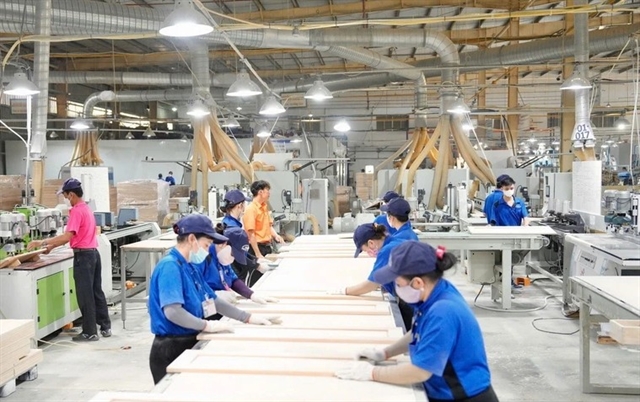
Workers at a furniture company in Bình Dương Province. VNA/VNS Photo
HÀ NỘI - Special mechanisms and policies will be implemented to foster the development of the private sector.
Under Government Resolution No. 139/NQ-CP, ministries, sectors and localities are tasked with implementing tasks in addition to their regular duties.
One of the plan's core objectives is to improve the business environment by reviewing and removing unnecessary, overlapping, and inconsistent business conditions that hinder private sector growth. This review must be completed no later than 31 December 2025.
The Government also aims to cut at least 30 per cent of administrative procedure processing time, compliance costs, and business conditions by the end of 2025, with continued reductions in the following years.
All targets set out in Resolution No. 66/NQ-CP on simplifying business-related administrative procedures for 2025–2026 must be met. Ministries must also review and amend investment and business conditions, shifting from licensing requirements to self-declaration mechanisms, with enhanced post-check measures. This reform is to be completed in 2025–2026.
To prevent inspection overlaps, each business or household business may only be inspected once per year unless there are clear signs of violations. Ministries must end duplicate inspections on the same subject and ensure that once an inspection has taken place, a second one on the same matter is not repeated in the same year.
Inspections must be publicly scheduled online to increase transparency. Remote and online inspections will be prioritised, with data-based risk assessments introduced to support early warnings of legal non-compliance. Government agencies are urged to combat counterfeit goods, smuggling, and copyright violations to protect lawful business interests.
Land access
To ease land and space constraints, the Ministry of Natural Resources and Environment will revise the Land Law to better manage land prices, especially for non-agricultural production, and ensure localities allocate land for industrial zones, hi-tech parks, and start-up incubators. Support will also be provided for land lease payments, and a national land database will be completed and linked with other government data centres by 2025.
The Ministry of Finance will revise Decree No. 35/2022/NĐ-CP to require that each industrial park allocate at least 20ha or 5 per cent of its land for high-tech, small- and medium-sized (SMEs), and start-up enterprises by 2025. It will also revise Decree No. 108/2024/NĐ-CP to facilitate access to unused public land and buildings for these same business groups.
By 2025, the ministry is expected to submit a policy that grants at least 30 per cent rent reductions for private hi-tech firms, SMEs, and start-ups for the first five years of land lease contracts in industrial or tech zones. The State will reimburse the rent support to infrastructure developers. Provinces must promptly publish land use and planning information, support site clearance activities, and apply digital solutions to shorten the time required for land lease approvals and issuance of land use rights by at least 30 per cent.
Tax, credit
The State Bank of Việt Nam and the Ministry of Finance will submit proposals to provide 2 per cent annual interest rate subsidies through commercial banks and off-budget financial funds to private businesses, households, and individuals borrowing for green, circular, or ESG-compliant projects. These policies are expected to be implemented in 2025.
To support innovation, the Ministry of Finance will propose a corporate income tax exemption for two years and a 50 per cent tax reduction for the following four years for start-ups and organisations supporting innovation, such as incubators and venture funds. Income from equity transfers or capital contributions in start-ups will also be exempted from personal and corporate income tax.
Additionally, tax incentives will be extended to experts and scientists working for innovative enterprises, with personal income tax exemptions for two years and 50 per cent reductions for four years. SMEs will enjoy a three-year corporate income tax exemption from the date of their initial business registration.
Training costs incurred by large enterprises for SMEs in their supply chains will also be deductible for tax purposes. From January 1, 2026, business households and individual traders will no longer be subject to the simplified lump-sum tax method. The Ministry of Finance will review relevant laws and propose necessary revisions.
To facilitate SME participation in public procurement, the ministry will submit a proposal for reserving state-funded construction, supply, and mixed tenders worth under VNĐ20 billion for SMEs, especially those led by youth, women, ethnic minorities, or people with disabilities, as well as those in remote or island areas. This is to be finalised by 2025. VNS
Source: VNS
Related News
MEMBER CORNER / PROMOTIONS
KNIC ENGAGES WITH GOVERNMENT AND HIGH-TECH BUSINESS COMMUNITIES IN CHINA
From Beijing to Shandong, KN Holdings and KN Industrial City are continuing to expand their engagement with government authorities, trade promotion organizations, and high-tech business communities in China. In Beijing, the delegation met with the Center for International Economic and Technological Cooperation under the Ministry of Industry and Information Technology (MIIT), exchanging perspectives on industrial and technology cooperation between the two markets.

VIETNAM ECONOMY INVESTMENT
VIETNAM’S TRADE TOPS $825 BILLION BY MID-SEPTEMBER
Figures released on September 21 showed goods trade reached nearly $55 billion in the first 15 days of September alone, bringing cumulative turnover since the beginning of the year to more than $825 billion. The strong growth reflects robust trade flows, with demand for consumer goods and production inputs remaining high.

TECHNOLOGY
VIỆT NAM'S BUSINESSES MOVE TOWARDS AI AGENTS
Việt Nam’s AI landscape is entering a new phase as businesses move beyond generative AI (GenAI) tools designed to assist human users towards autonomous AI, agentic AI and AI agents that can take action with limited supervision, experts have said. The shift comes as Việt Nam seeks to accelerate science and technology, innovation and digital transformation under Politburo Resolution 57-NQ/TW, issued on December 22, 2024.
GARMENT / TEXTILE
VIỆT NAM TARGETS $48 BILLION IN TEXTILE-GARMENT EXPORTS
Việt Nam’s textile and garment industry is facing both opportunities and challenges amid complex and unpredictable developments in the global market, prompting businesses to improve growth quality, optimise production costs and enhance adaptability in pursuit of an export turnover of about $48 billion this year. The target is considered an important milestone that requires concerted efforts from management agencies and the business community.
INFRASTRUCTURE / CONSTRUCTION / LOGISTIC / PORT
CUTTING LOGISTICS COSTS KEY TO BOOSTING EXPORTS
Reducing costs has become an increasingly urgent priority for import-export activities, particularly logistics costs, a conference in Hà Nội was told on Tuesday. According to Deputy General Director of the Ministry of Industry and Trade's Agency for Foreign Trade, Trần Thanh Hải, import-export activities has remained a bright spot for the economy in recent years, playing an important role and helping drive macroeconomic growth.
LEGAL UPDATE / POLICY
FLEXIBLE FISCAL POLICY HELPS DRIVE ECONOMIC GROWTH
Việt Nam’s fiscal policy has been implemented in a targeted expansionary manner since early 2026, helping maintain macroeconomic stability and supporting the country’s goal of achieving double-digit economic growth. According to the Ministry of Finance, State budget revenue in the first eight months of 2026 was estimated at VNĐ2.02 quadrillion (US$77.7 billion), equivalent to 80 per cent of the annual estimate and up 16 per cent year-on-year.
Events Sponsors






















