Want to be in the loop?
subscribe to
our notification
Business News
HÀ NỘI'S IMPORTS SURGE 41% IN FIRST EIGHT MONTHS OF 2026
Hà Nội should to strengthen domestic production capacity, raise the value added of its products and deepen its integration into supply chains with import growth significantly outpacing export growth.

Electronic components being produced at a factory in Hà Nội. — VNA/VNS Photos
HÀ NỘI — Hà Nội's goods imports rose 41 per cent from a year earlier to an estimated US$42.66 billion in the first eight months of 2026, the city's Statistics Office said.
Imports of machinery, equipment and spare parts increased 45 per cent to $8.78 billion in the period, reflecting stronger production activity, investment and demand for production inputs among businesses.
Petroleum product imports nearly doubled, climbing 96 per cent to $5.43 billion, while imports of transport vehicles and spare parts rose 77 per cent to $4.37 billion, and imports of computers, electronic products and components surged 36.4 per cent to $3.07 billion.
The domestic economic sector accounted for $35.5 billion of total imports in the eight-month period, up 44 per cent, while the foreign-invested sector imported $7.16 billion worth of goods, up 29 per cent.
According to the office, Hà Nội's exports during the January-August period increased 8 per cent year-on-year to an estimated $14.89 billion.
The foreign-invested sector continued to post significantly faster export growth than the domestic economic sector, underscoring its growing contribution to the city's export performance and highlighting the need for domestic companies to strengthen competitiveness and deepen their participation in global value chains, the office said.
Computers, electronic products and components were among the city's strongest-performing categories, rising 21 per cent to $2.26 billion. Agricultural products also increased 22 per cent to $1.26 billion.
Exports of transport vehicles and spare parts rose 7 per cent to $2.04 billion, while machinery, equipment and spare parts increased 1.2 per cent to $2.14 billion.
Some sectors, however, faced weaker overseas demand. Textile and garment exports fell 4 per cent to $1.53 billion, while wood and wood product exports dropped 12 per cent to $481 million. Telephone and component exports plunged 66 per cent to $42 million.
The office said the declines underscored continuing pressure from international markets and the need for businesses to improve their adaptability.
Head of the office Phạm Hoài Nam said Hà Nội should strengthen domestic production capacity, raise the value added of its products and deepen its integration into supply chains, with import growth significantly outpacing export growth.
The city should also step up trade promotion, strengthen links between businesses and domestic and international markets, help firms address operational difficulties and encourage greater use of free trade agreements, he said.
Such measures would help Hà Nội expand export markets, diversify trading partners and reduce reliance on a limited number of traditional markets, Nam added.
12% export growth through 2030
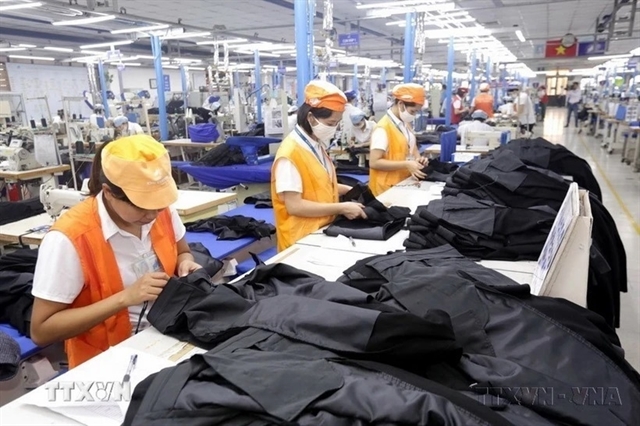
A garment factory in Hà Nội. The city's textile and garment exports fell 4 per cent to $1.53 billion in the first eight months of 2026.
The city aims to achieve average annual export growth of at least 12 per cent during 2026-30, with the city seeking to diversify export markets, boost high-tech and value-added products and reduce reliance on traditional markets, according to a plan signed by a city official.
Under the plan, the city also aims to increase the share of high-tech products to more than 50 per cent of total export value by 2030.
The capital will seek to expand merchandise exports alongside investment in infrastructure, science and technology, digital transformation, green manufacturing and workforce development, while promoting sustainable trade and environmental protection.
It plans to make greater use of commitments under free trade agreements, particularly next-generation pacts, to diversify products and export destinations and mitigate market risks.
The city will focus on key markets including the US, EU, Japan, South Korea, China and ASEAN, while seeking to expand into emerging markets in the Middle East, South Asia, Africa and Latin America.
Priority export sectors include computers, electronics and components; machinery, equipment and spare parts; textiles and garments; footwear; wood and wood products; agricultural and processed food products; handicrafts; and supporting-industry products.
The plan calls on businesses to expand production capacity, upgrade technology, improve product quality, increase processing and develop green and higher-value products for overseas markets.
Hanoi will also seek to raise the localisation rate of production inputs and strengthen links between domestic companies and supply chains, with support for businesses to meet international standards and develop supporting industries.
The city plans to encourage businesses to use global e-commerce platforms, including Amazon, Alibaba, ShopeeGlobal and Temu, while developing digital storefronts and expanding online trade promotion.
It will also invest in logistics infrastructure such as warehouses, container yards, bonded warehouses, inland container depots and multimodal logistics centres, while improving connectivity between seaports, railways, airports and expressways.
The plan also calls for the development of green logistics and the adoption of automation, enterprise resource planning and supply-chain management systems to improve productivity and export performance.
City authorities said they would continue working with relevant agencies, industry associations and logistics firms to help Hà Nội-based businesses speed up their exports.
As part of those efforts, the Hanoi Support Centre for Enterprise and Investment Promotion (SCE), under the Hanoi Department of Finance, recently held a conference to brief businesses on newly issued Decree No 169/2026/NĐ-CP, which sets out penalties for administrative violations in the customs sector.
The new decree requires businesses to proactively update their knowledge of customs regulations, particularly those governing administrative penalties related to import-export activities and customs procedures. — VNS
Source: VNS
Related News

INFRASTRUCTURE / CONSTRUCTION / LOGISTIC / PORT
VIỆT NAM-CAMBODIA TRADE GATHERS PACE TOWARDS $20 BILLION TARGET
Trade between Việt Nam and Cambodia continues to grow, remaining a bright spot and a key pillar of bilateral cooperation as the two countries aim to raise two-way trade to US$20 billion in the coming years. After setting a record of more than $11.3 billion last year, bilateral trade reached about $8.7 billion in the first eight months of this year, up 8.3 per cent year on year.

TECHNOLOGY
AI BEGINNING TO RESHAPE RECRUITMENT CRITERIA
Digital literacy is the only capability area in which fresh graduates meet employers’ expectations, according to a new report. Yet, it is also the standard rising fastest, as businesses increasingly expect new hires to use AI effectively in the workplace. Some 83 per cent of employers say AI has changed, or is beginning to change, their hiring criteria, while 94 per cent report higher expectations for digital and AI capabilities than they had two to three years ago.

INFRASTRUCTURE / CONSTRUCTION / LOGISTIC / PORT
ĐÀ NẴNG GREEN-LIGHTS US$105 MILLION THAI DEVELOPMENT DEAL
The central city has approved an investment proposal by Thailand’s WHA Group to develop infrastructure for the 400ha WHA Đà Nẵng Industrial Park project on two communes of Thăng Bình and Đồng Dương, with an investment of more than VNĐ2.7 trillion (US$105 million). The city said it approved WHA Industrial Development International's status as an investor in the project, which is expected to take place between 2027 and 2034.

VIETNAM ECONOMY INVESTMENT
MOBILE PHONE EXPORTS RISE 20% TO $51.8 BILLION IN FIRST NINE MONTHS
Exports of mobile phones and components rose 20 per cent year-on-year to nearly US$51.8 billion in the first nine months of 2026, with China, the US and Republic of Korea accounting for more than half of the total. Shipments to the three markets reached a combined $26.18 billion, or 50.6 per cent of total exports of the product group during the period, according to data from the Vietnam Department of Customs under the Ministry of Finance.

VIETNAM ECONOMY INVESTMENT
FRUIT AND VEGETABLE EXPORTS POISED TO HIT $10 BILLION IN 2026
Fruit and vegetable exports are on track to reach nearly US$10 billion in 2026, after rising 19.9 per cent year on year to nearly US$7.4 billion in the first nine months, driven by strong seasonal demand and abundant tropical fruit supplies. The Ministry of Agriculture and Environment said the growth reflected stronger international demand for fresh produce and processed agricultural products.

GARMENT / TEXTILE
TEXTILE EXPORTS FACE DUAL CHALLENGES OF SUSTAINING ORDERS AND BOOSTING EFFICIENCY AMID GROWING COMPETITION
Data shows that the textile and garment sector maintained its growth momentum in the first nine months of this year. The industry's total export turnover reached an estimated US$35.721 billion in the first nine months of this year, up 3.3 per cent year-on-year. Despite posting encouraging export figures, Vietnamese textile and garment enterprises continue to navigate unpredictable market variables.
Events Sponsors






















