Want to be in the loop?
subscribe to
our notification
Business News
INDUSTRIAL PROPERTY MARKET DRAWS FRESH WAVE OF FOREIGN INVESTMENT
Việt Nam’s industrial property market is heating up as foreign investors pour billions of dollars into factories, warehouses and ready-built facilities, driven by accelerating supply chain shifts and a new surge of global capital.
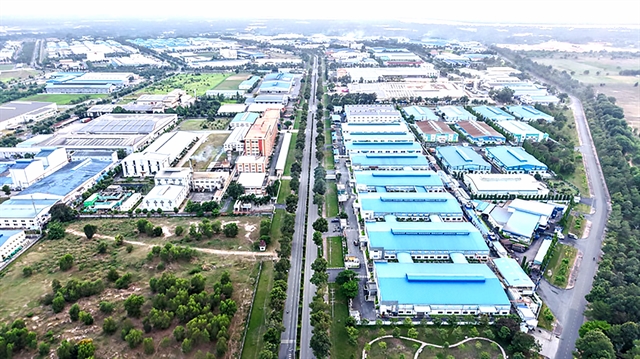
An industrial park in Đồng Nai Province in southern Việt Nam. The province hosts 31 operational parks as foreign investors ramp up spending on factories, warehouses and ready-built facilities. — VNA/VNS Photo
HCM CITY — Việt Nam’s industrial property market is heating up as foreign investors pour billions of dollars into factories, warehouses and ready-built facilities, driven by accelerating supply chain shifts and a new surge of global capital.
Foreign direct investment (FDI) into Việt Nam hit US$26.1 billion in the first eight months, up more than 27 per cent from a year earlier, according to the General Statistics Office.
Manufacturing dominated the inflows, attracting nearly $12 billion, with many companies opting for ready-built factories to slash costs and shorten production timelines.
In HCM City, Avery Dennison Worldon Vietnam, a venture between US labeling giant Avery Dennison and China’s Shenzhou Group, inaugurated a $4.7 million plant in June, its third in Việt Nam.
Đà Nẵng has also emerged as a magnet, signing agreements with Amata Vietnam, Green i-Park, GuogGuoguang Electric and European Plastic to explore projects in its free-trade zones.
GuogGuoguang Electric, a Chinese electronics supplier, is set to break ground on a component plant in Liên Chiểu before year-end.
Dutch developer CTP is committing 1 billion euros ($1.1 billion) to new industrial zones across Hưng Yên, Gia Lai and other provinces, underscoring confidence in Việt Nam’s role as a regional hub.
Race for ready-built space
The supply of ready-built factories has ballooned to 11 million square metres nationwide, with occupancy topping 85 per cent, Cushman & Wakefield estimates.
Hubs such as HCM City, Đồng Nai, Bắc Ninh and Hải Phòng are leading the charge.
Rents run $4-6 per square metre in the North and $5-7 in the South – attractive compared with building plants from scratch, which can cost $3-6 million upfront.
“Speed and flexibility are decisive in global supply chains,” said Trang Bùi, general director of Cushman & Wakefield Vietnam. “Ready-built factories allow firms to ramp up production immediately without being tied to long-term assets.”
Infrastructure momentum
The Government is pushing ahead with big-ticket infrastructure, including new bridges in Hà Nội, the proposed Gia Bình International Airport in Bắc Ninh, and a high-speed rail line linking Lào Cai, Hà Nội, Hải Phòng and Quảng Ninh.
Administrative reforms are also cutting red tape. “These changes are making Việt Nam a priority destination for global manufacturers and logistics groups,” said Michael Piro, CEO of Indochina Capital.
His firm’s joint venture, Indochina Kajima, has launched six Core5 ready-built factory projects across Quảng Ninh, Hưng Yên and Hải Phòng in just three years.
The influx of foreign capital is driving up industrial land rents. CBRE reports average rates in Hà Nội, Bắc Ninh and Hưng Yên rose nearly 4 per cent year-on-year to $139 per square metre.
In the South, Cushman & Wakefield pegged average rents at $179.
Investors are also demanding greener, higher-standard facilities. Core5’s LEED- and ESG-certified projects in Quảng Ninh and Hưng Yên achieved near-full occupancy within months. Japanese investor Hulic has joined forces with Core5 to expand further.
Trade shifts
The wave comes as Việt Nam cements its position in the “China+1” strategy.
A new US tariff regime on Asian exports that took effect in August imposed duties of 20 per cent – lower than initially feared – boosting confidence in Việt Nam as an alternative base.
Tech and consumer giants including Samsung, Intel, LG, Foxconn, Amkor, NVIDIA, Toyota, Unilever and Procter & Gamble are already entrenched in the country.
Contract manufacturers for Nike, Adidas and Puma have also scaled up operations, creating tens of thousands of jobs and deepening supporting industries from packaging to precision engineering.
“Việt Nam is steadily consolidating its position as a global industrial hub,” said Matthew Powell, director at Savills Hanoi. “Strategic location, competitive costs and modern facilities are proving irresistible for foreign investors.” — VNS
Source: VNS
Related News

INFRASTRUCTURE / CONSTRUCTION / LOGISTIC / PORT
VIỆT NAM-CAMBODIA TRADE GATHERS PACE TOWARDS $20 BILLION TARGET
Trade between Việt Nam and Cambodia continues to grow, remaining a bright spot and a key pillar of bilateral cooperation as the two countries aim to raise two-way trade to US$20 billion in the coming years. After setting a record of more than $11.3 billion last year, bilateral trade reached about $8.7 billion in the first eight months of this year, up 8.3 per cent year on year.

TECHNOLOGY
AI BEGINNING TO RESHAPE RECRUITMENT CRITERIA
Digital literacy is the only capability area in which fresh graduates meet employers’ expectations, according to a new report. Yet, it is also the standard rising fastest, as businesses increasingly expect new hires to use AI effectively in the workplace. Some 83 per cent of employers say AI has changed, or is beginning to change, their hiring criteria, while 94 per cent report higher expectations for digital and AI capabilities than they had two to three years ago.

INFRASTRUCTURE / CONSTRUCTION / LOGISTIC / PORT
ĐÀ NẴNG GREEN-LIGHTS US$105 MILLION THAI DEVELOPMENT DEAL
The central city has approved an investment proposal by Thailand’s WHA Group to develop infrastructure for the 400ha WHA Đà Nẵng Industrial Park project on two communes of Thăng Bình and Đồng Dương, with an investment of more than VNĐ2.7 trillion (US$105 million). The city said it approved WHA Industrial Development International's status as an investor in the project, which is expected to take place between 2027 and 2034.

VIETNAM ECONOMY INVESTMENT
MOBILE PHONE EXPORTS RISE 20% TO $51.8 BILLION IN FIRST NINE MONTHS
Exports of mobile phones and components rose 20 per cent year-on-year to nearly US$51.8 billion in the first nine months of 2026, with China, the US and Republic of Korea accounting for more than half of the total. Shipments to the three markets reached a combined $26.18 billion, or 50.6 per cent of total exports of the product group during the period, according to data from the Vietnam Department of Customs under the Ministry of Finance.

VIETNAM ECONOMY INVESTMENT
FRUIT AND VEGETABLE EXPORTS POISED TO HIT $10 BILLION IN 2026
Fruit and vegetable exports are on track to reach nearly US$10 billion in 2026, after rising 19.9 per cent year on year to nearly US$7.4 billion in the first nine months, driven by strong seasonal demand and abundant tropical fruit supplies. The Ministry of Agriculture and Environment said the growth reflected stronger international demand for fresh produce and processed agricultural products.

GARMENT / TEXTILE
TEXTILE EXPORTS FACE DUAL CHALLENGES OF SUSTAINING ORDERS AND BOOSTING EFFICIENCY AMID GROWING COMPETITION
Data shows that the textile and garment sector maintained its growth momentum in the first nine months of this year. The industry's total export turnover reached an estimated US$35.721 billion in the first nine months of this year, up 3.3 per cent year-on-year. Despite posting encouraging export figures, Vietnamese textile and garment enterprises continue to navigate unpredictable market variables.
Events Sponsors






















