Want to be in the loop?
subscribe to
our notification
Business News
INNOVATION BECOMES CORE SURVIVAL DRIVE FOR VIỆT NAM’S SMES
Cheap labour once provided a foundation for their survival, but has now become a constraint on growth.

Innovation is key for SMEs to boost competitiveness and integrate deeper into global value chains. — VNA/VNS Photo
HÀ NỘI — To survive and break through, innovation has become a core competitive tool for Việt Nam’s small and medium-sized enterprises (SMEs), which account for more than 97 per cent of all domestic enterprises.
As traditional competitive advantages like cheap labour and raw resource extraction reach their limits, competing primarily through financial muscle is no longer a viable strategy.
Resolution No 57-NQ/TW, issued by the Politburo on breakthroughs in the development of science and technology, innovation, and national digital transformation, aims to raise the proportion of enterprises engaged in innovation to more than 40 per cent. The resolution is helping establish a new framework for competition and reshaping the development trajectory of Việt Nam’s private sector.
According to experts, for decades, a significant number of Vietnamese SMEs have remained heavily reliant on the contract-manufacturing model. Cheap labour once provided a foundation for their survival, but has now become a constraint on growth. As countries across the region accelerate technological advancement, clinging to a “profit through labour” mindset risks pushing businesses out of global supply chains.
Innovation, however, is not the exclusive domain of technology giants. For SMEs, it often means flexibly restructuring business models and optimising existing processes. Examples include a mechanical workshop adopting inventory management software to reduce material waste, or an agricultural cooperative adding QR codes to product packaging to enable traceability.
Reflecting on this shift, Phạm Văn Việt, chairman of the Board of Directors of Viet Thang Jean Company Limited (VitaJean), said continued reliance on cheap labour would drive profit margins towards zero. The company has therefore had to invest in 3D design software and laser-cutting technology, reducing the time required for certain production stages from weeks to just hours, he said. These investments help optimise costs while enabling the company to respond to the constantly changing demands of international orders, he added.
The greatest advantage of SMEs lies not in their financial strength, but in their lean organisational structures, which allow them to make decisions and redirect their strategies much faster than large corporations. When combined with digital technologies, this agility becomes a powerful competitive weapon.
Rather than committing capital to massive, fully integrated production lines, many businesses are opting to outsource ancillary manufacturing processes and concentrate their resources on research and development (R&D) and design. Cloud computing platforms and process automation are also enabling SMEs to manage risks in real time while maintaining tighter control over logistics costs.
Nguyễn Thị Lan Hương, a representative of Việt Phúc Group, noted that innovation among small and medium-sized businesses does not necessarily require expensive production lines. By deploying Internet of Things (IoT) sensors to precisely control irrigation volumes and ensuring transparent product traceability data, a business can meet European technical requirements without expanding its cultivated land area, she said.
Markets have shifted from competing primarily on price to a race centred on adaptability and the ability to deliver personalised customer experiences. Yet moving away from the contract-manufacturing model has never been easy for SMEs, Hương said. The biggest obstacles are not always financial constraints, but also a shortage of technological skills and concerns about institutional and regulatory risks when experimenting with new approaches, she added.
Highlighting these practical bottlenecks from the perspective of supporting industries, Đỗ Phước Tống, chairman of the Members’ Council of Duy Khanh Engineering Co., Ltd., said the barriers preventing private enterprises from innovating do not lie entirely in their financial capacity, but also in the lack of effective risk-sharing mechanisms.
Businesses urgently need meaningful tax deductions for R&D expenditures that fail to generate commercial returns, he said. Only when the “right to fail” in research is protected by law will private enterprises be willing to commit substantial resources to core technologies.
The target of having more than 40 per cent of enterprises engaged in innovation under Resolution 57-NQ/TW is not merely a macroeconomic indicator; it is a market-driven imperative for survival. Achieving this goal will require more than the isolated efforts of SMEs.
Việt Nam’s economy needs a coordinated support ecosystem, encompassing transparent tax incentives, flexible credit guarantee funds, and a legal framework that takes a more tolerant approach to technological risks. Such measures would provide a solid launchpad for businesses to abandon outdated mindsets, redefine their positions, and strengthen their roles in global value chains. — VNS
Source: VNS
Related News

INFRASTRUCTURE / CONSTRUCTION / LOGISTIC / PORT
VIỆT NAM TO DEVELOP A NATIONAL PROGRAMME TO BOOST MARITIME INDUSTRY
Việt Nam will develop a national programme for the maritime and marine engineering industries through 2035 as part of the effort to strengthen domestic industrial capacity and build a modern, competitive and self-reliant maritime industry. Under Decision 2089/QĐ-TTg, signed by Permanent Deputy Prime Minister Phạm Gia Túc, the Government seeks to address existing difficulties and bottlenecks, mobilise resources and make more effective use of the industry's existing capabilities.
VIETNAM ECONOMY INVESTMENT
AVERAGE STARTUP CAPITAL PER NEW BUSINESS DOUBLED TO $800,000
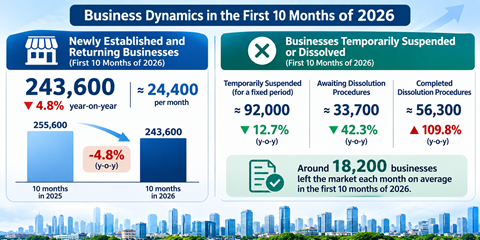
More than 243,600 businesses were newly established or resumed operations in the first 10 months of 2026, averaging 24,400 a month, according to the National Statistics Office under the Ministry of Finance. Total additional registered capital reached nearly VND5.8 quadrillion ($227 billion), up 11.6 per cent on-year.
VIETNAM ECONOMY INVESTMENT
VIETNAM’S TRADE TURNOVER SURPASSES $1 TRILLION FOR THE FIRST TIME
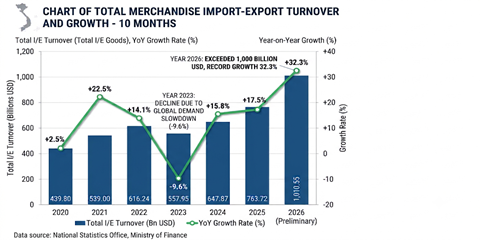
Total merchandise trade reached more than $1 trillion in the first 10 months of 2026, up 32.3 per cent on-year, according to the National Statistics Office under the Ministry of Finance. Exports hit $499.24 billion, up 27.5 per cent, while imports totalled $511.3 billion, up 37.4 per cent. With imports outpacing exports, Vietnam posted a merchandise trade deficit of $12.07 billion, compared with a surplus of about $19.5 billion a year earlier.

VIETNAM ECONOMY INVESTMENT
GROWTH HOLDS IN AGRO-FORESTRY-FISHERY EXPORTS DURING TEN MONTHS
Exports of agricultural, forestry and fishery products reached $63.02 billion in the first 10 months of 2026, generating a trade surplus of around $18.9 billion, according to the Ministry of Agriculture and Environment. Export earnings in October were estimated at $6.93 billion, up 7.9 per cent from September and 13.4 per cent from the same month last year. The 10-month total rose by 8 per cent year on year to $63.02 billion.

TECHNOLOGY
TECHNOLOGY ADDRESSES SOLUTIONS TO COST CHALLENGES IN FOOD INDUSTRY
Vietnam’s food processing sector grew by 11 per cent in 2025, reaching a scale of $88 billion, according to an annual report published by the US Department of Agriculture in early 2026. Meanwhile, the Vietnam’s food processing and handling equipment market was estimated at $1.2 billion last year, according to 6Wresearch.

VIETNAM ECONOMY INVESTMENT
VIỆT NAM SEEKS NEW GROWTH DRIVERS TO ACHIEVE DOUBLE-DIGIT EXPANSION IN 2027
The target, approved by the National Assembly (NA) on November 7, comes amid encouraging economic performance in the first 10 months of 2026. However, sustaining high growth will require more than increased investment and credit. Improving productivity, strengthening the private sector, promoting industrial development and accelerating science and technology adoption will be crucial to turning the ambitious target into reality.
Events Sponsors