Want to be in the loop?
subscribe to
our notification
Business News
JAPANESE CAPITAL CONTINUES POURING INTO TEXTILE AND GARMENT
Japanese firms are scaling up investment into Vietnam’s textile and garment sector to take advantage of the huge market potential and Vietnam’s new-generation free trade agreements.
Several months ago, leading Japanese general trading company Itochu bought an additional 10 per cent stake in Vietnam’s state-owned textile and garment conglomerate Vinatex, bringing its ownership to approximately 15 per cent.
The deal took place at a time when only two out of 11 members had approved the landmark Comprehensive and Progressive Agreement for Trans-Pacific Partnership (CPTPP).
After the deal was struck, Itochu became Vinatex’s second-largest shareholder behind the Ministry of Industry and Trade which, on behalf of the state, currently manages a 53 per cent stake.
Now the number of CPTPP signatories has reached seven, with Vietnam being the most recent country to have approved the deal.
Itochu’s move suggests that the group has accurately forecasted the CPTPP development journey and the textile and clothing sector’s remarkable advantages to avail themselves of the opportunities from the deal in the years to come.
The Japanese group’s apparel exports from Vietnam are worth about VND12.84 trillion ($558 million) per annum, with about half of this produced by Vinatex.
The company aims to boost processing volume and scale up its export value to $878 million by 2021.
With around 30 plants in operation, Sakai Amiori, another firm coming from Japan’s Fukui prefecture, has opened an export apparel production plant based in Phu Ha Industrial Zone (IZ) in the northern province of Phu Tho.
The plant finished construction in April 2017 and now sees stable production and exports.
Another Japanese firm, Matsuoka Corporation, first set foot in Vietnam in 2014 and quickly expanded production to raise capacity by 6-7-fold through the Matsuoka Phu Tho plant, which mainly produces apparel items carrying the Uniqlo brand to be exported back to Japan.
As a partner to leading global apparel brands like Uniqlo, Tore, and Korabu, Matsuoka Corporation generates an annual revenue touching $530 million, taking the lead in Japan and the 11th worldwide.
The company operates an expansive network of 17 plants across Asia and has chosen Vietnam for capital injection and production expansion in recent years to take advantage of the opportunities anticipated to be brought by new-generation free trade agreements (FTAs) such as the EVFTA and the CPTPP.
After its first plant coming online in 2016, the second plant began production in last August, with an annual capacity of about two million products.
The company has further invested in an apparel plant complex with an investment value surpassing $16 million and annual production capacity of seven million products.
By the end of this year, the complex is expected to create jobs for more than 2,500 local labourers.
The influx of foreign direct investment continuing to flow into export-oriented sectors like textiles and clothing has the dual benefits of helping to boost the sector’s capacity and turning Vietnam into a global manufacturing base.
A look into the textile and clothing sector’s export-import performance from 2010 until present shows that the sector has posted a constantly-growing trade surplus, going from a mere $2.9 billion to $12.7 billion last year, along with a 13.8 per cent jump against 2016.
According to Vu Duc Giang, chairman of the Vietnam Textile and Apparel Association, in the first 11 months of this year, the sector’s export value came to $30 billion and trade surplus surpassed $13 billion.
Source: VIR
Related News

INFRASTRUCTURE / CONSTRUCTION / LOGISTIC / PORT
VIỆT NAM-CAMBODIA TRADE GATHERS PACE TOWARDS $20 BILLION TARGET
Trade between Việt Nam and Cambodia continues to grow, remaining a bright spot and a key pillar of bilateral cooperation as the two countries aim to raise two-way trade to US$20 billion in the coming years. After setting a record of more than $11.3 billion last year, bilateral trade reached about $8.7 billion in the first eight months of this year, up 8.3 per cent year on year.
TECHNOLOGY
AI BEGINNING TO RESHAPE RECRUITMENT CRITERIA
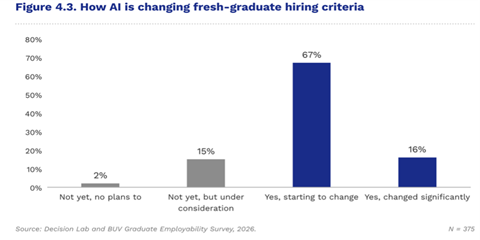
Digital literacy is the only capability area in which fresh graduates meet employers’ expectations, according to a new report. Yet, it is also the standard rising fastest, as businesses increasingly expect new hires to use AI effectively in the workplace. Some 83 per cent of employers say AI has changed, or is beginning to change, their hiring criteria, while 94 per cent report higher expectations for digital and AI capabilities than they had two to three years ago.

INFRASTRUCTURE / CONSTRUCTION / LOGISTIC / PORT
ĐÀ NẴNG GREEN-LIGHTS US$105 MILLION THAI DEVELOPMENT DEAL
The central city has approved an investment proposal by Thailand’s WHA Group to develop infrastructure for the 400ha WHA Đà Nẵng Industrial Park project on two communes of Thăng Bình and Đồng Dương, with an investment of more than VNĐ2.7 trillion (US$105 million). The city said it approved WHA Industrial Development International's status as an investor in the project, which is expected to take place between 2027 and 2034.

VIETNAM ECONOMY INVESTMENT
MOBILE PHONE EXPORTS RISE 20% TO $51.8 BILLION IN FIRST NINE MONTHS
Exports of mobile phones and components rose 20 per cent year-on-year to nearly US$51.8 billion in the first nine months of 2026, with China, the US and Republic of Korea accounting for more than half of the total. Shipments to the three markets reached a combined $26.18 billion, or 50.6 per cent of total exports of the product group during the period, according to data from the Vietnam Department of Customs under the Ministry of Finance.

VIETNAM ECONOMY INVESTMENT
FRUIT AND VEGETABLE EXPORTS POISED TO HIT $10 BILLION IN 2026
Fruit and vegetable exports are on track to reach nearly US$10 billion in 2026, after rising 19.9 per cent year on year to nearly US$7.4 billion in the first nine months, driven by strong seasonal demand and abundant tropical fruit supplies. The Ministry of Agriculture and Environment said the growth reflected stronger international demand for fresh produce and processed agricultural products.
GARMENT / TEXTILE
TEXTILE EXPORTS FACE DUAL CHALLENGES OF SUSTAINING ORDERS AND BOOSTING EFFICIENCY AMID GROWING COMPETITION
Data shows that the textile and garment sector maintained its growth momentum in the first nine months of this year. The industry's total export turnover reached an estimated US$35.721 billion in the first nine months of this year, up 3.3 per cent year-on-year. Despite posting encouraging export figures, Vietnamese textile and garment enterprises continue to navigate unpredictable market variables.
Events Sponsors






















