Want to be in the loop?
subscribe to
our notification
Business News
KEY TRANSPORT INFRASTRUCTURE PROJECTS FACE CAPITAL SHORTAGE
Many major transport infrastructure projects such as the North-South Expressway, and Ring Road No.2 of HCMC may fall behind schedule due to shortages in investment capital and complicated mechanisms, reported Thanh Nien newspaper.
The total length of the North-South Expressway will be some 2,100 kilometers, spanning 32 provinces and cities. The project has been divided into three phases.
The first phase of 11 sub-projects requires an estimated VND104 trillion (US$4.4 billion), including over VND40 trillion (US$1.7 billion) from the State budget, to develop 650 kilometers of the cross-country expressway between 2017 and 2020. As such, the remaining capital will be mobilized under the public-private partnership (PPP) model.
Similarly, HCMC is an important economic center of Vietnam, but the funds from the State budget being allocated to the city in the 2016-2020 period are expected to fulfill some 10% of the capital demand, at over VND500 trillion (US$21.4 billion), for the development of urban transport infrastructure.
The Ministry of Transport said in a report that despite witnessing strong growth over the past five years, the country’s transport infrastructure has yet to keep pace with development requirements.
Due to financial problems, the current infrastructure systems have not been maintained in a timely manner, thereby limiting their operational capacity.
The transport sector requires funding of some VND952.7 trillion (US$40.9 billion) during the 2016-2020 period. However, only VND292.4 trillion (US$12.5 billion) from the State budget is being allocated to the sector, meeting 30.6% of the total demand. This is regarded as a tough barrier to the fulfillment of targets and tasks assigned for the development of the transport infrastructure.
Vu Anh Tuan, director of the Vietnamese-German Transport Research Center, said the build-operate-transfer (BOT) investment format and other PPP forms used in the construction of infrastructure facilities have become a global trend.
In other countries, whether rich or poor, according to Tuan, state capital cannot provide sufficient funds for infrastructure projects. Even in developed countries, state money only meets one third of the infrastructure construction demand, while the remainder is mobilized from the domestic private and foreign direct investment sectors.
Tuan said infrastructure facilities can be divided into two types. The first is common infrastructure funded by the State budget and official development assistant loans to meet the public’s essential needs, such as travel and cargo transport.
The second is intended to help fuel growth, adding value for the economy and facilitating travel.
Tuan said that the State budget alone cannot finance the second type of projects. Therefore, the Government has no choice but to cooperate with the private sector.
Some transport projects, such as certain expressways between Hanoi City and Lao Cai Province, HCMC and Dong Nai Province’s Long Thanh District, Quang Ninh Province's Halong City and Haiphong City, which were opened to traffic, have helped residents travel faster, hence bolstering economic growth.
Tuan said some sub-projects within the scope of the North-South Expressway would be more feasible if they were developed under the BOT format. He predicted that if these expressway sections were opened to traffic, they would witness strong growth in the number of vehicles, thereby guaranteeing that the investors would be able to recover their investment capital and repay their bank loans.
He noted that numerous obstacles to the execution of BOT transport projects have made local and foreign investors hesitant. State management agencies should draw on experience gleaned from unsuccessful projects and address difficulties to maximize the benefits from these PPP projects, especially those following the BOT system.
Pham Van Hung, deputy head of the Sub-Institute of Transport Science and Technology in Southern Vietnam, echoed Tuan’s view, adding that if certain transport projects were some three years behind schedule, their costs would increase by 50%. This would cause severe damage to the State and the national economy.
He stressed that the Government should introduce rigorous oversight mechanisms and standardize the relevant regulations. Besides this, BOT transport projects should be put up for auction in an objective and transparent manner to seek competent investors in terms of investment capital, professional knowledge and work experience.
Source: The Saigon Times
Related News

MEMBER CORNER / PROMOTIONS
HCMC | CERTIFIED SUSTAINABILITY PROFESSIONAL (CSP) TRAINING | REGISTRATION OPEN
As sustainability becomes deeply embedded in corporate strategy and supply-chain operations across Vietnam, Hong Kong Business Association Vietnam is pleased to endorse the upcoming Certified Sustainability Professional (CSP) training program by the Asia Institute for Sustainability (AIS) - a premier internationally recognized ESG credential in Vietnam.
VIETNAM ECONOMY INVESTMENT
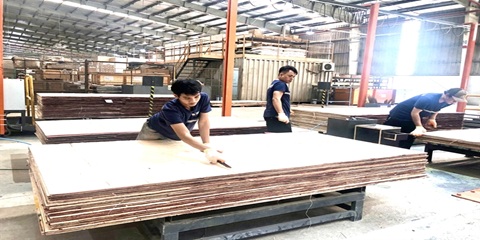
HCM CITY SAYS HOW IT PLANS TO ACHIEVE 10-11% ANNUAL EXPORT GROWTH FOR REST OF DECADE
The southern economic hub aims to strengthen its role as the country’s largest import-export centre while developing into a regional transhipment centre in Southeast Asia, supported by green and digital transformation and a circular economy. HCM City has outlined measures to expand production capacity, cut logistics costs, diversify export markets, and help businesses meet increasingly stringent international standards as it targets average annual export growth of 10-11 per cent through 2030.
VIETNAM ECONOMY INVESTMENT
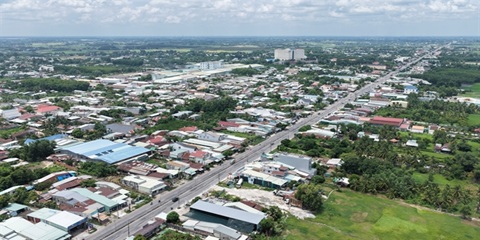
HCM CITY LEADS ECONOMIC RESTRUCTURING IN SOUTHEAST REGION
According to Associate Professor, Dr Vũ Tuấn Hưng, director of the Institute of Social Sciences of the Southern Region, the Southeast is a strategically important socio-economic space in Việt Nam’s development given its advantages in location, industry, trade, services, logistics, science and technology, urbanisation and human resources.
TECHNOLOGY
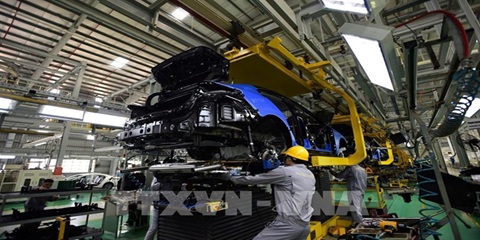
DIGITAL TRANSFORMATION TURNED INTO PRACTICAL TOOLS FOR PEOPLE, BUSINESSES
Việt Nam is moving its digital transformation agenda beyond policy frameworks and individual technology platforms towards practical applications that address everyday needs, as authorities seek measurable outcomes from science, technology and innovation. Under Politburo Resolution No. 57-NQ/TW issued on December 22, 2024, the implementation is increasingly shifting from simply completing assigned tasks towards developing concrete products and services for citizens and businesses.
TECHNOLOGY
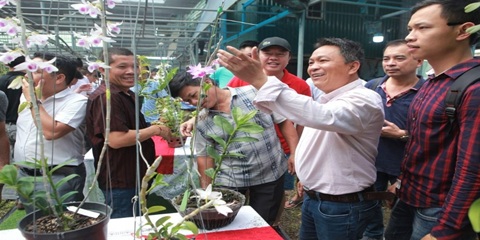
APPLYING TECHNOLOGY FOR ECONOMIC TRANSFORMATION
Having completed its new rural development program, Hanoi is shifting its focus toward improving development quality and building smart, sustainable rural areas. The transformation of Dong La orchid-growing village in An Khanh, a western commune of Hanoi, shows how digital technology is becoming a driver of production, market expansion, and higher incomes for local residents.

MEMBER CORNER / PROMOTIONS
VIGLACERA HONORED AS THE "LEADING GREEN INDUSTRIAL REAL ESTATE DEVELOPER 2026"
Organized by the Vietnam Investment Review, this prestigious awards program recognizes industry pioneers advancing eco-industrial parks, clean energy transition, and rigorous ESG standards. Outperforming competitors through a rigorous evaluation, Viglacera Corporation – JSC proudly ranked among the Top 5 highest-positioned enterprises in the Leading Green Industrial Real Estate Developers 2026 category, reinforcing its premier position in Vietnam’s industrial real estate sector.
Events Sponsors






















