Want to be in the loop?
subscribe to
our notification
Business News
LÂM ĐỒNG TARGETS DIGITAL ECONOMY TO ACCOUNT FOR 30 PER CENT OF GRDP BY 2030
The province will support SMEs in assessing their level of digital transformation, developing digitalisation roadmaps and applying technology to management, finance, human resources, customer relations and supply chains.
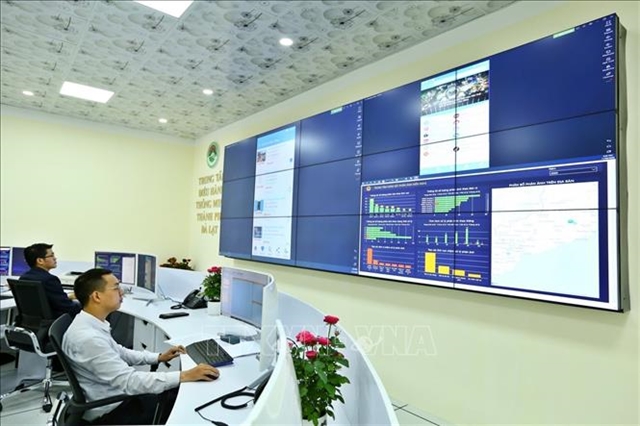
Intelligent Operation Center in Lâm Đồng Province. The province has issued a plan to develop digital economy and society by 2030. — VNA/VNS Photo Minh Quyết
LÂM ĐỒNG — Lâm Đồng Province aims to raise the digital economy’s contribution to around 30 per cent of its gross regional domestic product (GRDP) by 2030, as part of a five-year plan to develop digital economy and society issued recently.
Under Plan No. 15358/KH-UBND, the province targets more than 60 per cent of small- and medium-sized enterprises (SMEs) to adopt digital technologies by 2030 while increasing the value of cashless payments to 30 times its GRDP.
The plan also set the goal of raising the share of university enrolment in science, technology, engineering and mathematics (STEM) to 40 per cent.
These are considered important indicators to boost labour productivity and competitiveness as well as creating new sources of growth driven by science, technology and digital transformation.
To develop a digital society, the province plans to ensure all households have access to fibre-optic broadband with a minimum speed of 1 Gbps.
In addition, 5G networks at speeds of at least 100 Mb per second is planned to cover 99 per cent of the population.
All citizens aged 14 and above are expected to have identity cards and electronic identification accounts, while more than 95 per cent of people aged 15 and above are targeted to have transaction accounts at banks or authorised financial institutions.
The province aims for more than 70 per cent of people aged 18 and above to have personal digital or electronic signatures. At least 50,000 people of working age will get training of basic digital skills while more than 95 per cent of residents are expected to have electronic health records.
Under the plan, Lâm Đồng has also set specifc targets for each sector.
In agriculture, the province aims for 70 per cent of communes to have cooperatives using digital technology solutions or platforms. At least 70 per cent of high-tech agricultural products are expected to meet quality standards, carry recognised brands and have QR-code for traceability.
All of its One Commune One Product (OCOP) products will be digitalised. The province will also support at least 1,900 businesses and other entities to put more than 4,000 agricultural and OCOP products on domestic and international e-commerce platforms.
In tourism, at least 70 per cent of establishments are expected to use digital platforms for management and operation, while all community tourism sites are targeted to apply information technology and digital transformation.
Of note, tourist attractions, historical sites and scenic destinations will be digitised using 3D and VR360 technologies, alongside the development of databases and digital maps for community tourism.
To achieve the targets, the province has identified digital infrastructure, data infrastructure and shared digital platforms as priorities.
The focus would be on expanding fibre-optic networks, increasing 5G coverage and modernising connectivity between information systems.
A shared geospatial database will be completed and connected with with data systems in land, forestry, agriculture, construction and transport.
Lâm Đồng plans to issue a strategy for applying artificial intelligence (AI) in state agencies in 2027. During 2027-28, AI will be piloted to support administration, data analysis and forecasting.
Between 2027 and 2029, the province plans to deploy virtual assistants and AI chatbots to help residents and businesses with administrative procedures and online public services. AI applications will also be promoted in agriculture, healthcare, education, tourism, resources and environment, industry and trade.
Alongside technological development, the province will strengthen information security, cybersecurity and data protection.
The province will support SMEs in assessing their level of digital transformation, developing digitalisation roadmaps and applying technology to management, finance, human resources, customer relations and supply chains.
It will also promote e-commerce, digital payments, electronic invoices, electronic contracts and digital signatures. — VNS
Source: VNS
Related News

INFRASTRUCTURE / CONSTRUCTION / LOGISTIC / PORT
VIỆT NAM-CAMBODIA TRADE GATHERS PACE TOWARDS $20 BILLION TARGET
Trade between Việt Nam and Cambodia continues to grow, remaining a bright spot and a key pillar of bilateral cooperation as the two countries aim to raise two-way trade to US$20 billion in the coming years. After setting a record of more than $11.3 billion last year, bilateral trade reached about $8.7 billion in the first eight months of this year, up 8.3 per cent year on year.

TECHNOLOGY
AI BEGINNING TO RESHAPE RECRUITMENT CRITERIA
Digital literacy is the only capability area in which fresh graduates meet employers’ expectations, according to a new report. Yet, it is also the standard rising fastest, as businesses increasingly expect new hires to use AI effectively in the workplace. Some 83 per cent of employers say AI has changed, or is beginning to change, their hiring criteria, while 94 per cent report higher expectations for digital and AI capabilities than they had two to three years ago.

INFRASTRUCTURE / CONSTRUCTION / LOGISTIC / PORT
ĐÀ NẴNG GREEN-LIGHTS US$105 MILLION THAI DEVELOPMENT DEAL
The central city has approved an investment proposal by Thailand’s WHA Group to develop infrastructure for the 400ha WHA Đà Nẵng Industrial Park project on two communes of Thăng Bình and Đồng Dương, with an investment of more than VNĐ2.7 trillion (US$105 million). The city said it approved WHA Industrial Development International's status as an investor in the project, which is expected to take place between 2027 and 2034.

VIETNAM ECONOMY INVESTMENT
MOBILE PHONE EXPORTS RISE 20% TO $51.8 BILLION IN FIRST NINE MONTHS
Exports of mobile phones and components rose 20 per cent year-on-year to nearly US$51.8 billion in the first nine months of 2026, with China, the US and Republic of Korea accounting for more than half of the total. Shipments to the three markets reached a combined $26.18 billion, or 50.6 per cent of total exports of the product group during the period, according to data from the Vietnam Department of Customs under the Ministry of Finance.

VIETNAM ECONOMY INVESTMENT
FRUIT AND VEGETABLE EXPORTS POISED TO HIT $10 BILLION IN 2026
Fruit and vegetable exports are on track to reach nearly US$10 billion in 2026, after rising 19.9 per cent year on year to nearly US$7.4 billion in the first nine months, driven by strong seasonal demand and abundant tropical fruit supplies. The Ministry of Agriculture and Environment said the growth reflected stronger international demand for fresh produce and processed agricultural products.

GARMENT / TEXTILE
TEXTILE EXPORTS FACE DUAL CHALLENGES OF SUSTAINING ORDERS AND BOOSTING EFFICIENCY AMID GROWING COMPETITION
Data shows that the textile and garment sector maintained its growth momentum in the first nine months of this year. The industry's total export turnover reached an estimated US$35.721 billion in the first nine months of this year, up 3.3 per cent year-on-year. Despite posting encouraging export figures, Vietnamese textile and garment enterprises continue to navigate unpredictable market variables.
Events Sponsors






















