Want to be in the loop?
subscribe to
our notification
Business News
LAW OFFERS REAL ESTATE BREAKTHROUGH
“This will mean foreign invested enterprises will be allowed to own land and develop property directly, along with foreigners being allowed to own apartments and houses,” said Tizzard.
Tizzard explained that a foreign developer will be able to buy land and develop their property without having to find and negotiate a deal with a local partner, which should speed up the time taken as well as reduce the development risk of the project.
In addition, there is suddenly a huge new market for products among foreigners and Vietnamese living abroad. “With yields from property in other countries much lower than in Vietnam, foreigners will be looking closely at real estate in Vietnam, both in Hanoi and Ho Chi Minh City as well as tourist areas such as Danang and Nha Trang and perhaps other areas as the country continues to develop,” he said.
Meanwhile, Nguyet Nguyen, senior associate from Mayer Brown JSM commented that the revised law on real estate business is being hailed as providing a breakthrough for the real estate market.
According to Nguyet, one of the outstanding aspects of the revised law was to open the door for foreign organisations and individuals to purchase houses.
The revised law also allows foreign organisations and individuals to purchase constructed facilities for use as offices, production facilities, and business or service functions.
In addition, foreign-invested enterprises are also allowed to lease houses and constructed facilities for sub-leasing.
Developers of residential projects, Nguyet added, will also benefit from banks acting as guarantors on as-yet constructed properties. “If the developer fails to hand over the houses as agreed, the purchaser may request the guarantor to return the advance and other payments they have made to the investors,” she said.
“This is the first time guarantees in the sale of property have been incorporated into law. The provision is intended to ensure that developers are financially viable and greater security is provided to buyers,” she added.
In addition, the revised Law on Real Estate Business stipulates that the legal capital for real estate business not to be less than VND20 billion ($952,000), compared to the legal capital of just VND6 billion ($285,000) under the current laws.
“However, as development of a real estate project in reality requires a large investment capital, this adjustment of the legal capital is reasonable, it is the first step to identifying and sorting out financially capable investors,” she said.
Nguyet also cited that another important highlight was the right to break up larger projects into more manageable pieces. “While investors under the current laws may only assign the whole of a residential project, an industrial zone infrastructure project or a new urban project, the revised law allows an investor of a real estate project (not limited to the three above types as in the current laws) to assign the whole or part of such project to another investor for the latter’s continued investment,” she added.
However, Tizzard said that there remain problems that need to be addressed in the revised law.
These include the time taken to move and compensate those displaced by development. “Currently, it is up to the developer to negotiate with affected parties and there are no formal laws governing the amount of compensation to be paid or the timescale to move, unlike in other countries such as the UK,” Tizzard said. This creates a huge amount of uncertainty and potential cost for developers.
In addition, many developers have previously bought land with the intention of developing the land once clearance and compensation has happened (and once the property market had recovered) but were unable to continue with their developments due to delays in resettlement.
The revised laws also means that land use right fees (LUR) are now based on a market price, which basically means that the fee payable to the government to obtain the LUR certificate is a lot more than it used to be.
“Many developers bought land in the past and had a significant amount of time (normally 5 years) in which to pay these LUR fees, which they believed would be very low. However, now these fees are much higher and will mean that many development sites are unfeasible. This could lead to a lot of developers either going bankrupt or deciding against developing the land, causing further problems,” he said.
Source: VIR
Related News

MEMBER CORNER / PROMOTIONS
BẰNG KIỀU LIVESHOW - A SYMPHONY OF LOVE UNDER THE GOLDEN GLOW
A masterclass in live music that takes the audience on a soulful journey through immortal love songs, guided by the peerless artistry and emotive storytelling of renowned singer Bằng Kiều. The highlight of the night is his seamless musical chemistry with special guest Triệu Hồng Ngọc, promising passionate and deeply resonant duets inside the magnificent Grand Ballroom.

INFRASTRUCTURE / CONSTRUCTION / LOGISTIC / PORT
ĐÀ NẴNG GREEN-LIGHTS US$105 MILLION THAI DEVELOPMENT DEAL
The central city has approved an investment proposal by Thailand’s WHA Group to develop infrastructure for the 400ha WHA Đà Nẵng Industrial Park project on two communes of Thăng Bình and Đồng Dương, with an investment of more than VNĐ2.7 trillion (US$105 million). The city said it approved WHA Industrial Development International's status as an investor in the project, which is expected to take place between 2027 and 2034.

VIETNAM ECONOMY INVESTMENT
MOBILE PHONE EXPORTS RISE 20% TO $51.8 BILLION IN FIRST NINE MONTHS
Exports of mobile phones and components rose 20 per cent year-on-year to nearly US$51.8 billion in the first nine months of 2026, with China, the US and Republic of Korea accounting for more than half of the total. Shipments to the three markets reached a combined $26.18 billion, or 50.6 per cent of total exports of the product group during the period, according to data from the Vietnam Department of Customs under the Ministry of Finance.

INFRASTRUCTURE / CONSTRUCTION / LOGISTIC / PORT
VIỆT NAM-CAMBODIA TRADE GATHERS PACE TOWARDS $20 BILLION TARGET
Trade between Việt Nam and Cambodia continues to grow, remaining a bright spot and a key pillar of bilateral cooperation as the two countries aim to raise two-way trade to US$20 billion in the coming years. After setting a record of more than $11.3 billion last year, bilateral trade reached about $8.7 billion in the first eight months of this year, up 8.3 per cent year on year.

VIETNAM ECONOMY INVESTMENT
FRUIT AND VEGETABLE EXPORTS POISED TO HIT $10 BILLION IN 2026
Fruit and vegetable exports are on track to reach nearly US$10 billion in 2026, after rising 19.9 per cent year on year to nearly US$7.4 billion in the first nine months, driven by strong seasonal demand and abundant tropical fruit supplies. The Ministry of Agriculture and Environment said the growth reflected stronger international demand for fresh produce and processed agricultural products.
GARMENT / TEXTILE
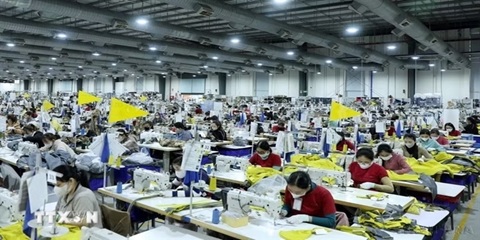
TEXTILE EXPORTS FACE DUAL CHALLENGES OF SUSTAINING ORDERS AND BOOSTING EFFICIENCY AMID GROWING COMPETITION
Data shows that the textile and garment sector maintained its growth momentum in the first nine months of this year. The industry's total export turnover reached an estimated US$35.721 billion in the first nine months of this year, up 3.3 per cent year-on-year. Despite posting encouraging export figures, Vietnamese textile and garment enterprises continue to navigate unpredictable market variables.
Events Sponsors






















