Want to be in the loop?
subscribe to
our notification
Business News
LAWMAKERS APPROVE LAW ON DIGITAL TECHNOLOGY INDUSTRY
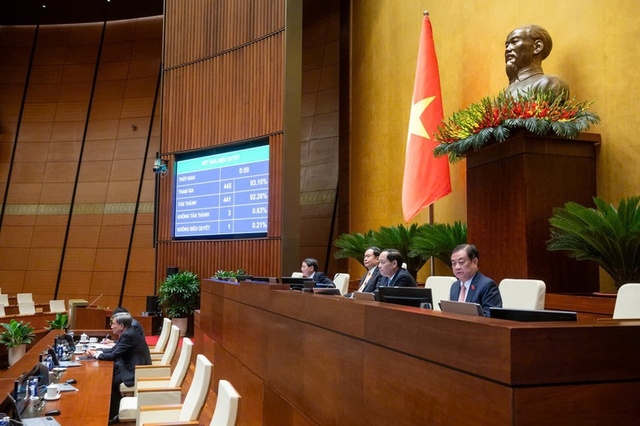
The National Assembly passed the Law on Digital Technology Industry at its ongoing 9th sitting held in Ha Noi on Saturday.
With this move, Viet Nam has become the first country in the world to enact a standalone law specifically dedicated to digital technology industry, according to the Ministry of Science and Technology whish is responsible for drafting the law,
The law, scheduled to take effect on January 1, 2026, is expected to promote the national digital transformation process, paving the way for domestic tech enterprises to grow sustainably, integrate deeply into the global market, and contribute to establishing a new position for Vietnam on the world stage.
The law focuses on increasing the proportion of domestically produced technology products through strategic measures and targeted support policies.
Foreign-invested enterprises are encouraged to transfer technology and collaborate with local companies, with incentives such as multi-year corporate income tax reductions if they meet these criteria.
Domestic startups are eligible for support covering 50 percent of the costs for acquiring advanced technologies and developing prototypes, aimed at enhancing their capacity to produce "Make in Viet Nam" products.
Notably, the government will establish a network of representatives for Viet Nam's digital technology industry in key global markets, in coordination with international cooperation programs to support Vietnamese enterprises in gradually evolving into multinational companies, capable of competing on equal footing with major global tech corporations.
With the goal of building a robust digital technology enterprise ecosystem and reaching 150,000 businesses by 2035, the law introduces a comprehensive set of support policies. Small and medium-sized enterprises will receive assistance with infrastructure investment costs, training of high-quality human resources, and will be given priority in bidding for public procurement projects.
In terms of finance, the government will provide investment capital for special projects and funding for technological innovation, helping businesses enhance their creativity and competitiveness.
Digital technology production projects and supporting enterprises will enjoy tax incentives similar to those in specially disadvantaged areas, while foreign investment will be facilitated to strengthen production capacity.
The development of dedicated digital technology zones with attractive incentive policies will create an enabling environment for startups and sustainable growth, contributing to the realization of this strategic goal.
The law implements comprehensive solutions and policies for workforce development. High-quality digital technology professionals will be exempted from personal income tax for the first five years of working in Viet Nam, providing a strong financial incentive for long-term contributions.
Foreign experts will be granted five-year visas and exempted from work permit requirements, which is expected to simplify administrative procedures and attract international talent to facilitate technology transfer and knowledge sharing.
The law is grounded in principles that put people at the center, ensuring transparency, safety, and non-discrimination. It requires that artificial intelligence (AI) systems remain under human oversight. AI is categorized into high-risk, high-impact, and non-high-risk groups, with high-risk systems subject to strict technical standards and rigorous monitoring.
In addition, to harness the vast economic potential of digital assets while ensuring transparency, security, and compliance with international standards, the law introduces, for the first time, a definition and legal framework for digital assets, which include both tokenized and virtual assets and are classified based on their intended use and technology, thereby establishing a clear legal foundation for their management and regulation.
The same day, the National Assembly also adopted Law on Corporate Income Tax, Excise Tax Law, Law on Management and Investment of State Capital in Enterprises, and Law amending and supplementing a number of articles of the Law on Standards and Technical Regulations.
Source: VCCI
Related News

MEMBER CORNER / PROMOTIONS
A CULINARY MASTERPIECE
Don't need a special occasion to treat yourself to a perfect Chinese dining experience. This October, Ngan Dinh Restaurant introduces an exquisite three-dish menu, promising to satisfy diners who appreciate culinary innovation and refined flavors. Enjoy 20% OFF a glass of house red/white wine, or Imported German Veltins Draught Beer/Maisel's Weisse Dunkel when ordering any of the above dishes!

MEMBER CORNER / PROMOTIONS
ONE YEAR OF PRIME MOMENTS — LET’S CELEBRATE!
Olivia’s Prime Saigon is turning one, and we’d love to celebrate this special milestone with you! Order any featured steak size and enjoy all its designated complimentary pasta, side dishes and sauces — with a combined value of up to 80% of your steak price! Thank you for being part of our journey. Here’s to great steaks, wonderful company, and many more prime moments together!

MEMBER CORNER / PROMOTIONS
SENTRYSAFE - PROTECT WHAT MATTERS MOST
From cash, important documents and records to valuable belongings, a quality safe gives you greater peace of mind against unexpected risks. SentrySafe - a trusted safe brand from the USA, suitable for homes, offices and various storage needs. Contact Sen Wai Vietnam for expert advice and to find the right safe for your needs.

MEMBER CORNER / PROMOTIONS
50% DISCOUNT FOR HKBAV MEMBER: EUGENE ONEGIN - EIFMAN BALLET OF ST. PETERSBURG WORLD TOUR 2026
Adapted from the classic novel in verse by acclaimed Russian poet Alexander Pushkin, Eugene Onegin explores timeless themes of love, pride, choices, and irreversible regret. Eifman's distinctive language of psychological ballet is brought to life through Tchaikovsky's music alongside contemporary rock by Alexander Sitkovetsky, creating an extraordinary artistic experience.

MEMBER CORNER / PROMOTIONS
COSMOPARK – ENERGY ADVANTAGES FOR POWER-INTENSIVE INDUSTRIES
As global corporations place increasing emphasis on energy security, renewable energy adoption, and carbon emissions reduction, electricity is no longer viewed merely as a component of technical infrastructure. For high-tech projects, data centers, and large-scale manufacturing facilities, reliable energy infrastructure has become a critical factor in investment location decisions.

VIETNAM ECONOMY INVESTMENT
FOREIGN INVESTORS TO BE WIDENED FOR MARKET ACCESS
Vietnam is moving to widen market access, improve investment incentives, and streamline procedures, with greater support tied to investors’ actual commitments and results, as part of the law on amending and supplementing a number of articles of the Law on Investment. The proposal was mentioned at the sixth session of the National Assembly Standing Committee in Hanoi on September 30, on amending the Law on Investment.
Events Sponsors






















