Want to be in the loop?
subscribe to
our notification
Business News
LIVESTOCK INDUSTRY TURNS TO MARKETING TO CAPTURE HIGHER VALUE
The country has the world's sixth-largest pig herd and second-largest waterfowl population, while its animal feed and veterinary medicine industries rank among the largest in Southeast Asia.
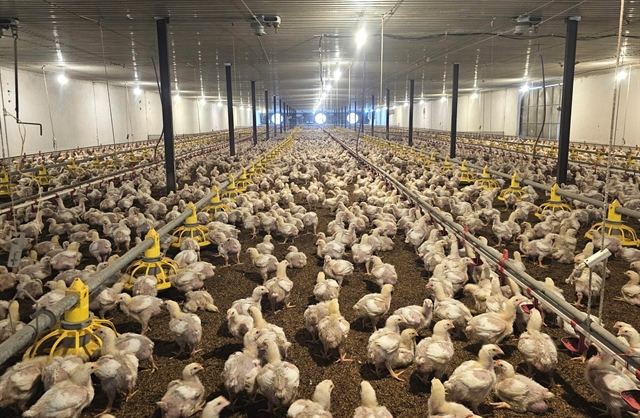
A chicken farm in HCM City. Việt Nam already has a large livestock production base, but is facing pressure to move toward higher value. — VNA/VNS Photo Hương Giang
HÀ NỘI — The livestock industry is facing mounting pressure to shift away from growth driven mainly by herd expansion towards higher-value products, stronger brands and greater export competitiveness amid the impacts of climate change, diseases, environmental issues and increasing competition, experts have said.
After more than two decades of expansion, the industry has reached a scale where increasing herd sizes and output alone are no longer enough to sustain growth, said Phạm Kim Đăng, deputy head of the Department of Livestock Production and Animal Health.
Đăng said Việt Nam already has a large livestock production base. Pork output is about four million tonnes a year, meeting around 90.9 per cent of domestic demand, while poultry meat production stands at about 1.8 million tonnes, covering 81.8 per cent. Egg production exceeds 21.4 billion units, surpassing domestic demand.
The country has the world's sixth-largest pig herd and second-largest waterfowl population, while its animal feed and veterinary medicine industries rank among the largest in Southeast Asia.
Some Vietnamese products, including chicken, dairy products, animal feed and veterinary vaccines, have begun entering markets with stringent requirements, Đăng added.
But exporting products is only the first step. The industry is facing a bigger challenge: how to build brands that can command higher prices and retain more value in Việt Nam.
"Looking at the scale, Việt Nam's livestock industry is not small," said Nguyễn Xuân Dương, chairman of the Vietnam Animal Husbandry Association.
Dương said domestic producers are facing growing pressure as imports increase, while domestic production is growing by only about 2-3 per cent.
Household farmers and domestic companies are also competing with large corporations that have greater scale and stronger financial and technological resources.
The industry thus cannot rely solely on the domestic market, he said. Deeper integration is opening Việt Nam's market to more foreign products while requiring Vietnamese producers to compete more directly in international markets.
China's experience with livestock oversupply highlights the risks of expanding production without sufficient market information and supply chain coordination, according to Dương.
"The question for the next phase is not simply how much to produce, but what products to make, whom to sell to, where to sell them and how much value can be retained across the entire chain," he noted.
Dương said sustainable development should rest on four pillars: economic efficiency, environmental protection, social considerations and animal health and welfare.
Building brands
As output growth is no longer treated as the sole measure, building brands for the livestock industry will become critical to increasing value.
According to Đăng, there are opportunities not only in major products such as pork, poultry and dairy, but also in speciality products and processed foods, such as H'Mong cattle, Hương Sơn deer, bird's nests and honey.
International examples, such as Japan's Kobe beef and the Republic of Korea's Hanwoo beef, show how value can be built around genetics, production standards, quality and branding, rather than volume alone.
However, turning Việt Nam's potential products into export brands will require a coordinated ecosystem covering breeding, production areas, standards, processing, traceability, logistics and trade promotion, he said.
Industry databases must also improve so that supply and demand can be forecast more accurately, allowing producers to align output with market demand.
Companies are also urged to view brands as long-term assets rather than just a way to sell products.
Experts pointed out that Việt Nam remains heavily dependent on imported animal feed ingredients and breeding stock.
In addition, the uneven geographic distribution of livestock production is putting pressure on the environment and creating biosecurity risks, while fragmented slaughtering and distribution systems and weak supply chain links make disease control and food safety management more difficult.
Restructuring the industry thus needs to focus on improving the quality of the entire production chain.
The sector also needs to accelerate the use of science and technology, including genome-based breeding, increase domestic production of feed inputs, digitise industry databases and introduce identification codes for production facilities.
Coordination among regulators, businesses, scientists and farmers will be critical to achieving that goal, experts said.
Under a five-year plan to restructure Việt Nam's livestock industry, the Ministry of Agriculture and Environment has set a target of US$1.5 billion in annual exports of livestock products by 2030.
In the first eight months of this year, exports of livestock products were estimated at $511.9 million, up 30 per cent. — VNS
Source: VNS
Related News

INFRASTRUCTURE / CONSTRUCTION / LOGISTIC / PORT
VIỆT NAM-CAMBODIA TRADE GATHERS PACE TOWARDS $20 BILLION TARGET
Trade between Việt Nam and Cambodia continues to grow, remaining a bright spot and a key pillar of bilateral cooperation as the two countries aim to raise two-way trade to US$20 billion in the coming years. After setting a record of more than $11.3 billion last year, bilateral trade reached about $8.7 billion in the first eight months of this year, up 8.3 per cent year on year.

TECHNOLOGY
AI BEGINNING TO RESHAPE RECRUITMENT CRITERIA
Digital literacy is the only capability area in which fresh graduates meet employers’ expectations, according to a new report. Yet, it is also the standard rising fastest, as businesses increasingly expect new hires to use AI effectively in the workplace. Some 83 per cent of employers say AI has changed, or is beginning to change, their hiring criteria, while 94 per cent report higher expectations for digital and AI capabilities than they had two to three years ago.

INFRASTRUCTURE / CONSTRUCTION / LOGISTIC / PORT
ĐÀ NẴNG GREEN-LIGHTS US$105 MILLION THAI DEVELOPMENT DEAL
The central city has approved an investment proposal by Thailand’s WHA Group to develop infrastructure for the 400ha WHA Đà Nẵng Industrial Park project on two communes of Thăng Bình and Đồng Dương, with an investment of more than VNĐ2.7 trillion (US$105 million). The city said it approved WHA Industrial Development International's status as an investor in the project, which is expected to take place between 2027 and 2034.

VIETNAM ECONOMY INVESTMENT
MOBILE PHONE EXPORTS RISE 20% TO $51.8 BILLION IN FIRST NINE MONTHS
Exports of mobile phones and components rose 20 per cent year-on-year to nearly US$51.8 billion in the first nine months of 2026, with China, the US and Republic of Korea accounting for more than half of the total. Shipments to the three markets reached a combined $26.18 billion, or 50.6 per cent of total exports of the product group during the period, according to data from the Vietnam Department of Customs under the Ministry of Finance.

VIETNAM ECONOMY INVESTMENT
FRUIT AND VEGETABLE EXPORTS POISED TO HIT $10 BILLION IN 2026
Fruit and vegetable exports are on track to reach nearly US$10 billion in 2026, after rising 19.9 per cent year on year to nearly US$7.4 billion in the first nine months, driven by strong seasonal demand and abundant tropical fruit supplies. The Ministry of Agriculture and Environment said the growth reflected stronger international demand for fresh produce and processed agricultural products.

GARMENT / TEXTILE
TEXTILE EXPORTS FACE DUAL CHALLENGES OF SUSTAINING ORDERS AND BOOSTING EFFICIENCY AMID GROWING COMPETITION
Data shows that the textile and garment sector maintained its growth momentum in the first nine months of this year. The industry's total export turnover reached an estimated US$35.721 billion in the first nine months of this year, up 3.3 per cent year-on-year. Despite posting encouraging export figures, Vietnamese textile and garment enterprises continue to navigate unpredictable market variables.
Events Sponsors






















