Want to be in the loop?
subscribe to
our notification
Business News
LOGISTICS UPGRADE A MUST TO INTEGRATE
"According to the World Bank's Logistics Performance Index, Vietnamese logistics ranks fourth in ASEAN and 48th in the world. The infrastructure index has improved in recent years," said Nguyen Nhat, deputy minister of the Ministry of Transport, at the conference.
"ASEAN logistics co-operation began in 2011, and this relationship should deepen in upcoming years so that we can take advantage of the AEC," he said.
To prepare for a more robust and competitive trade environment, the Government has been developing infrastructure for transport and logistics, including 18 national highways linked with ASEAN and a railway system connecting Laos and Cambodia. Local waterways between Thailand and Cambodia have also been improved.
"However, limited legal framework, poor human resources and weak connections among different means of transport, especially railway and sea, and unprofessional and small companies are all challenges for the logistics industry in Viet Nam," he said.
To improve the situation, Nhat suggested that in the future Viet Nam should deploy an infrastructure network for multi-modal transport, build an entrepot system at international ports, establish big multi-modal transport corporations and strengthen administrative reform to promote commodities circulation.
Speaking at the conference, Alvin Chua, chairman of the ASEAN Federation of Forwarders Association (AFFA), presented an ASEAN master plan for achieving overall ASEAN Connectivity through enhanced physical infrastructure development (physical connectivity); effective institutions, mechanisms and processes (institutional connectivity); and empowered people (people-to-people connectivity).
"ASEAN governments must also address non-tariff barriers to facilitate intra-ASEAN trade and investment along with harmonising standards and achieving conformity of assessment procedures," he said.
In the future, the ASEAN master plan will need to upgrade existing infrastructure, build new infrastructure and logistics facilities and harmonise the regulatory framework as well as nurture an innovative culture.
"Viet Nam must pro-actively participate in acceleration of AEC 2015 Integration into the ASEAN Economy," Stanley Lim, chairman of the Singapore Logistics Association, said.
He suggested that ASEAN governments must concentrate on four key pillars: a single market, as trade barriers among nations fall to a minimum; a competitive economic region, fostering a culture of fair competition; equitable economic development by assisting the growth of SMEs, the backbone of ASEAN's economy; and deep integration into the global economy by deleting trade barriers.
"ASEAN logistics will support trade with efficient movement of goods with professionally skilled labour by efficient cross-border of goods through trade facilitation; a single window for speedy customs clearance; human resource development through training in competence logistics skill sets; and connectivity with multi-modal transport," he added.
According to the ministry of Industry and Trade's master plan for logistics, by 2020, the industry will contribute 10 per cent to GDP at a growth of 25 per cent each year and by 2030 the figure will be 15 per cent and 35 per cent, respectively.
"The master plan targets to reduce logistics costs by 0.5 – 1 per cent of GDP every year, equivalent to $1-3 billion, with investment in logistics to grow by 25-30 per cent annually and create jobs for 4-5 per cent of the population," said Tran Chi Dung, deputy director of the Viet Nam Logistics Institute.
The conference was organised by the Viet Nam Logistics Association with participation of ASEAN top logistics experts from 10 nations, government officials and 150 local companies involved in import, export, logistics, forwarding, transport, airlines, ships, sea ports, insurance and consultancy.
Source: VNS
Related News
MEMBER CORNER / PROMOTIONS
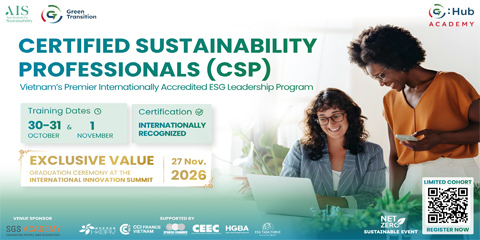
HCMC | CERTIFIED SUSTAINABILITY PROFESSIONAL (CSP) TRAINING | REGISTRATION OPEN
As sustainability becomes deeply embedded in corporate strategy and supply-chain operations across Vietnam, Hong Kong Business Association Vietnam is pleased to endorse the upcoming Certified Sustainability Professional (CSP) training program by the Asia Institute for Sustainability (AIS) - a premier internationally recognized ESG credential in Vietnam.
VIETNAM ECONOMY INVESTMENT
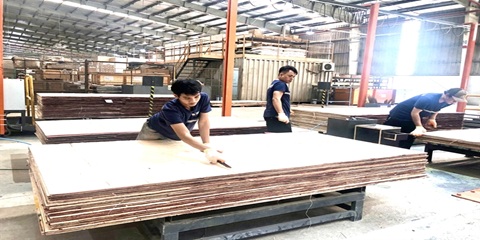
HCM CITY SAYS HOW IT PLANS TO ACHIEVE 10-11% ANNUAL EXPORT GROWTH FOR REST OF DECADE
The southern economic hub aims to strengthen its role as the country’s largest import-export centre while developing into a regional transhipment centre in Southeast Asia, supported by green and digital transformation and a circular economy. HCM City has outlined measures to expand production capacity, cut logistics costs, diversify export markets, and help businesses meet increasingly stringent international standards as it targets average annual export growth of 10-11 per cent through 2030.
VIETNAM ECONOMY INVESTMENT
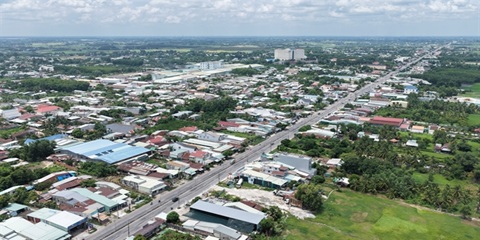
HCM CITY LEADS ECONOMIC RESTRUCTURING IN SOUTHEAST REGION
According to Associate Professor, Dr Vũ Tuấn Hưng, director of the Institute of Social Sciences of the Southern Region, the Southeast is a strategically important socio-economic space in Việt Nam’s development given its advantages in location, industry, trade, services, logistics, science and technology, urbanisation and human resources.
TECHNOLOGY
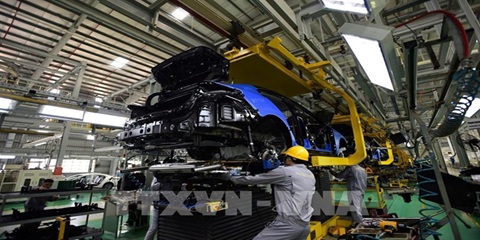
DIGITAL TRANSFORMATION TURNED INTO PRACTICAL TOOLS FOR PEOPLE, BUSINESSES
Việt Nam is moving its digital transformation agenda beyond policy frameworks and individual technology platforms towards practical applications that address everyday needs, as authorities seek measurable outcomes from science, technology and innovation. Under Politburo Resolution No. 57-NQ/TW issued on December 22, 2024, the implementation is increasingly shifting from simply completing assigned tasks towards developing concrete products and services for citizens and businesses.
TECHNOLOGY
APPLYING TECHNOLOGY FOR ECONOMIC TRANSFORMATION
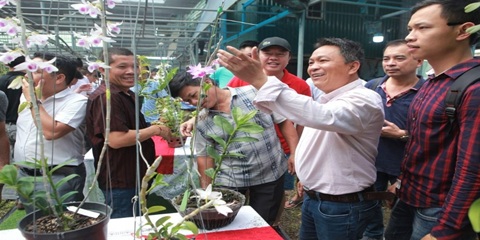
Having completed its new rural development program, Hanoi is shifting its focus toward improving development quality and building smart, sustainable rural areas. The transformation of Dong La orchid-growing village in An Khanh, a western commune of Hanoi, shows how digital technology is becoming a driver of production, market expansion, and higher incomes for local residents.

MEMBER CORNER / PROMOTIONS
VIGLACERA HONORED AS THE "LEADING GREEN INDUSTRIAL REAL ESTATE DEVELOPER 2026"
Organized by the Vietnam Investment Review, this prestigious awards program recognizes industry pioneers advancing eco-industrial parks, clean energy transition, and rigorous ESG standards. Outperforming competitors through a rigorous evaluation, Viglacera Corporation – JSC proudly ranked among the Top 5 highest-positioned enterprises in the Leading Green Industrial Real Estate Developers 2026 category, reinforcing its premier position in Vietnam’s industrial real estate sector.
Events Sponsors






















