Want to be in the loop?
subscribe to
our notification
Business News
LOGISTICS SECTOR POISED FOR NEW GROWTH PHASE
Vietnam’s logistics sector is set for a new phase of growth as enterprises accelerate expansion strategies in response to key policy shifts aimed at shaping future market trends.
Vietnamese freight forwarder Bee Logistics has re-evaluated its medium-term development strategy towards 2030 to better align with fresh policy directions from the government. The company review followed the recent issuance of four strategic resolutions focused on science and technology, international integration, legal reform, and private economic development.
Vu Ho Ninh, director of the northern region at Bee Logistics, said the firm plans to expand its office network domestically and internationally, while maintaining close ties with industry associations and local authorities to stay abreast of regional planning and investment policy changes. The company will also continue to advance digital transformation, pursue green growth, and invest in infrastructure to support long-term sustainable development in line with the new resolutions.
“For us, the resolutions carry major significance,” Ninh told VIR. “We already operate more than 40 branches and offices across key economic centres in Vietnam and overseas. But to extend our reach, regional connectivity and infrastructure remain vital.”
For instance, with prioritised expressway investments such as Lang Son–Cao Bang or Phu Tho–Tuyen Quang thanks in part to Resolution No.66/NQ-TW, goods from new industrial parks in northern mountainous areas can reach seaports one to two days faster, greatly reducing transit time and operating costs, Ninh said.
He added that Resolution 66, which focuses on legal reform, would also help reduce risks and streamline logistics processes, particularly in customs, taxation, and inspection procedures that rely on business-friendly legal frameworks.
At Bee Logistics, most orders are now tracked and managed through an integrated transport management system. The company’s warehouse operations are gradually adopting Internet of Things technology and radio-frequency identification for real-time inventory tracking.
In March, the company inaugurated the Bee Distribution Centre in the central region – deemed one of the most modern logistics hubs in the area – with 26,000sq.m of space and storage capacity for up to 30,000 pallets. The facility is equipped with a warehouse management system, transport management software, barcode scanning technology, and automation tools to optimise warehousing and supply chain activities.
Other logistics players are making similar moves. T&M Forwarding, which has nearly three decades of experience in international logistics, sees this period as a pivotal time for transformation, restructuring, and expansion.
Chu Kieu Lien, Hanoi manager at T&M Forwarding, said modern logistics cannot be separated from digital transformation and the application of smart technologies such as AI, big data, and blockchain. She said the newly issued resolutions are expected to give further impetus to this shift.
“In line with these policy directions, T&M Forwarding will broaden its service offerings and transport routes, and expand its network of agents and partners in key markets such as the United States, ASEAN, Northeast Asia, and the EU,” Lien said. “We also aim to deepen strategic cooperation with shipping lines, airlines, and international warehouse networks to strengthen our position in the global supply chain – especially in e-commerce logistics and services for foreign-invested enterprises.”
Vietnam Maritime Corporation (VIMC) is also aligning with this national strategy. Over the coming years, the group plans to enhance port operations, expand logistics services, and invest in a more modern, environmentally friendly fleet. It is currently partnering with leading global shipping companies to boost international maritime connectivity.
Nguyen Canh Tinh, newly appointed chairman of VIMC, said, “From now to 2030, we will prioritise strategic infrastructure projects, including deepwater ports, international transit hubs, and inland container depots in key economic zones. We will also invest in next-generation vessels and high-tech ships, with a focus on modernising our container fleet to increase VIMC’s maritime transport capacity.”
VIMC is encouraging green and energy transformation, such as using more renewable energy, cutting emissions, and complying with international sustainability standards. “These efforts are essential to keeping pace with trends in the global maritime industry,” he said.
The group is also developing major logistics centres in Haiphong, Danang, and Ho Chi Minh City to strengthen the maritime supply chain. These facilities are expected to play a key role in connecting international routes and enhancing the competitiveness of Vietnam’s maritime sector in regional and global markets.
Tinh said VIMC will boost cooperation with reputable seaports and global shipping lines to expand international shipping routes and logistics markets, directly linking its port network with the world. The corporation is also prioritising the attraction of strategic investors and financial partners to participate in large-scale seaport projects.
According to logistics experts, the four resolutions are not only long-term strategies for regional development, but also timely responses to structural imbalances and rising logistical pressures on the economy.
Vietnam’s logistics costs remain high, accounting for approximately 16.5 per cent of GDP – far above the global average of 11–12 per cent, according to the Vietnam Logistics Report 2024. Logistics expert Le Tuong attributed this gap to limited regional connectivity, fragmented infrastructure, and overlapping transport planning.
“These resolutions are reshaping regional master planning and helping develop logistics infrastructure – a critical step in removing longstanding bottlenecks,” he said. “Logistics is vital to linking Vietnam with global markets, especially as we enter more free trade agreements. The key now is turning policy into practice – building a robust logistics industry that raises the country’s position in global supply and value chains.”
Source: VIR
Related News
MEMBER CORNER / PROMOTIONS
HCMC | CERTIFIED SUSTAINABILITY PROFESSIONAL (CSP) TRAINING | REGISTRATION OPEN
As sustainability becomes deeply embedded in corporate strategy and supply-chain operations across Vietnam, Hong Kong Business Association Vietnam is pleased to endorse the upcoming Certified Sustainability Professional (CSP) training program by the Asia Institute for Sustainability (AIS) - a premier internationally recognized ESG credential in Vietnam.
VIETNAM ECONOMY INVESTMENT
HCM CITY SAYS HOW IT PLANS TO ACHIEVE 10-11% ANNUAL EXPORT GROWTH FOR REST OF DECADE
The southern economic hub aims to strengthen its role as the country’s largest import-export centre while developing into a regional transhipment centre in Southeast Asia, supported by green and digital transformation and a circular economy. HCM City has outlined measures to expand production capacity, cut logistics costs, diversify export markets, and help businesses meet increasingly stringent international standards as it targets average annual export growth of 10-11 per cent through 2030.
VIETNAM ECONOMY INVESTMENT
HCM CITY LEADS ECONOMIC RESTRUCTURING IN SOUTHEAST REGION
According to Associate Professor, Dr Vũ Tuấn Hưng, director of the Institute of Social Sciences of the Southern Region, the Southeast is a strategically important socio-economic space in Việt Nam’s development given its advantages in location, industry, trade, services, logistics, science and technology, urbanisation and human resources.
TECHNOLOGY
DIGITAL TRANSFORMATION TURNED INTO PRACTICAL TOOLS FOR PEOPLE, BUSINESSES
Việt Nam is moving its digital transformation agenda beyond policy frameworks and individual technology platforms towards practical applications that address everyday needs, as authorities seek measurable outcomes from science, technology and innovation. Under Politburo Resolution No. 57-NQ/TW issued on December 22, 2024, the implementation is increasingly shifting from simply completing assigned tasks towards developing concrete products and services for citizens and businesses.
TECHNOLOGY
APPLYING TECHNOLOGY FOR ECONOMIC TRANSFORMATION
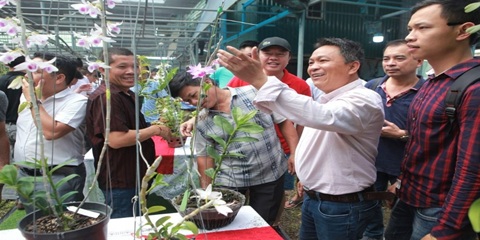
Having completed its new rural development program, Hanoi is shifting its focus toward improving development quality and building smart, sustainable rural areas. The transformation of Dong La orchid-growing village in An Khanh, a western commune of Hanoi, shows how digital technology is becoming a driver of production, market expansion, and higher incomes for local residents.
MEMBER CORNER / PROMOTIONS
VIGLACERA HONORED AS THE "LEADING GREEN INDUSTRIAL REAL ESTATE DEVELOPER 2026"
Organized by the Vietnam Investment Review, this prestigious awards program recognizes industry pioneers advancing eco-industrial parks, clean energy transition, and rigorous ESG standards. Outperforming competitors through a rigorous evaluation, Viglacera Corporation – JSC proudly ranked among the Top 5 highest-positioned enterprises in the Leading Green Industrial Real Estate Developers 2026 category, reinforcing its premier position in Vietnam’s industrial real estate sector.
Events Sponsors






















