Want to be in the loop?
subscribe to
our notification
Business News
MINIMUM WAGE INCREASES CONTINUE TO FALL FAR SHORT
Viet Nam has posted the highest regional increase in minimum wages over the last three years, more than Indonesia and China, but workers still struggle to make ends meet.
Things are not likely to change with the latest increase, set to take effect next month, local reports say.
From July 1, the basic salary for civil servants and public employees will increase seven per cent to VNĐ1.3 million (about US$57.2) from the current VNĐ1.21 million.
The new basic salary, used for calculating payrolls and allowances, will apply for public officials, public employees working in State agencies and civil service providers of the Party or the Government, State-funded socio-political organisations and the armed forces.
Lê Đình Quảng, deputy head of the Labor Relations department of the Việt Nam General Confederation of Labor, said that the government had plans to increase minimum wage for employees every year to improve living standards.
However, the current minimum wage increase only met 90 per cent of the minimum living standard needs of workers and their families.
Even workers of businesses that pay higher than the minimum wage, VNĐ4-5 million per month, face many difficulties in daily lives.
An overwhelming majority of workers, 97 per cent, did not want to work overtime, but had no choice but to do so, just to make ends meet, Quảng told the Hải Quan (Customs) newspaper.
The newspaper reports that from 2014 to 2016, Việt Nam had the highest regional minimum wage increase of nearly 14 per cent, against seven per cent in Indonesia and 10 per cent in China.
Many people wonder why such an increase is unable to meet workers’ demands, the report says.
The reason is that Việt Nam’s minimum wage is only higher than Laos and Cambodia and lower than most countries in Southeast Asia like Thailand, Malaysia or Singapore, it explains.
The real wage of workers is still very low, it is not high enough to cover workers’ basic needs because the costs of many services also increase along with the minimum wage.
In fact, in some enterprises, the real income of workers reduce when the minimum wage increases.
Some business owners also threaten to cut their workforce if production costs increase because of higher wages.
The results of study by the ISEAL Alliance – the global association for sustainability standards and social accountability – released at a seminar in Hà Nội recently showed that an employee in HCM City must be paid more than VNĐ6.4 million a month to meet their daily expenses.
The salary was calculated by the research team on the basis of what a household of two adults and two children spend a month.
Unfortunately, the average salary of a worker in the garment sector, a major employer, is just over VNĐ4.8 million a month.
According to the study, at a monthly wage of VNĐ6.4 million, an employee may save VNĐ488,000 per month, five per cent of the income after spending for food, housing fee, insurance and other needs.
The study estimates that for rural areas, in two surveyed provinces of Sóc Trăng and Thái Bình, a worker needs at least VNĐ3.99 million a month, but the current average salary in these localities is just VNĐ3.2 million.
Most employers pay only minimum wage, which is not enough to meet actual minimum living costs, forcing workers to work overtime to make ends meet, the study found.
Workers are, therefore, left wondering if and when they will be able to meet daily expenses and save some money for a rainy day.
Bùi Sỹ Lợi, Deputy Chairman of the National Assembly’s Social Affairs Committee, said the minimum wage must be adjusted based on socio-economic development and workes should be compensated in accordance with market mechanisms.
Currently, the minimum wage is based on food prices, which is inadequate. Therefore, authorised agencies must re-calculate the minimum wage so as to ensure the benefits of employees, especially when they retire, while creating favourable conditions for business growth, he said.
Source: VIR
Related News

INFRASTRUCTURE / CONSTRUCTION / LOGISTIC / PORT
VIỆT NAM-CAMBODIA TRADE GATHERS PACE TOWARDS $20 BILLION TARGET
Trade between Việt Nam and Cambodia continues to grow, remaining a bright spot and a key pillar of bilateral cooperation as the two countries aim to raise two-way trade to US$20 billion in the coming years. After setting a record of more than $11.3 billion last year, bilateral trade reached about $8.7 billion in the first eight months of this year, up 8.3 per cent year on year.
TECHNOLOGY
AI BEGINNING TO RESHAPE RECRUITMENT CRITERIA
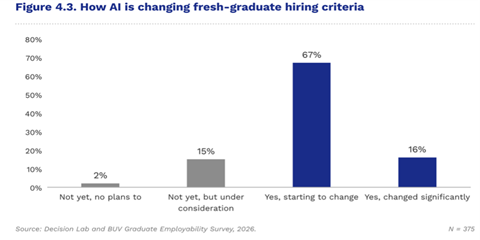
Digital literacy is the only capability area in which fresh graduates meet employers’ expectations, according to a new report. Yet, it is also the standard rising fastest, as businesses increasingly expect new hires to use AI effectively in the workplace. Some 83 per cent of employers say AI has changed, or is beginning to change, their hiring criteria, while 94 per cent report higher expectations for digital and AI capabilities than they had two to three years ago.

INFRASTRUCTURE / CONSTRUCTION / LOGISTIC / PORT
ĐÀ NẴNG GREEN-LIGHTS US$105 MILLION THAI DEVELOPMENT DEAL
The central city has approved an investment proposal by Thailand’s WHA Group to develop infrastructure for the 400ha WHA Đà Nẵng Industrial Park project on two communes of Thăng Bình and Đồng Dương, with an investment of more than VNĐ2.7 trillion (US$105 million). The city said it approved WHA Industrial Development International's status as an investor in the project, which is expected to take place between 2027 and 2034.

VIETNAM ECONOMY INVESTMENT
MOBILE PHONE EXPORTS RISE 20% TO $51.8 BILLION IN FIRST NINE MONTHS
Exports of mobile phones and components rose 20 per cent year-on-year to nearly US$51.8 billion in the first nine months of 2026, with China, the US and Republic of Korea accounting for more than half of the total. Shipments to the three markets reached a combined $26.18 billion, or 50.6 per cent of total exports of the product group during the period, according to data from the Vietnam Department of Customs under the Ministry of Finance.

VIETNAM ECONOMY INVESTMENT
FRUIT AND VEGETABLE EXPORTS POISED TO HIT $10 BILLION IN 2026
Fruit and vegetable exports are on track to reach nearly US$10 billion in 2026, after rising 19.9 per cent year on year to nearly US$7.4 billion in the first nine months, driven by strong seasonal demand and abundant tropical fruit supplies. The Ministry of Agriculture and Environment said the growth reflected stronger international demand for fresh produce and processed agricultural products.
GARMENT / TEXTILE
TEXTILE EXPORTS FACE DUAL CHALLENGES OF SUSTAINING ORDERS AND BOOSTING EFFICIENCY AMID GROWING COMPETITION
Data shows that the textile and garment sector maintained its growth momentum in the first nine months of this year. The industry's total export turnover reached an estimated US$35.721 billion in the first nine months of this year, up 3.3 per cent year-on-year. Despite posting encouraging export figures, Vietnamese textile and garment enterprises continue to navigate unpredictable market variables.
Events Sponsors






















