Want to be in the loop?
subscribe to
our notification
Business News
POSITIVE OUTLOOK FOR VIỆT NAM’S BANKING SECTOR IN 2025
Bank stocks will deliver a strong performance again this year, partly because sector-wide bank earnings growth is expected to accelerate from 14 per cent in 2024 to 17 per cent in 2025 driven by a shift in GDP growth drivers from external factors to domestic driven growth, according to investment management firm VinaCapital.
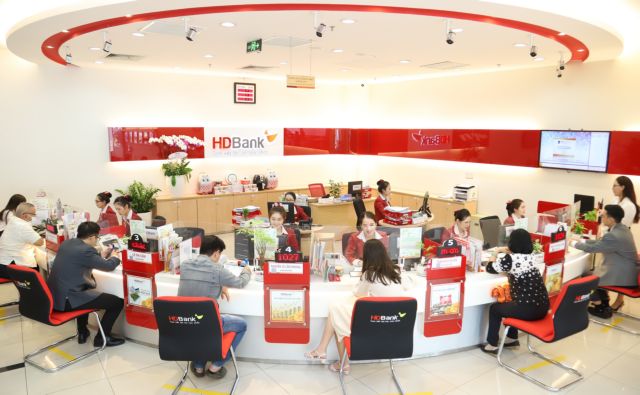
Banking sector’s earnings growth is expected to pick up this year driven by a shift in GDP growth drivers from exports and tourism in 2024 to consumption, infrastructure spending, and real estate in 2025. — Photo courtesy of HDBank
HCM CITY — Bank stocks will deliver a strong performance again this year, partly because sector-wide bank earnings growth is expected to accelerate from 14 per cent in 2024 to 17 per cent in 2025 driven by a shift in GDP growth drivers from external factors to domestic driven growth, according to investment management firm VinaCapital.
Bank stocks significantly outperformed the VN-Index in 2024 with the 18 banks listed on the Ho Chi Minh Stock Exchange surging 26 per cent in VND terms versus 12 per cent for the VN-Index.
A recent report conducted by Michael Kokalari, chief economist at VinaCapital, and Nguyễn Thị Thúy Anh, senior bank analyst at VinaCapital, pointed out that earnings growth acceleration, coupled with attractive valuations (1.3x price to book (P/B) versus 16 per cent return on equity (ROE)), should drive further stock price appreciation.
According to the report, Việt Nam’s export growth to the US is projected to plunge this year, which should be offset by increases in infrastructure spending, real estate development activity, and consumer spending.
Slower export growth will weigh on GDP growth because exports are nearly 100 per cent/GDP, but most of Việt Nam’s exports are produced by FDI companies that are not reliant on local banks for financing; while slower exports will affect the economy, they will not significantly hurt the banks.
Furthermore, banks should be the biggest beneficiaries of the shift to more domestically driven growth because Vietnamese banks touch nearly every part of the country’s domestic economy, and banks are especially exposed to real estate and consumption, which will help drive the economy in 2025.
VinaCapital expected that the Government will take concrete steps to boost the real estate market this year, which could result in mortgage loan growth doubling from around 10 per cent in 2024 to 20 per cent in 2025.
A real estate market revival would also boost consumer confidence, as well as other forms of high margin consumer lending, such as auto loans and buy-now-pay-later purchases.
The Government also plans to support 2025 GDP growth by spending more on infrastructure development, which should create more lending opportunities for banks.
They stressed that the combination of increased infrastructure spending, improved consumer sentiment, and a real estate market revival would all propel banks’ credit growth, support banks’ net interest margins (NIMs), and foster the ongoing recovery of asset quality in Việt Nam.
Recovering asset quality and improving loan mix
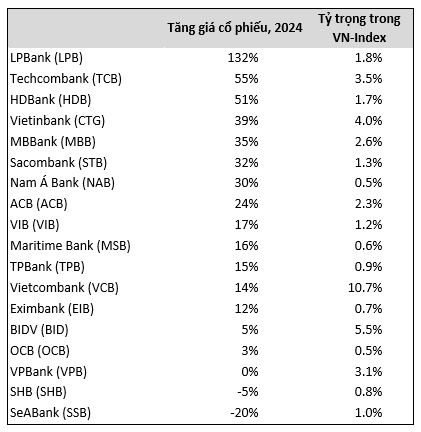
The 18 banks listed on the Ho Chi Minh Stock Exchange surged 26 per cent in VND terms versus 12 per cent for the VN-Index in 2024. Bank stocks are expected to deliver a strong performance again this year. — Source VinaCapital
The two experts expected the earnings of Việt Nam’s listed banks to grow 17 per cent this year, driven by 15 per cent system-wide credit growth and by a slight increase in system-wide NIM (by 6 basis points (bps) to 355 bps in 2025). The ongoing recovery in asset quality will also support earnings growth somewhat this year, as will an improved composition of loan growth.
Việt Nam’s system-wide loan growth is expected to remain at around 15 per cent in 2025 but for high-margin retail loan growth to accelerate from around 12 per cent in 2024 to 15 per cent in 2025.
They also expected banks to make more long-dated loans this year by lending to infrastructure projects, which typically have long time horizons. The resulting “maturity transformation” associated with those new long-dated loans will support NIMs (banks earn higher profits by gathering short-term deposits and extending long-term loans that usually earn higher interest rates).
Finally, real estate lending picked up considerably last year as the market recovery gathered steam, although some lending to real estate developers was for the refinancing of maturing corporate bonds that developers previously sold to retail and other investors.
Attractive valuations
Kokalari underscored that Vietnamese bank stocks are trading at a 1.3x price to book for 2025 versus 16 per cent expected return on equity, which is nearly two standard deviations below banks’ 5-year average P/B (banks that generate 16 per cent ROE typically trade above 2x P/B).
Valuation is also cheap on a Price Earnings Ratio basis at 0.5x PEG (8x FY2025 P/E vs. 17 per cent EPS growth). Last year, valuations were even cheaper before a partial re-rating of bank stock valuations, when the increase in bank stock prices (26 per cent) outpaced EPS growth (14 per cent).
One reason for that cheap valuation is that Việt Nam’s 30 per cent foreign ownership limit for banks essentially makes local retail investors the marginal buyers who set bank stock prices in Việt Nam, and those investors are not as focused on valuations as foreigners.
Investors in Việt Nam’s stock market are generally aware of the sector’s inexpensive valuation, but many do not realise how big the divergence is between the valuations and stock price performance of individual banks, or how much divergence there is between the operating, asset quality, and other metrics among individual banks, he said. — VNS
Source: VNS
Related News

CHARITY / EXHIBITION / OTHER EVENTS
INVESTMENT OPPORTUNITIES IN CA MAU PROVINCE: 96 PROJECTS AND 20 STRATEGIC PROJECTS
We are pleased to share with you information on investment projects currently seeking investors in Ca Mau Province. Should your esteemed company or association be interested, we kindly invite you to review the project information and complete the registration form via the links provided. The Ho Chi Minh City Investment and Trade Promotion Centre (ITPC) will consolidate the expressions of interest and facilitate connections with the leadership of Ca Mau Province at a meeting tentatively scheduled for 13 November 2026 in Ho Chi Minh City.

MEMBER CORNER / PROMOTIONS
BẰNG KIỀU LIVESHOW - A SYMPHONY OF LOVE UNDER THE GOLDEN GLOW
A masterclass in live music that takes the audience on a soulful journey through immortal love songs, guided by the peerless artistry and emotive storytelling of renowned singer Bằng Kiều. The highlight of the night is his seamless musical chemistry with special guest Triệu Hồng Ngọc, promising passionate and deeply resonant duets inside the magnificent Grand Ballroom.

INFRASTRUCTURE / CONSTRUCTION / LOGISTIC / PORT
ĐÀ NẴNG GREEN-LIGHTS US$105 MILLION THAI DEVELOPMENT DEAL
The central city has approved an investment proposal by Thailand’s WHA Group to develop infrastructure for the 400ha WHA Đà Nẵng Industrial Park project on two communes of Thăng Bình and Đồng Dương, with an investment of more than VNĐ2.7 trillion (US$105 million). The city said it approved WHA Industrial Development International's status as an investor in the project, which is expected to take place between 2027 and 2034.

VIETNAM ECONOMY INVESTMENT
MOBILE PHONE EXPORTS RISE 20% TO $51.8 BILLION IN FIRST NINE MONTHS
Exports of mobile phones and components rose 20 per cent year-on-year to nearly US$51.8 billion in the first nine months of 2026, with China, the US and Republic of Korea accounting for more than half of the total. Shipments to the three markets reached a combined $26.18 billion, or 50.6 per cent of total exports of the product group during the period, according to data from the Vietnam Department of Customs under the Ministry of Finance.

INFRASTRUCTURE / CONSTRUCTION / LOGISTIC / PORT
VIỆT NAM-CAMBODIA TRADE GATHERS PACE TOWARDS $20 BILLION TARGET
Trade between Việt Nam and Cambodia continues to grow, remaining a bright spot and a key pillar of bilateral cooperation as the two countries aim to raise two-way trade to US$20 billion in the coming years. After setting a record of more than $11.3 billion last year, bilateral trade reached about $8.7 billion in the first eight months of this year, up 8.3 per cent year on year.

VIETNAM ECONOMY INVESTMENT
FRUIT AND VEGETABLE EXPORTS POISED TO HIT $10 BILLION IN 2026
Fruit and vegetable exports are on track to reach nearly US$10 billion in 2026, after rising 19.9 per cent year on year to nearly US$7.4 billion in the first nine months, driven by strong seasonal demand and abundant tropical fruit supplies. The Ministry of Agriculture and Environment said the growth reflected stronger international demand for fresh produce and processed agricultural products.
Events Sponsors






















