Want to be in the loop?
subscribe to
our notification
Business News
POSITIVE OUTLOOK FOR WOOD PRODUCT EXPORTS AFTER ROARING SUCCESS IN 2024
The woodworking industry will strive to achieve the export target of US$18 billion for this year, the Handicraft and Wood Industry Association of HCM City has said.
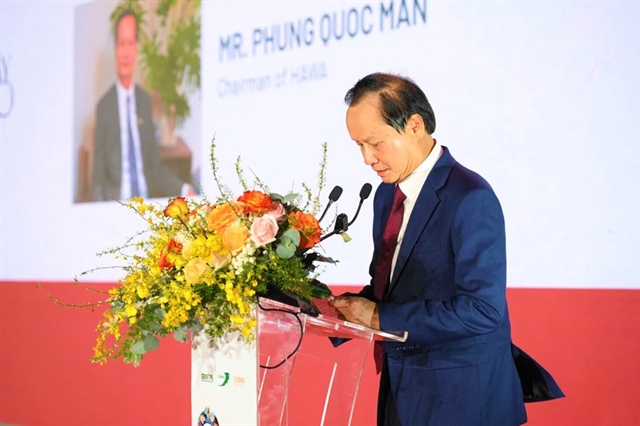
Phùng Quốc Mẫn, chairman of the Handicraft and Wood Industry Association of HCM City, speaks at the ancestral worship ceremony of the woodworking and handicraft industry in HCM City last week. — Photo courtesy of HAWA
HCM CITY – The woodworking industry will strive to achieve the export target of US$18 billion for this year, the Handicraft and Wood Industry Association of HCM City has said.
The association along with the Bình Dương Furniture Association (BIFA), and the Đồng Nai Wood and Handicraft Association (DOWA) organised a ceremony in HCM City last week to honour the Ancestors of Carpentry and celebrate the achievements of the woodworking and handicraft industry in 2024.
It was attended by more than 700 delegates representing members and partners.
Phùng Quốc Mẫn, HAWA chairman, said Việt Nam's wood product exports last year were worth a record US$16.3 billion after rising by 20.3 per cent from 2023.
"This is a truly impressive achievement, reflecting the strength and resilience of the industry in overcoming challenges."
Trần Quang Bảo, director of the Forestry Department, told the event that non-wood forestry products were worth another $1.04 billion.
"As a long-standing traditional industry, the woodworking industry not only brings economic value but also plays a crucial role in preserving the national culture and creating products that proudly bear the mark of Việt Nam in the international market."
Vietnamese wood products are now present in over 170 countries, he said.
In 2025 the wood processing and export industry would have both opportunities and challenges, with significant changes expected in international trade policies, especially in major markets like the US, he said.
To achieve the export target of $18 billion, he urged the industry to diversify its markets to avoid over-reliance on a few major ones and leveraging e-commerce platforms.
It also needs to build transparent supply chains, adopt technology in production and management, ensure traceability of wood materials, develop sustainable and eco-friendly products, and foster collaboration and innovation, he said.
"Associations such as HAVW, DOWA and BIFA should continue to be bridges between businesses and regulatory agencies, supporting workforce training and encouraging innovation.”
Unity for collective prosperity
Mẫn said: "In 2025 we will strive together with the wood furniture community to achieve the export target of $18 billion."
The global furniture consumption is worth more than $516 billion a year and exports from Việt Nam are still very modest, meaning that the industry still holds immense potential for growth, he said.
"The US, the largest furniture market in the world, is also witnessing dynamic political movements. These developments may present new opportunities for Việt Nam's wood industry. If leveraged effectively, Việt Nam can establish a stronger and more sustainable position in the global market."
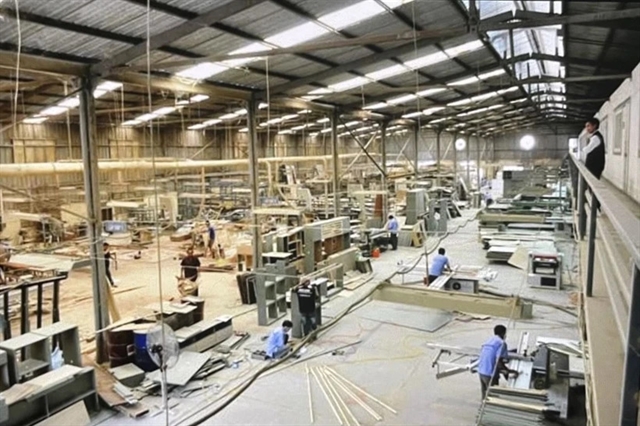
Inside a furniture manufacturing plant in HCM City. — VNA/VNS photo
He also stressed the importance of unity between businesses in the industry to grow together.
"Competition is a driving force for development, but it is crucial to distinguish between healthy and unhealthy competition. Businesses should not 'get in each other's way' but should cooperate to grow together, and build the strength needed to conquer the world markets. Then, all enterprises will benefit."
He said the HAWA executive board has prioritised connectivity between member businesses, enhancement of ties between associations and leveraging the strengths of different regions to achieve shared development.
He referred to the unique regional characteristics of the country’s handicraft and wood industry, saying the north is a raw material supplier with large furniture production areas and distinctive traditional craft villages.
The central region excels in outdoor furniture and serves as a focal point for developing plantation forests, while the south is the heart of wood processing with three major centres, HCM City and Đồng Nai and Bình Dương provinces.
HCM City stands out for creativity, designing, trading, branding, logistics, and finance.
But connecting the three regions to leverage these values remains an unachieved goal, he said.
He stressed the need for establishing connections to enable Việt Nam's handicraft and wood processing industry to create a complete furniture supply chain for the global market.
He also appreciated businesses for making significant efforts to invest in machinery and equipment, fostering creative design and steadily seeking to expand their markets.
Enterprises have also embraced new business models and leveraged e- commerce, enabling direct exports through platforms like Amazon, Wayfair and others, he said.
It is encouraging to see the active support of the Government and relevant authorities, who have joined hands with the wood industry through initiatives such as organising trade promotion programmes domestically and internationally and planning plantation forest resources, he said.
"Thus, the overall picture of the wood industry today can be summarised in one sentence: External conditions are favourable, and internal transformation is underway."
"I firmly believe that with optimism and collaboration and the spirit of unity among all of us, the Vietnamese woodworking and handicraft industry will overcome challenges and achieve remarkable success in 2025." - VNS
Source: VNS
Related News

CHARITY / EXHIBITION / OTHER EVENTS
INVESTMENT OPPORTUNITIES IN CA MAU PROVINCE: 96 PROJECTS AND 20 STRATEGIC PROJECTS
We are pleased to share with you information on investment projects currently seeking investors in Ca Mau Province. Should your esteemed company or association be interested, we kindly invite you to review the project information and complete the registration form via the links provided. The Ho Chi Minh City Investment and Trade Promotion Centre (ITPC) will consolidate the expressions of interest and facilitate connections with the leadership of Ca Mau Province at a meeting tentatively scheduled for 13 November 2026 in Ho Chi Minh City.

MEMBER CORNER / PROMOTIONS
BẰNG KIỀU LIVESHOW - A SYMPHONY OF LOVE UNDER THE GOLDEN GLOW
A masterclass in live music that takes the audience on a soulful journey through immortal love songs, guided by the peerless artistry and emotive storytelling of renowned singer Bằng Kiều. The highlight of the night is his seamless musical chemistry with special guest Triệu Hồng Ngọc, promising passionate and deeply resonant duets inside the magnificent Grand Ballroom.

INFRASTRUCTURE / CONSTRUCTION / LOGISTIC / PORT
ĐÀ NẴNG GREEN-LIGHTS US$105 MILLION THAI DEVELOPMENT DEAL
The central city has approved an investment proposal by Thailand’s WHA Group to develop infrastructure for the 400ha WHA Đà Nẵng Industrial Park project on two communes of Thăng Bình and Đồng Dương, with an investment of more than VNĐ2.7 trillion (US$105 million). The city said it approved WHA Industrial Development International's status as an investor in the project, which is expected to take place between 2027 and 2034.

VIETNAM ECONOMY INVESTMENT
MOBILE PHONE EXPORTS RISE 20% TO $51.8 BILLION IN FIRST NINE MONTHS
Exports of mobile phones and components rose 20 per cent year-on-year to nearly US$51.8 billion in the first nine months of 2026, with China, the US and Republic of Korea accounting for more than half of the total. Shipments to the three markets reached a combined $26.18 billion, or 50.6 per cent of total exports of the product group during the period, according to data from the Vietnam Department of Customs under the Ministry of Finance.

INFRASTRUCTURE / CONSTRUCTION / LOGISTIC / PORT
VIỆT NAM-CAMBODIA TRADE GATHERS PACE TOWARDS $20 BILLION TARGET
Trade between Việt Nam and Cambodia continues to grow, remaining a bright spot and a key pillar of bilateral cooperation as the two countries aim to raise two-way trade to US$20 billion in the coming years. After setting a record of more than $11.3 billion last year, bilateral trade reached about $8.7 billion in the first eight months of this year, up 8.3 per cent year on year.

VIETNAM ECONOMY INVESTMENT
FRUIT AND VEGETABLE EXPORTS POISED TO HIT $10 BILLION IN 2026
Fruit and vegetable exports are on track to reach nearly US$10 billion in 2026, after rising 19.9 per cent year on year to nearly US$7.4 billion in the first nine months, driven by strong seasonal demand and abundant tropical fruit supplies. The Ministry of Agriculture and Environment said the growth reflected stronger international demand for fresh produce and processed agricultural products.
Events Sponsors






















