Want to be in the loop?
subscribe to
our notification
Business News
RETAIL WAVE HEADING TOWARDS VIETNAM’S SATELLITE URBAN AREAS
Second- and third-tier cities are becoming a new promised land for the foreign retail industry, especially major names from Japan, due to dense population, improved income, and low competition.
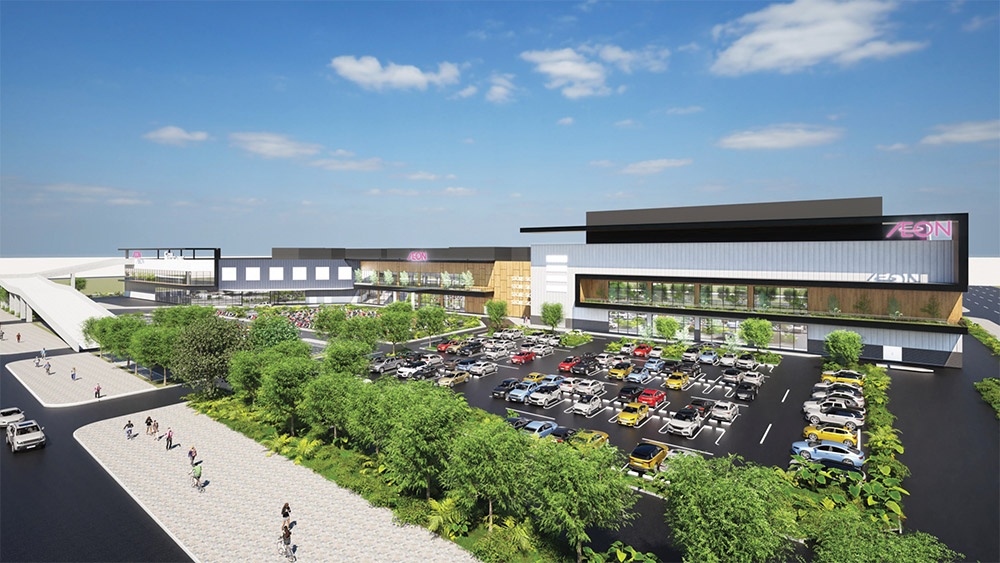
AEON’s leaders acknowledge the importance of the Vietnam market to its overall operations
Two weeks ago, Japanese retailer AEON commenced the construction of AEON Hai Duong Shopping Centre, promising to bring a modern shopping space and enhance the experience for local consumers when it comes into operation in 2026.
AEON Hai Duong is the first community shopping mall developed by the company in the northern region, with investment of approximately $47 million.
Tezuka Daisuke, general director of AEON Vietnam, stated the project is in line with Hai Duong province’s development orientation with the target of an average economic growth of 9.5 per cent per year, raising regional GDP per capita to over $7,200 by 2030 and aiming to become a centrally governed city by 2050.
“We believe that AEON Hai Duong will contribute to encouraging local economic development and create approximately 1,000 new job opportunities, support the consumption of high-quality products of the province and contribute positively to the sustainable development of the region,” he noted.
As the second key market for the AEON Group after Japan, AEON has been continuously expanding its investments, strengthening its position in the market, and developing retail infrastructure in Vietnam. Over the past decade, AEON Vietnam has opened more shopping centres and stores in major cities, targeting new urban areas with increasing demand for modern shopping experiences.
Japanese Ambassador to Viet Nam Ito Naoki said AEON Vietnam has recognised the potential of Hai Duong province due to its convenient transportation location, dense population, numerous industrial zones, and a large workforce, especially workers at Japanese enterprises.
“Vietnam has distinguished itself as one of the countries with great potential for economic development with a growing middle class. As Vietnam is promoting the recovery of the private economic sector, I am pleased that Japanese companies, including AEON, can actively contribute as a form of high-quality foreign investment,” Ambassador Naoki said.
The retail market scale is expected to reach around $190 billion by 2024, with a system consisting of around 1,300 supermarkets, 275 shopping centres, and nearly 7,000 convenience stores, according to data from the Vietnam Retailers Association.
Nguyen Anh Duc, chairman of the Vietnam Retailers Association, said that the market’s attractiveness comes not only from its expanding scale but also from its significant growth potential, especially in rural areas, which account for 65 per cent of the national market but still have low competition levels.
“The retail market is witnessing an increasingly fierce competition, not only in terms of price and convenience but also in geographic coverage, especially in areas that have not been fully explored,” Duc remarked.
In fact, expanding investment into secondary cities has become a focus in the development strategy of many retailers in recent times.
At the end of March, Bruno Jousselin, CEO of MM Mega Market Vietnam, proposed the construction of a hypermarket in the northern province of Vinh Phuc, as part of a strategy to expand its business network in potential secondary cities.
“We highly appreciate the geographical location advantages, transportation infrastructure, and investment attraction policies of Vinh Phuc. MM Mega Market aims to accompany the province in promoting local economic development through sustainable investments in the retail sector,” Jousselin stated.
He also requested the government’s support in finding suitable locations and creating stronger conditions for investment procedures to promptly implement the project. If approved, this will be the third hypermarket from MM Mega Market in the northern region, following Hanoi and Haiphong.
Previously, MM Mega Market started construction of its first shopping mall in the central city of Danang, worth $20 million, in November 2024, expected to be operational by the end of this year.
South Korean retailer Lotte is also following the trend by announcing plans to invest in building a hypermarket in the northern province of Thai Nguyen in March.
Hong Won Sik, general director of Lotte Mart Vietnam, stated that Thai Nguyen is a dynamic economic centre in the north, currently home to rapidly developing industrial zones, especially with the presence of large corporations such as Samsung, which has created high consumer demand and is also a favourable condition for Lotte Mart to implement the hypermarket project.
“Vietnam is currently the third key market for Lotte Group, after Korea and Japan,” Sik said. “We see great growth potential in Vietnam and expect to achieve strong development in the near future.”
Lotte Mart currently operates 16 shopping centres in seven locations. Expanding investment in Thai Nguyen will enhance the corporation’s presence in Vietnam and better meet the increasing consumer demand, Sik added.
Meanwhile, Central Retail from Thailand is also preparing to open a GO! hypermarket in Hung Yen in the north in July. By late 2024, Central Retail operated 42 GO! supermarkets in Vietnam, with three new locations in Bac Lieu, Ha Nam, and Ninh Thuan provinces. Two more supermarkets in Hung Yen and Yen Bai provinces are expected to open in 2025.
Central Retail aims to increase its total investment in Vietnam to $2 billion by 2026, a significant increase from its previous commitment of $1.5 billion, to boost its presence in localities with high consumption potential.
Source: VIR
Related News

CHARITY / EXHIBITION / OTHER EVENTS
INVESTMENT OPPORTUNITIES IN CA MAU PROVINCE: 96 PROJECTS AND 20 STRATEGIC PROJECTS
We are pleased to share with you information on investment projects currently seeking investors in Ca Mau Province. Should your esteemed company or association be interested, we kindly invite you to review the project information and complete the registration form via the links provided. The Ho Chi Minh City Investment and Trade Promotion Centre (ITPC) will consolidate the expressions of interest and facilitate connections with the leadership of Ca Mau Province at a meeting tentatively scheduled for 13 November 2026 in Ho Chi Minh City.

MEMBER CORNER / PROMOTIONS
BẰNG KIỀU LIVESHOW - A SYMPHONY OF LOVE UNDER THE GOLDEN GLOW
A masterclass in live music that takes the audience on a soulful journey through immortal love songs, guided by the peerless artistry and emotive storytelling of renowned singer Bằng Kiều. The highlight of the night is his seamless musical chemistry with special guest Triệu Hồng Ngọc, promising passionate and deeply resonant duets inside the magnificent Grand Ballroom.

INFRASTRUCTURE / CONSTRUCTION / LOGISTIC / PORT
ĐÀ NẴNG GREEN-LIGHTS US$105 MILLION THAI DEVELOPMENT DEAL
The central city has approved an investment proposal by Thailand’s WHA Group to develop infrastructure for the 400ha WHA Đà Nẵng Industrial Park project on two communes of Thăng Bình and Đồng Dương, with an investment of more than VNĐ2.7 trillion (US$105 million). The city said it approved WHA Industrial Development International's status as an investor in the project, which is expected to take place between 2027 and 2034.

VIETNAM ECONOMY INVESTMENT
MOBILE PHONE EXPORTS RISE 20% TO $51.8 BILLION IN FIRST NINE MONTHS
Exports of mobile phones and components rose 20 per cent year-on-year to nearly US$51.8 billion in the first nine months of 2026, with China, the US and Republic of Korea accounting for more than half of the total. Shipments to the three markets reached a combined $26.18 billion, or 50.6 per cent of total exports of the product group during the period, according to data from the Vietnam Department of Customs under the Ministry of Finance.

INFRASTRUCTURE / CONSTRUCTION / LOGISTIC / PORT
VIỆT NAM-CAMBODIA TRADE GATHERS PACE TOWARDS $20 BILLION TARGET
Trade between Việt Nam and Cambodia continues to grow, remaining a bright spot and a key pillar of bilateral cooperation as the two countries aim to raise two-way trade to US$20 billion in the coming years. After setting a record of more than $11.3 billion last year, bilateral trade reached about $8.7 billion in the first eight months of this year, up 8.3 per cent year on year.

VIETNAM ECONOMY INVESTMENT
FRUIT AND VEGETABLE EXPORTS POISED TO HIT $10 BILLION IN 2026
Fruit and vegetable exports are on track to reach nearly US$10 billion in 2026, after rising 19.9 per cent year on year to nearly US$7.4 billion in the first nine months, driven by strong seasonal demand and abundant tropical fruit supplies. The Ministry of Agriculture and Environment said the growth reflected stronger international demand for fresh produce and processed agricultural products.
Events Sponsors






















