Want to be in the loop?
subscribe to
our notification
Business News
RICE EXPORTS EXPECTED TO GAIN MOMENTUM IN YEAR-END MONTHS
The total rice export value is forecast at around US$3.94 billion for this year, down about 4 per cent from last year due to low average export prices in the first months of the year.
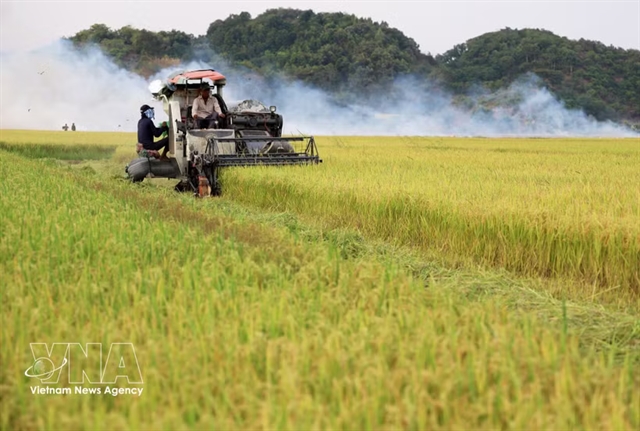
As of August 15, Việt Nam exported an estimated 5.7 million tonnes of rice. The full-year volume is projected at about 7.7 million tonnes. — VNA/VNS Photo
HÀ NỘI — Việt Nam’s rice exports are expected to improve in value during the final months of this year as export prices show signs of recovery while stronger demand in several major markets could support shipments.
The Vietnam Food Association reported that as of August 15, Việt Nam exported an estimated 5.7 million tonnes of rice. The full-year volume is projected at about 7.7 million tonnes.
The total rice export value is forecast at around US$3.9 billion for this year, down about 4 per cent from last year due to low average export prices in the first months of the year. However, the recovery in prices since July is expected to help improve export turnover in the remaining months.
According to the Ministry of Agriculture and Environment, several developments in the global rice market could support Việt Nam’s exports toward the end of the year.
Export prices in July were 5.8 per cent higher than in the same month last year, marking the first year-on-year increase this year and the highest level since June last year. If prices remain at this level, export revenue could improve in the coming months.
Global rice supply and demand in the 2026-27 crop year are forecast to move into a deficit while global rice trade is expected to reach a record level. The possibility of a strong El Nino could also encourage countries to increase food reserves.
The Philippines, Việt Nam’s largest rice export market, has confirmed that it will not suspend rice imports this year and will continue purchases to build up reserves. It is expected to import around 5.6 million tonnes of rice in the 2026-27 crop year, the world’s largest volume. In the first seven months of this year, its rice imports rose about 27 per cent year on year.
China has also recorded a sharp increase in rice import volume, particularly broken rice used as animal feed, creating greater opportunities for Việt Nam’s raw rice, broken rice and glutinous rice.
Nigeria is forecast to face a rice shortfall of around 3.5 million tonnes in the 2026-27 crop year, promising chances for Vietnamese exporters if they can improve price competitiveness. Kenya has also waived import duties on white rice under a quota through November this year.
Domestically, tighter rice supplies are reducing pressure on farmers and traders to sell at low prices, giving exporters more room to negotiate. Notably, high-quality, low-emission certified rice has fetched more than $1,000 per tonne in some markets, including Japan, the EU and Australia, highlighting the potential to increase the value of Vietnamese rice.
Market and input cost risks
Despite these favourable factors, the rice export sector still faces several challenges.
The Philippines is considering additional safeguard duties on the grain from Việt Nam, as well as Thailand, Myanmar and Pakistan. If approved, the combined tariff could exceed 35 per cent. This is a significant risk because the Philippines currently accounts for the largest share of Việt Nam’s rice export value.
Indonesia has no plans to import rice this year as its domestic production and reserves remain high, making this market almost shut down to Vietnamese rice for the time being.
Some African markets, including Côte d’Ivoire and Ghana, have sharply reduced imports of Vietnamese rice because it is more expensive than that from India and Pakistan in the mainstream segment. Meanwhile, Thailand is strengthening its presence in China through government-to-government contracts, and Cambodia is increasing shipments of fragrant rice, creating stronger direct competition for Vietnamese grain.
Input costs, including fertiliser, transportation and energy, remain high amid geopolitical tensions and export restrictions imposed by some countries, affecting farmers’ production efficiency.
In addition, El Nino is predicted to affect the 2026-27 winter-spring crop. Drought and saltwater intrusion could occur from late December 2026 to April 2027, requiring the sector to prepare response measures early, including adjustments to planting schedules and crop varieties. — VNA/VNS
Source: VNS
Related News

MEMBER CORNER / PROMOTIONS
KNIC ENGAGES WITH GOVERNMENT AND HIGH-TECH BUSINESS COMMUNITIES IN CHINA
From Beijing to Shandong, KN Holdings and KN Industrial City are continuing to expand their engagement with government authorities, trade promotion organizations, and high-tech business communities in China. In Beijing, the delegation met with the Center for International Economic and Technological Cooperation under the Ministry of Industry and Information Technology (MIIT), exchanging perspectives on industrial and technology cooperation between the two markets.
VIETNAM ECONOMY INVESTMENT
VIETNAM’S TRADE TOPS $825 BILLION BY MID-SEPTEMBER
Figures released on September 21 showed goods trade reached nearly $55 billion in the first 15 days of September alone, bringing cumulative turnover since the beginning of the year to more than $825 billion. The strong growth reflects robust trade flows, with demand for consumer goods and production inputs remaining high.

TECHNOLOGY
VIỆT NAM'S BUSINESSES MOVE TOWARDS AI AGENTS
Việt Nam’s AI landscape is entering a new phase as businesses move beyond generative AI (GenAI) tools designed to assist human users towards autonomous AI, agentic AI and AI agents that can take action with limited supervision, experts have said. The shift comes as Việt Nam seeks to accelerate science and technology, innovation and digital transformation under Politburo Resolution 57-NQ/TW, issued on December 22, 2024.

GARMENT / TEXTILE
VIỆT NAM TARGETS $48 BILLION IN TEXTILE-GARMENT EXPORTS
Việt Nam’s textile and garment industry is facing both opportunities and challenges amid complex and unpredictable developments in the global market, prompting businesses to improve growth quality, optimise production costs and enhance adaptability in pursuit of an export turnover of about $48 billion this year. The target is considered an important milestone that requires concerted efforts from management agencies and the business community.
INFRASTRUCTURE / CONSTRUCTION / LOGISTIC / PORT
CUTTING LOGISTICS COSTS KEY TO BOOSTING EXPORTS
Reducing costs has become an increasingly urgent priority for import-export activities, particularly logistics costs, a conference in Hà Nội was told on Tuesday. According to Deputy General Director of the Ministry of Industry and Trade's Agency for Foreign Trade, Trần Thanh Hải, import-export activities has remained a bright spot for the economy in recent years, playing an important role and helping drive macroeconomic growth.

LEGAL UPDATE / POLICY
FLEXIBLE FISCAL POLICY HELPS DRIVE ECONOMIC GROWTH
Việt Nam’s fiscal policy has been implemented in a targeted expansionary manner since early 2026, helping maintain macroeconomic stability and supporting the country’s goal of achieving double-digit economic growth. According to the Ministry of Finance, State budget revenue in the first eight months of 2026 was estimated at VNĐ2.02 quadrillion (US$77.7 billion), equivalent to 80 per cent of the annual estimate and up 16 per cent year-on-year.
Events Sponsors






















