Want to be in the loop?
subscribe to
our notification
Business News
STRICTER DISBURSEMENT GOAL TARGETS CAPITAL ACCELERATION
The government has altered its target of public investment disbursement for this year, with a continued focus on infrastructure development to spur high economic growth.
The government last week ordered that all public investment capital for this year must be disbursed, instead of 95 per cent previously targeted, and that one of the key tasks in the coming months is to speed up this kind of capital at all costs, with a focus continued being laid on infrastructure development.
Public investment must be a major driver and attracter of all resources from society, including the private sector, said the prime minister’s public telegram on key solutions and tasks for reaching desired growth in 2025 of 8 per cent or more.
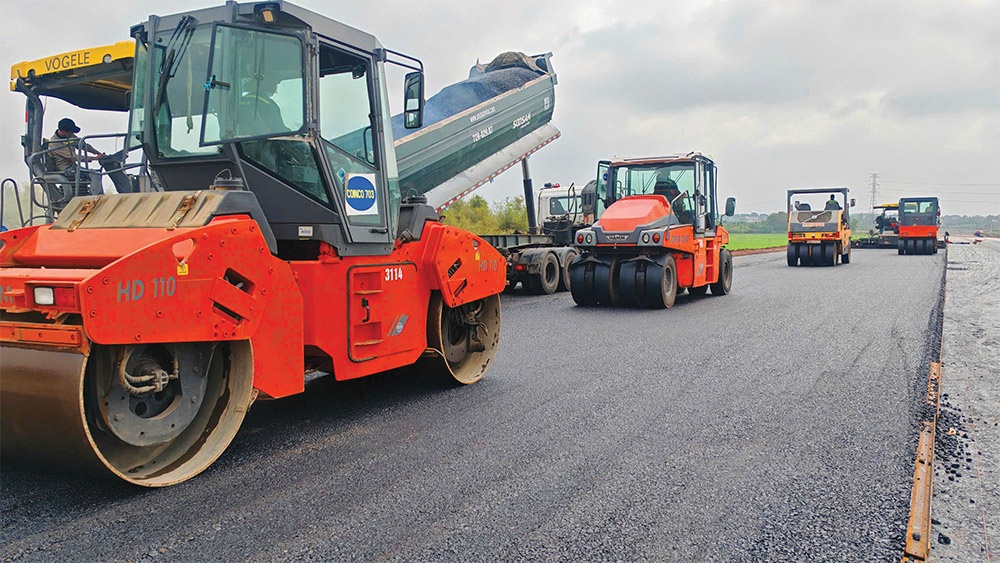
Faster government spending is set to give the economy a boost, photo Le Toan
In the first quarter of 2025, total public investment disbursement hit about $4.67 billion, up 19.8 per cent on-year.
Dorsati Madani, who is a senior economist from the World Bank in Vietnam, told VIR that while the economy is expected to register robust growth in 2025, authorities could consider expanding public investment and supporting domestic demand.
“Existing fiscal space allows for much-needed infrastructure investment in backbone services such as transport, logistics, energy, and ITC, and improved public investment management would support economic growth in the medium term,” Madani said. “Strategic public investment in backbone services will crowd-in private investment and support private sector development, especially when accompanied by reforms to improve the business environment, including for small- and medium-sized enterprises.”
Many international organisations have issued positive forecasts for Vietnam’s economic growth in 2025. They said amid global uncertainties and headwinds, one of the best solutions to spur on economic growth this year is to centre on accelerating public investment – which is also a must to attract private investments and develop the domestic material market involving production of cement, steel, sand, and others.
The International Monetary Fund (IMF) stated that Vietnam should boost public investment to fuel economic growth, especially to improve infrastructure development.
“Boosting public infrastructure can also help increase productivity and medium-term economic growth, but will require ensuring high quality of public investment and sound fiscal planning,” said Paulo Medas, division chief for Vietnam at the IMF. “There are still large infrastructure gaps in Vietnam, reflected by the high logistics costs compared to its regional peers. Improving transport, digital, and IT infrastructure could help lower transportation costs, facilitate efficient movement of labour, goods and information, and reduce production constraints for the private sector.”
Total public investment capital assigned by the PM for this year is about $36 billion.
In March, Prime Minister Pham Minh Chinh established working groups to inspect and promote annual disbursement of public investment capital at authorities at all levels.
For example, one such group is responsible for examining disbursement of nine ministries and nine localities in particular - including Hue, Danang, Quang Nam, Quang Ngai, Binh Dinh, Phu Yen, Khanh Hoa, Ninh Thuan, and Binh Thuan. Results showed that by the end of March, five out of nine ministries and agencies, and four out of nine localities had allocated all assigned capital.
Meanwhile, four out of nine ministries and central agencies, and five out of nine localities had failed to allocate all assigned capital, with the total remaining unallocated capital being $63.9 billion (including $37.3 billion from the central budget and $26.6 billion from the local coffers), accounting for 1.86 per cent of the total plan assigned by the prime minister to ministries, central agencies, and localities.
A governmental resolution stated that ministers, agency heads, and provincial leaders are requested to clearly identify difficulties and causes of slow disbursement of each specific project.
“This is aimed to physically direct and promptly resolve the impediments within their authority, report to authorised agencies if they exceed their authority,” stated the resolution. “They have to take full responsibility before the government and the prime minister for the results of allocation and disbursement of public investment capital in 2025.”
The government last week requested that all efforts be made to complete the goal of having at least 3,000km of expressways and over 1,000km of coastal roads by the end of 2025.
Moreover, construction must be completed for the $16 billion Long Thanh International Airport in the southern province of Dong Nai, and for ports in the Lach Huyen area in the northern city of Haiphong.
Also, Terminal 3 at Tan Son Nhat Airport and Terminal 2 of Noi Bai Airport must be put into operation, while construction of Lien Chieu port in the central city of Danang must be started, and investment procedures for constructing Can Gio international seaport in Ho Chi Minh City must be completed.
It is estimated that calculated that an increase of 1 per cent in public investment disbursement corresponds to a 0.058 per cent increase in GDP growth. Moreover, every $1 of disbursed public investment capital stimulates $1.61 of investment capital from the non-state sector.
According to a recent study by the Asian Development Bank (ADB), weak coordination between public investment and budget processes has resulted in slow and insufficient budget allocation.
In recent years, it has been reported that central agencies received higher allocations than what they can initiate, while provinces received too little to meet their needs.
“The pressing challenge of the mismatch between allocated budgets and investment mandates often leads to inefficiencies and delays in project implementation - funds may not be optimally directed toward identified priority areas, resulting in suboptimal resource utilisation,” the ADB said. “This limits project progress and capital utilisation efficiency.”
Source: VIR
Related News

CHARITY / EXHIBITION / OTHER EVENTS
INVESTMENT OPPORTUNITIES IN CA MAU PROVINCE: 96 PROJECTS AND 20 STRATEGIC PROJECTS
We are pleased to share with you information on investment projects currently seeking investors in Ca Mau Province. Should your esteemed company or association be interested, we kindly invite you to review the project information and complete the registration form via the links provided. The Ho Chi Minh City Investment and Trade Promotion Centre (ITPC) will consolidate the expressions of interest and facilitate connections with the leadership of Ca Mau Province at a meeting tentatively scheduled for 13 November 2026 in Ho Chi Minh City.

MEMBER CORNER / PROMOTIONS
BẰNG KIỀU LIVESHOW - A SYMPHONY OF LOVE UNDER THE GOLDEN GLOW
A masterclass in live music that takes the audience on a soulful journey through immortal love songs, guided by the peerless artistry and emotive storytelling of renowned singer Bằng Kiều. The highlight of the night is his seamless musical chemistry with special guest Triệu Hồng Ngọc, promising passionate and deeply resonant duets inside the magnificent Grand Ballroom.

INFRASTRUCTURE / CONSTRUCTION / LOGISTIC / PORT
ĐÀ NẴNG GREEN-LIGHTS US$105 MILLION THAI DEVELOPMENT DEAL
The central city has approved an investment proposal by Thailand’s WHA Group to develop infrastructure for the 400ha WHA Đà Nẵng Industrial Park project on two communes of Thăng Bình and Đồng Dương, with an investment of more than VNĐ2.7 trillion (US$105 million). The city said it approved WHA Industrial Development International's status as an investor in the project, which is expected to take place between 2027 and 2034.

VIETNAM ECONOMY INVESTMENT
MOBILE PHONE EXPORTS RISE 20% TO $51.8 BILLION IN FIRST NINE MONTHS
Exports of mobile phones and components rose 20 per cent year-on-year to nearly US$51.8 billion in the first nine months of 2026, with China, the US and Republic of Korea accounting for more than half of the total. Shipments to the three markets reached a combined $26.18 billion, or 50.6 per cent of total exports of the product group during the period, according to data from the Vietnam Department of Customs under the Ministry of Finance.

INFRASTRUCTURE / CONSTRUCTION / LOGISTIC / PORT
VIỆT NAM-CAMBODIA TRADE GATHERS PACE TOWARDS $20 BILLION TARGET
Trade between Việt Nam and Cambodia continues to grow, remaining a bright spot and a key pillar of bilateral cooperation as the two countries aim to raise two-way trade to US$20 billion in the coming years. After setting a record of more than $11.3 billion last year, bilateral trade reached about $8.7 billion in the first eight months of this year, up 8.3 per cent year on year.

VIETNAM ECONOMY INVESTMENT
FRUIT AND VEGETABLE EXPORTS POISED TO HIT $10 BILLION IN 2026
Fruit and vegetable exports are on track to reach nearly US$10 billion in 2026, after rising 19.9 per cent year on year to nearly US$7.4 billion in the first nine months, driven by strong seasonal demand and abundant tropical fruit supplies. The Ministry of Agriculture and Environment said the growth reflected stronger international demand for fresh produce and processed agricultural products.
Events Sponsors






















