Want to be in the loop?
subscribe to
our notification
Business News
SUPPORTING HI-TECH FIRMS FOR QUANTUM LEAP
Mr. Nguyen Khac Lich, Director of the Authority of Information Technology Industry under the Ministry of Science and Technology, stated that Vietnam is the first country to enact the Law on Digital Technology Industry. This marks a historic milestone in completing the legal framework to position Vietnam as a global digital technology hub. The law was passed by the 15th National Assembly on June 14, 2025 and scheduled to take effect on January 1, 2026 (with some provisions effective from July 1, 2025).
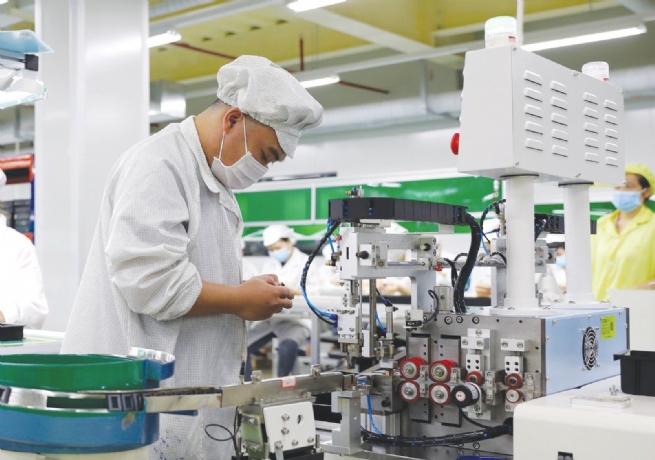
The new law offers exceptional incentives for key digital projects, opening new opportunities for high-tech supporting industry
Outstanding financial support policies
At a press conference held at the end of June by the Ministry of Science and Technology, he emphasized that to make the digital technology industry a key economic driver growing 2-3 times faster than GDP, the law introduces exceptional incentives for key projects in digital technology, semiconductors, AI and data centers. This is a breakthrough step in science and technology policy, creating new opportunities for high-tech supporting industries. For example, projects investing VND6 trillion or more will enjoy a 5% corporate income tax rate for 37 years, tax exemption for six years, a 50% tax reduction for the next 13 years, land rent exemption for up to 22 years, and a 75% reduction for the remaining years.
Businesses will receive financial support from the state budget and development investment funds and may deduct up to 200% of actual R&D (research and development) expenses when calculating corporate income tax.
Digital technology zones and innovative startup projects will be eligible for incentives equivalent to those offered in especially disadvantaged areas in a bid to provide strong motivation for digital technology firms.
Notably, this law also establishes Vietnam’s first legal framework for artificial intelligence (AI). AI is becoming a key driver of socioeconomic development in Vietnam, especially amid national digital transformation. AI helps automate processes in manufacturing, healthcare, education and public services, improve productivity and reduce costs.
However, the rapid development of AI also presents challenges related to ethics, cybersecurity and privacy, requiring a clear and effective legal framework. The Law on Digital Technology Industry is the first legal framework in Vietnam that specifically regulates AI, marking a significant step in institutionalizing the Party's policies, especially Resolution 57-NQ/TW on breakthroughs in science and technology development, innovation, and national digital transformation.
The law clearly defines principles for AI development, risk control throughout the AI system lifecycle, and requirements for the supervision and inspection of high-risk, high-impact AI systems. These are part of the principles governing the development, provision, deployment and use of AI.
Developing Vietnam’s semiconductor industry ecosystem
For the first time, the semiconductor industry has been legally recognized and positioned in Vietnam's legal system. This provides a foundation to promote the development of the semiconductor industry - a critical sector that significantly influences many other industries in today's digital era. The law stipulates principles for developing Vietnam’s semiconductor industry, focusing on breakthrough chip development across sectors, tight integration with the global semiconductor ecosystem, and alignment with the electronics industry. It encourages foreign investment and mobilization of domestic and international resources to drive the semiconductor industry forward, aiming for mastery of chip technology, design and production.
The law introduces special mechanisms and policies for comprehensive semiconductor industry development, covering the full supply chain, from inputs - supporting manufacturing to outputs - electronics enterprises. This new policy approach is designed to foster a Vietnamese semiconductor ecosystem integrated with the global semiconductor landscape, positioning Vietnam as a key player in the global semiconductor supply chain.
According to international reports, over one-fifth of Vietnam’s population owns cryptocurrency, ranking second globally (Triple-A 2024) and third in global crypto adoption (The 2023 Global Crypto Adoption Index, Chainalysis). However, there is still no legal framework for cryptocurrencies, which are a form of digital asset. The Law on Digital Technology Industry serves as a vital foundation to establish such a legal framework, ensure ownership rights, transactions and security for digital assets, a pressing need in Vietnam’s current development context. Furthermore, the law encourages technological innovation and supports the development of blockchain platforms, while protecting users against risks such as scams or asset loss due to a lack of regulation. By doing so, the law contributes to building a transparent, sustainable digital ecosystem and promoting the growth of the digital economy.
Source: VCCI
Related News
MEMBER CORNER / PROMOTIONS
A CULINARY MASTERPIECE
Don't need a special occasion to treat yourself to a perfect Chinese dining experience. This October, Ngan Dinh Restaurant introduces an exquisite three-dish menu, promising to satisfy diners who appreciate culinary innovation and refined flavors. Enjoy 20% OFF a glass of house red/white wine, or Imported German Veltins Draught Beer/Maisel's Weisse Dunkel when ordering any of the above dishes!

MEMBER CORNER / PROMOTIONS
ONE YEAR OF PRIME MOMENTS — LET’S CELEBRATE!
Olivia’s Prime Saigon is turning one, and we’d love to celebrate this special milestone with you! Order any featured steak size and enjoy all its designated complimentary pasta, side dishes and sauces — with a combined value of up to 80% of your steak price! Thank you for being part of our journey. Here’s to great steaks, wonderful company, and many more prime moments together!
MEMBER CORNER / PROMOTIONS
SENTRYSAFE - PROTECT WHAT MATTERS MOST
From cash, important documents and records to valuable belongings, a quality safe gives you greater peace of mind against unexpected risks. SentrySafe - a trusted safe brand from the USA, suitable for homes, offices and various storage needs. Contact Sen Wai Vietnam for expert advice and to find the right safe for your needs.

MEMBER CORNER / PROMOTIONS
50% DISCOUNT FOR HKBAV MEMBER: EUGENE ONEGIN - EIFMAN BALLET OF ST. PETERSBURG WORLD TOUR 2026
Adapted from the classic novel in verse by acclaimed Russian poet Alexander Pushkin, Eugene Onegin explores timeless themes of love, pride, choices, and irreversible regret. Eifman's distinctive language of psychological ballet is brought to life through Tchaikovsky's music alongside contemporary rock by Alexander Sitkovetsky, creating an extraordinary artistic experience.
MEMBER CORNER / PROMOTIONS
COSMOPARK – ENERGY ADVANTAGES FOR POWER-INTENSIVE INDUSTRIES
As global corporations place increasing emphasis on energy security, renewable energy adoption, and carbon emissions reduction, electricity is no longer viewed merely as a component of technical infrastructure. For high-tech projects, data centers, and large-scale manufacturing facilities, reliable energy infrastructure has become a critical factor in investment location decisions.

VIETNAM ECONOMY INVESTMENT
FOREIGN INVESTORS TO BE WIDENED FOR MARKET ACCESS
Vietnam is moving to widen market access, improve investment incentives, and streamline procedures, with greater support tied to investors’ actual commitments and results, as part of the law on amending and supplementing a number of articles of the Law on Investment. The proposal was mentioned at the sixth session of the National Assembly Standing Committee in Hanoi on September 30, on amending the Law on Investment.
Events Sponsors






















