Want to be in the loop?
subscribe to
our notification
Business News
TARGETING GDP PER CAPITA OF US$8,500 BY 2030
The first Congress of the Party Committee of the Ministry of Finance set the target that the average gross domestic product (GDP) growth rate for the 2026-2030 period will reach 10% per year or higher, and GDP per capita will reach US$8,500 by 2030.
Many important achievements
The first Congress of the Party Committee of the Ministry of Finance for the 2025-2030 term recently opened in Hanoi. In his opening speech, Secretary of the Party Committee and Minister of Finance Nguyen Van Thang said that the first Congress of the Party Committee of the Ministry of Finance took place in a special context and held extremely important significance.
Looking back at the past term, despite many challenges, the Party Committee of the Ministry of Finance promoted a spirit of solidarity to obtain many achievements. Fiscal policies were proactively and flexibly implemented, contributing to macroeconomic stability, promoting economic recovery, and ensuring social security and sustainable development.
Total state budget revenue for the 2021-2025 period is estimated at VND9.4 million billion, far exceeding the set target. The Party Committee proactively proposed exemptions, reductions, and deferrals of taxes, fees, and land rents totaling about VND1.1 million billion, creating conditions for production and business recovery and earning high appreciation from the business community and the public.
Total state budget expenditure for the 2021-2025 period is estimated at VND10.4 million billion, meeting the planned target. Development investment expenditure reached VND3.4 million billion, exceeding the plan, of which VND176.4 trillion was allocated to implementing the socio-economic recovery program. The average state budget deficit for the period is about 3.4% of GDP, meeting the planned target and remaining below the ceiling of 3.7% of GDP. Public debt has been tightly controlled, decreasing from 62.7% of GDP at the end of 2021 to about 36-37% of GDP at the end of 2025, all remaining within safe limits.
Notable targets by 2030
In the next five-year period, the Ministry of Finance has established key targets for implementing political tasks. Specifically, regarding economic development, the average gross domestic product (GDP) growth rate for the 2026-2030 period is expected to reach 10% per year or higher, and GDP per capita is projected to reach US$8,500 by 2030.
The contribution of total factor productivity (TFP) to growth is expected to be about 55%. The average growth rate of social labor productivity will reach approximately 8.5% per year. Total asset accumulation will account for about 35-36% of GDP, while the proportion of final consumption will be around 62-63% of GDP.
Regarding macroeconomic stability and inflation, the average state budget deficit for the 2026-2030 period is expected to be about 5% of GDP. The average public debt-to-GDP ratio will exceed 45%, and average inflation during this period is projected at about 4.0-4.5% per year.
In terms of mobilization and allocation of financial resources, the average total social investment capital over five years is expected to be about 40% of GDP, with the public investment ratio accounting for 20-22% of total social investment capital. By 2030, the capitalization of the stock market is projected to reach 120% of GDP.
Outstanding debt in the bond market is expected to reach at least 58% of GDP, of which outstanding corporate bonds will account for at least 25% of GDP. The derivatives market is projected to grow at an average rate of about 25-30% per year during the 2026-2030 period.
The goal is to have 2 million enterprises by 2030, equivalent to 20 enterprises per thousand people. At least 20 large enterprises are expected to participate in the global value chain. The average growth rate of the private economy is projected at about 10-12% per year, by 2030 there will be at least 50 enterprises in the Top 500 Southeast Asian enterprises and at least one enterprise in the Top 500 global enterprises.
Six strategic breakthroughs
The Ministry of Finance set six strategic breakthroughs for the coming period as follows: creating strong breakthroughs in institutions, financial policies, decentralization of authority, unblocking resources to generate momentum for development; improving the efficiency of mobilizing and allocating financial resources and enhancing the effectiveness of public investment; developing the private economy as the most important driving force for national economic growth; promoting breakthroughs in science and technology, innovation, and digital transformation; strengthening the effectiveness of strategy formulation, planning, and statistical systems to support rapid and sustainable development; and focusing on developing high-quality human resources.
Source: VCCI
Related News

MEMBER CORNER / PROMOTIONS
BẰNG KIỀU LIVESHOW - A SYMPHONY OF LOVE UNDER THE GOLDEN GLOW
A masterclass in live music that takes the audience on a soulful journey through immortal love songs, guided by the peerless artistry and emotive storytelling of renowned singer Bằng Kiều. The highlight of the night is his seamless musical chemistry with special guest Triệu Hồng Ngọc, promising passionate and deeply resonant duets inside the magnificent Grand Ballroom.

INFRASTRUCTURE / CONSTRUCTION / LOGISTIC / PORT
ĐÀ NẴNG GREEN-LIGHTS US$105 MILLION THAI DEVELOPMENT DEAL
The central city has approved an investment proposal by Thailand’s WHA Group to develop infrastructure for the 400ha WHA Đà Nẵng Industrial Park project on two communes of Thăng Bình and Đồng Dương, with an investment of more than VNĐ2.7 trillion (US$105 million). The city said it approved WHA Industrial Development International's status as an investor in the project, which is expected to take place between 2027 and 2034.

VIETNAM ECONOMY INVESTMENT
MOBILE PHONE EXPORTS RISE 20% TO $51.8 BILLION IN FIRST NINE MONTHS
Exports of mobile phones and components rose 20 per cent year-on-year to nearly US$51.8 billion in the first nine months of 2026, with China, the US and Republic of Korea accounting for more than half of the total. Shipments to the three markets reached a combined $26.18 billion, or 50.6 per cent of total exports of the product group during the period, according to data from the Vietnam Department of Customs under the Ministry of Finance.

INFRASTRUCTURE / CONSTRUCTION / LOGISTIC / PORT
VIỆT NAM-CAMBODIA TRADE GATHERS PACE TOWARDS $20 BILLION TARGET
Trade between Việt Nam and Cambodia continues to grow, remaining a bright spot and a key pillar of bilateral cooperation as the two countries aim to raise two-way trade to US$20 billion in the coming years. After setting a record of more than $11.3 billion last year, bilateral trade reached about $8.7 billion in the first eight months of this year, up 8.3 per cent year on year.

VIETNAM ECONOMY INVESTMENT
FRUIT AND VEGETABLE EXPORTS POISED TO HIT $10 BILLION IN 2026
Fruit and vegetable exports are on track to reach nearly US$10 billion in 2026, after rising 19.9 per cent year on year to nearly US$7.4 billion in the first nine months, driven by strong seasonal demand and abundant tropical fruit supplies. The Ministry of Agriculture and Environment said the growth reflected stronger international demand for fresh produce and processed agricultural products.
GARMENT / TEXTILE
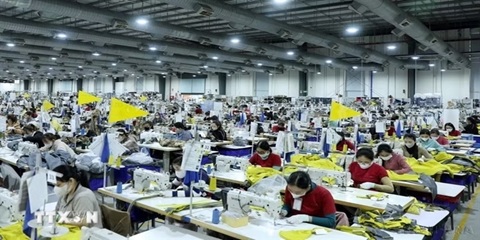
TEXTILE EXPORTS FACE DUAL CHALLENGES OF SUSTAINING ORDERS AND BOOSTING EFFICIENCY AMID GROWING COMPETITION
Data shows that the textile and garment sector maintained its growth momentum in the first nine months of this year. The industry's total export turnover reached an estimated US$35.721 billion in the first nine months of this year, up 3.3 per cent year-on-year. Despite posting encouraging export figures, Vietnamese textile and garment enterprises continue to navigate unpredictable market variables.
Events Sponsors






















