Want to be in the loop?
subscribe to
our notification
Business News
TEXTILE, GARMENT EXPORTS ESTIMATED TO HIT $46 BILLION IN 2025
The industry’s trade surplus is estimated at $21 billion, reaffirming the sector’s position as a key pillar of Việt Nam’s trade balance.
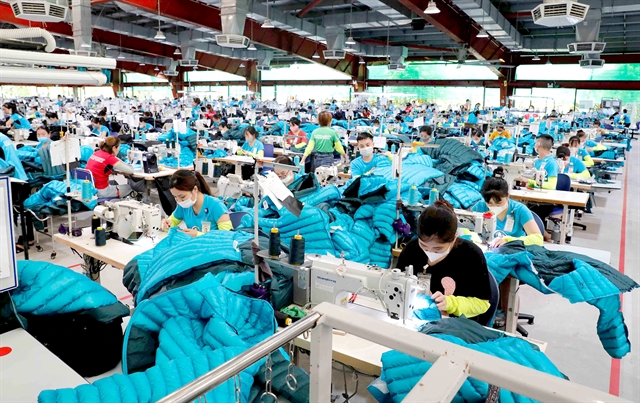
Producing export products at Maxport Thái Bình Garment Co. Việt Nam maintained its ranking among the Top 3 textile and garment exporters globally. –VNA/VNS Photo
HÀ NỘI — Việt Nam’s textile and garment industry is expected to achieve export revenues of US$46 billion in 2025, marking a 5.6 per cent increase compared to 2024.
The Việt Nam Textile and Apparel Association (VITAS) announced these positive performances at a press conference held in Hà Nội on November 25 to introduce a meeting of the association’s seventh term during 2025-2030, and the industry review conference to be held in December.
According to VITAS chairman Vũ Đức Giang, this year promises to be a milestone for the sector as it continues its strong recovery after several years of global disruptions.
The industry’s trade surplus is estimated at $21 billion, reaffirming the sector’s position as a key pillar of Việt Nam’s trade balance.
He noted that the domestic localisation rate had risen to about 52 per cent, highlighting significant progress in localising raw material supplies.
Giang emphasised VITAS’s ongoing trade promotion efforts, including 10 national programmes and 20 initiatives that have helped Vietnamese businesses participate in major international exhibitions in the US, France, Germany, Australia, Russia and Canada. These efforts have played a decisive role in maintaining and expanding market share across key global markets.
Between 2020 and 2025, the textile and garment sector faced unprecedented challenges - from the COVID-19 pandemic to rising geopolitical tensions, stricter environmental regulations, and growing protectionist measures such as US reciprocal tariffs.
Despite these pressures, Việt Nam maintained its ranking among the Top 3 textile and garment exporters globally.
Giang attributed this resilience to the dynamism of enterprises and VITAS’s role in connecting and supporting industry stakeholders.
In the past five years, VITAS has grown by 293 new members, significantly strengthening links between domestic firms and foreign-invested enterprises to optimise supply chain efficiency.
VITAS has actively partnered with major international organisations - including ILO, IFC, GIZ, IDH, WWF and KITECH - as well as global textile associations such as CNTAC, KOFOTI, ITMF, AAFA and CCI.
These collaborations have supported nearly 300 seminars and specialised training programmes on technical innovation, design, sustainability, and greenhouse-gas reduction.
A core strength of VITAS lies in its policymaking support. The association has consistently advised the National Assembly, the Government, and relevant ministries on streamlining administrative procedures, revising laws on social insurance and trade union funds, and improving tax and credit policies.
These efforts aim to enhance the overall business environment and create momentum for industry recovery and growth.
VITAS has also collaborated with other national associations to propose amendments to laws and regulations affecting production, business operations, and import–export activities across Việt Nam’s economic sectors.
Strategic vision
Entering its seventh term from 2025 to 2030, VITAS has set ambitious objectives aligned with sustainable development and the circular economy.
Key targets include export turnover of $64.5 billion by 2030, with an average annual growth rate of 6.5–7 per cent; domestic market revenue of $8-9 billion.
They will also focus on greening - digitalising the industry, increasing the localisation rate to over 60 per cent; and building a strong, internationally recognised Vietnamese fashion brand.
The association's seventh congress and the 2025 VITAS review conference will take place on December 16–17, 2025, in Hà Nội.
The event is expected to welcome around 500 participants, including government leaders, international experts, policy advisors, business executives and global brands.
Attendees will discuss strategic directions for Việt Nam’s textile and garment sector amid global volatility and explore adaptive solutions to ensure sustainable development and transition toward a circular economy. — VNS
Source: VNS
Related News

INFRASTRUCTURE / CONSTRUCTION / LOGISTIC / PORT
VIỆT NAM-CAMBODIA TRADE GATHERS PACE TOWARDS $20 BILLION TARGET
Trade between Việt Nam and Cambodia continues to grow, remaining a bright spot and a key pillar of bilateral cooperation as the two countries aim to raise two-way trade to US$20 billion in the coming years. After setting a record of more than $11.3 billion last year, bilateral trade reached about $8.7 billion in the first eight months of this year, up 8.3 per cent year on year.
TECHNOLOGY
AI BEGINNING TO RESHAPE RECRUITMENT CRITERIA
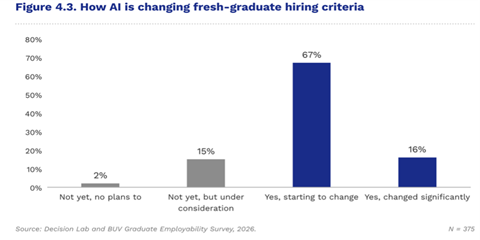
Digital literacy is the only capability area in which fresh graduates meet employers’ expectations, according to a new report. Yet, it is also the standard rising fastest, as businesses increasingly expect new hires to use AI effectively in the workplace. Some 83 per cent of employers say AI has changed, or is beginning to change, their hiring criteria, while 94 per cent report higher expectations for digital and AI capabilities than they had two to three years ago.

INFRASTRUCTURE / CONSTRUCTION / LOGISTIC / PORT
ĐÀ NẴNG GREEN-LIGHTS US$105 MILLION THAI DEVELOPMENT DEAL
The central city has approved an investment proposal by Thailand’s WHA Group to develop infrastructure for the 400ha WHA Đà Nẵng Industrial Park project on two communes of Thăng Bình and Đồng Dương, with an investment of more than VNĐ2.7 trillion (US$105 million). The city said it approved WHA Industrial Development International's status as an investor in the project, which is expected to take place between 2027 and 2034.

VIETNAM ECONOMY INVESTMENT
MOBILE PHONE EXPORTS RISE 20% TO $51.8 BILLION IN FIRST NINE MONTHS
Exports of mobile phones and components rose 20 per cent year-on-year to nearly US$51.8 billion in the first nine months of 2026, with China, the US and Republic of Korea accounting for more than half of the total. Shipments to the three markets reached a combined $26.18 billion, or 50.6 per cent of total exports of the product group during the period, according to data from the Vietnam Department of Customs under the Ministry of Finance.

VIETNAM ECONOMY INVESTMENT
FRUIT AND VEGETABLE EXPORTS POISED TO HIT $10 BILLION IN 2026
Fruit and vegetable exports are on track to reach nearly US$10 billion in 2026, after rising 19.9 per cent year on year to nearly US$7.4 billion in the first nine months, driven by strong seasonal demand and abundant tropical fruit supplies. The Ministry of Agriculture and Environment said the growth reflected stronger international demand for fresh produce and processed agricultural products.
GARMENT / TEXTILE
TEXTILE EXPORTS FACE DUAL CHALLENGES OF SUSTAINING ORDERS AND BOOSTING EFFICIENCY AMID GROWING COMPETITION
Data shows that the textile and garment sector maintained its growth momentum in the first nine months of this year. The industry's total export turnover reached an estimated US$35.721 billion in the first nine months of this year, up 3.3 per cent year-on-year. Despite posting encouraging export figures, Vietnamese textile and garment enterprises continue to navigate unpredictable market variables.
Events Sponsors






















