Want to be in the loop?
subscribe to
our notification
Business News
UNLOCKING MORE THAN $38 BILLION IN PUBLIC INVESTMENT TO DRIVE GROWTH
According to the Ministry of Finance, the Government and Prime Minister have assigned a total public investment plan of VNĐ1.014 quadrillion for this year, including VNĐ364 trillion from the central budget and VNĐ650 trillion from local budgets. Including additional local budget funds, the total planned capital reached VNĐ1.029 quadrillion as of August 6.
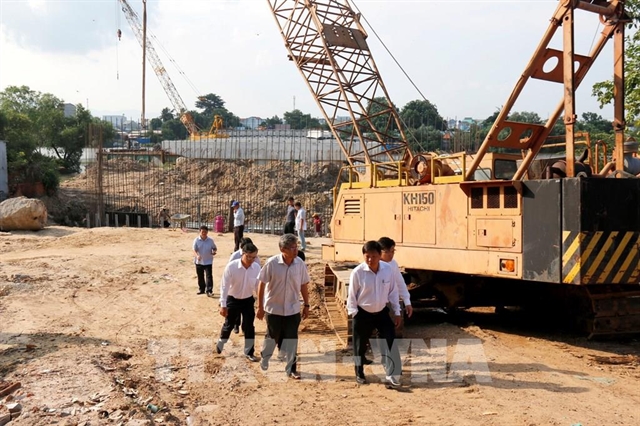
Provincial leaders conduct a quick inspection of public investment disbursement progress at the Văn Thánh Bridge construction project in Phan Thiết Ward, Lâm Đồng Province. — VNA/VNS Photo
HÀ NỘI — Public investment disbursement is emerging as a key driver that Việt Nam can actively harness to support economic growth this year.
With more than VNĐ1 quadrillion (US$38.5 billion) allocated, a record high, the Government is seeking to remove bottlenecks, reallocate capital and accelerate project implementation in ministries, agencies and localities where disbursement remains slow, with the ultimate goal of achieving 100 per cent disbursement.
According to the Ministry of Finance, the Government and the Prime Minister have assigned a total public investment plan worth VNĐ1.01 quadrillion for this year, including VNĐ364 trillion from the central budget and VNĐ650 trillion from local budgets. After including additional local budget funds, total planned capital reached VNĐ1.03 quadrillion as of August 6.
This large-scale funding provides significant resources for infrastructure development and expansion of economic space, but also puts considerable pressure on implementation.
Public investment was estimated at around VNĐ1.1 quadrillion this year, up 31 per cent year-on-year, according to Dr Cấn Văn Lực, chief economist and director of the BIDV Training and Research Institute. He described it as an important source of growth if the capital can be promptly translated into infrastructure and new production capacity.
However, disbursement remains relatively slow. As of August 6, VNĐ433.454 trillion had been disbursed, equivalent to 42.7 per cent of the plan assigned by the PM. The pace also slowed sharply in early August, with disbursement during August 1-6 amounting to only VNĐ8.1 trillion, or about one-fourth of the previous week’s figure.
This means a substantial amount of capital must be disbursed in the remaining months of the year, requiring much faster implementation.
Disbursement performance varies significantly among ministries, central agencies and localities. Eight central ministries and agencies and 22 localities had disbursement rates at or above the national average.
Among the top performers, the Vietnam Bank for Social Policies has fully disbursed its allocated capital, while the Vietnam Expressway Corporation and Vietnam Development Bank reached 84.5 per cent and 78.1 per cent, respectively. The Ministry of Industry and Trade also recorded a relatively high rate of 61.8 per cent.
However, 25 central ministries and agencies and 12 localities remain below the national average, highlighting significant differences in implementation capacity.
Against the backdrop of Việt Nam’s ambitious growth target for 2026, accelerating public investment is more than a matter of fulfilling the State budget plan.
Lực said public investment would remain a key growth driver and that achieving 100 per cent disbursement could add around 1.8 percentage points to economic growth.
The impact goes beyond direct Government spending. Infrastructure projects generate demand for construction materials, machinery, transport and services, while newly developed infrastructure can facilitate investment and production in the years ahead.
Economica Vietnam Director Lê Duy Bình said that amid uncertain external factors, public investment is one of the growth drivers Việt Nam can actively control.
GDP grew 8.18 per cent in the first half of the year, but sustaining strong growth in the second half would depend significantly on public investment disbursement, private investment and the removal of economic bottlenecks.
He noted that effectively disbursing more than VNĐ1 quadrillion would not only boost aggregate demand, but also strengthen infrastructure, expand development space and improve the economy’s competitiveness. He therefore called for disbursement to reach at least 99 per cent, ideally 100 per cent, to support strong growth this year.
One immediate priority is to address capital that has yet to be allocated to specific projects. As of August 6, VNĐ19.8 trillion in central budget capital remained unallocated, equivalent to around 2 per cent of the PM’s assigned plan. Some agencies received additional funds only in June and July and need more time to complete investment procedures, while others have proposed reducing allocations due to a lack of demand.
The use of key performance indicators to monitor and supervise public investment disbursement should also be directly linked to the responsibilities and performance of each unit. The wide gap between units that have disbursed more than 50 per cent of their allocated capital and those that have disbursed less than 10 per cent, or have yet to disburse any funds, shows significant differences in implementation capacity despite operating under the same regulatory framework.
Accelerating public investment should also go hand in hand with removing institutional bottlenecks and encouraging private investment. If public and private capital can be mobilised simultaneously, they could provide a dual boost to aggregate demand and create additional momentum for economic growth in 2026. — VNS
Source: VNS
Related News

INFRASTRUCTURE / CONSTRUCTION / LOGISTIC / PORT
VIỆT NAM-CAMBODIA TRADE GATHERS PACE TOWARDS $20 BILLION TARGET
Trade between Việt Nam and Cambodia continues to grow, remaining a bright spot and a key pillar of bilateral cooperation as the two countries aim to raise two-way trade to US$20 billion in the coming years. After setting a record of more than $11.3 billion last year, bilateral trade reached about $8.7 billion in the first eight months of this year, up 8.3 per cent year on year.

TECHNOLOGY
AI BEGINNING TO RESHAPE RECRUITMENT CRITERIA
Digital literacy is the only capability area in which fresh graduates meet employers’ expectations, according to a new report. Yet, it is also the standard rising fastest, as businesses increasingly expect new hires to use AI effectively in the workplace. Some 83 per cent of employers say AI has changed, or is beginning to change, their hiring criteria, while 94 per cent report higher expectations for digital and AI capabilities than they had two to three years ago.

INFRASTRUCTURE / CONSTRUCTION / LOGISTIC / PORT
ĐÀ NẴNG GREEN-LIGHTS US$105 MILLION THAI DEVELOPMENT DEAL
The central city has approved an investment proposal by Thailand’s WHA Group to develop infrastructure for the 400ha WHA Đà Nẵng Industrial Park project on two communes of Thăng Bình and Đồng Dương, with an investment of more than VNĐ2.7 trillion (US$105 million). The city said it approved WHA Industrial Development International's status as an investor in the project, which is expected to take place between 2027 and 2034.

VIETNAM ECONOMY INVESTMENT
MOBILE PHONE EXPORTS RISE 20% TO $51.8 BILLION IN FIRST NINE MONTHS
Exports of mobile phones and components rose 20 per cent year-on-year to nearly US$51.8 billion in the first nine months of 2026, with China, the US and Republic of Korea accounting for more than half of the total. Shipments to the three markets reached a combined $26.18 billion, or 50.6 per cent of total exports of the product group during the period, according to data from the Vietnam Department of Customs under the Ministry of Finance.

VIETNAM ECONOMY INVESTMENT
FRUIT AND VEGETABLE EXPORTS POISED TO HIT $10 BILLION IN 2026
Fruit and vegetable exports are on track to reach nearly US$10 billion in 2026, after rising 19.9 per cent year on year to nearly US$7.4 billion in the first nine months, driven by strong seasonal demand and abundant tropical fruit supplies. The Ministry of Agriculture and Environment said the growth reflected stronger international demand for fresh produce and processed agricultural products.

GARMENT / TEXTILE
TEXTILE EXPORTS FACE DUAL CHALLENGES OF SUSTAINING ORDERS AND BOOSTING EFFICIENCY AMID GROWING COMPETITION
Data shows that the textile and garment sector maintained its growth momentum in the first nine months of this year. The industry's total export turnover reached an estimated US$35.721 billion in the first nine months of this year, up 3.3 per cent year-on-year. Despite posting encouraging export figures, Vietnamese textile and garment enterprises continue to navigate unpredictable market variables.
Events Sponsors






















