Want to be in the loop?
subscribe to
our notification
Business News
VIỆT NAM'S COFFEE EXPORTS AIM FOR $6 BILLION MILESTONE
February was a notable period when Việt Nam exported over 193,000 tonnes of coffee, bringing in US$1.08 billion.
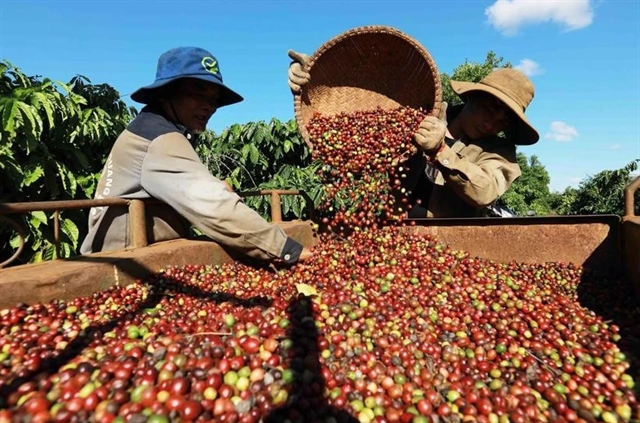
Coffee harvested in Buôn Ma Thuột City, the Central Highlands province of Đắk Lắk. — VNA/VNS Photo
HÀ NỘI — The Vietnamese coffee industry made a distinct impression in the first two months of this year, with export turnover rising by 26.2 per cent year-on-year to US$1.58 billion while volume falling by 28.4 per cent to 284,000 tonnes, according to the Ministry of Agriculture and Environment.
This achievement not only affirmed Việt Nam's position in the global coffee market but also opened bright prospects for exceeding the $6 billion target this year.
The rise of “brown gold”
Last month was a notable period when Việt Nam exported over 193,000 tonnes of coffee, bringing in $1.08 billion – a record figure within a single month. Of this, green coffee beans accounted for the majority with over 178,000 tonnes while processed one contributed nearly 15,000 tonnes.
One of the key factors helping the coffee industry achieve remarkable results was the surge in export prices. The ministry’s report showed that the average coffee price in the January-February period reached $5,574.5 per tonne, up 76.3 per cent compared to the same period in 2024. In February alone, this figure rose to $5,596 per tonne, an all-time record high.
Chairman of the Vietnam Coffee-Cocoa Association (VICOFA) Nguyễn Nam Hải said that high prices helped the coffee industry bring in $1.08 billion in February alone, exceeding all expectations.
The sector’s value growth came not only from green coffee which brought home $956.58 million, up 107 per cent from the same month last year, but also from contributions by deeply processed coffee. In the month, roasted, instant, and blended coffee were sold abroad at over $123 million, making up 11.4 per cent of the total value, indicating a trend towards value-added products that helps elevate the position of Vietnamese “brown gold” internationally.
Germany, Italy, and Japan remained the largest consumer markets, accounting for 16.6 per cent, 9.4 per cent, and 8.2 per cent of market share, respectively. Compared to the same period last year, export value in January 2025 to Germany increased by 53 per cent, to Italy by 5.6 per cent, and to Japan by 10.4 per cent, demonstrating the stable appeal of Vietnamese coffee in traditional markets.
Hải noted that coffee had become a “hot” commodity on world trading floors, attracting significant investor interest. He elaborated that the price difference between Robusta and Arabica coffee was currently about $3,000 per tonne. When Arabica prices rise high, roasters would switch to Robusta – the variety in which Việt Nam is the global leader.
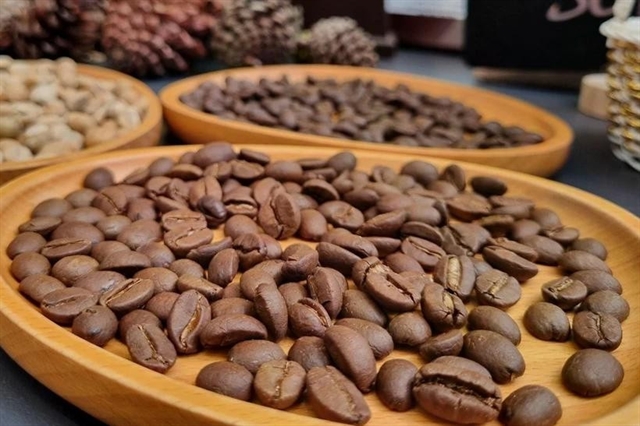
Việt Nam is the world's leading robusta coffee grower. — VNA/VNS Photo
Challenges and opportunities from global market
The Ministry of Industry and Trade’s Agency of Foreign Trade said La Niña might replace El Niño this year, affecting coffee-growing regions in Brazil – the world's largest exporting country. The risk of frost in Brazil could reduce production for the 2025-2026 crop year to its lowest level in three years, creating opportunities for Việt Nam to strengthen its position.
However, Hải believes that although Brazil's coffee production will decrease from July onwards, it will not have great impacts, and the market still needs to be closely monitored.
To deliver on the export target of over $6 billion, the domestic coffee sector needed to maintain its stable cultivation areas and improve quality according to international standards, Hải said, adding businesses need to link purchasing with deep processing while diversifying markets to avoid dependence on a few major partners. Additionally, capitalising on the leading position in Robusta coffee, which accounts for 95 per cent of Việt Nam's production, will be key to maintaining growth momentum.
Deputy Minister of Agriculture and Environment Phùng Đức Tiến held that with the current growth rate, the industry would be able to complete its set target this year.
"The strong growth in export value in the first two months of the year is evidence of the industry's potential," he said, underscoring the need to continue investing in processing technology, expanding markets, and responding flexibly to global fluctuations.
The ministry was working with VICOFA and enterprises to develop a long-term strategy aimed at sustainable development and improvement in the value of the Vietnamese coffee brand, he added. — VNS
Source: VNS
Related News

CHARITY / EXHIBITION / OTHER EVENTS
INVESTMENT OPPORTUNITIES IN CA MAU PROVINCE: 96 PROJECTS AND 20 STRATEGIC PROJECTS
We are pleased to share with you information on investment projects currently seeking investors in Ca Mau Province. Should your esteemed company or association be interested, we kindly invite you to review the project information and complete the registration form via the links provided. The Ho Chi Minh City Investment and Trade Promotion Centre (ITPC) will consolidate the expressions of interest and facilitate connections with the leadership of Ca Mau Province at a meeting tentatively scheduled for 13 November 2026 in Ho Chi Minh City.

MEMBER CORNER / PROMOTIONS
BẰNG KIỀU LIVESHOW - A SYMPHONY OF LOVE UNDER THE GOLDEN GLOW
A masterclass in live music that takes the audience on a soulful journey through immortal love songs, guided by the peerless artistry and emotive storytelling of renowned singer Bằng Kiều. The highlight of the night is his seamless musical chemistry with special guest Triệu Hồng Ngọc, promising passionate and deeply resonant duets inside the magnificent Grand Ballroom.

INFRASTRUCTURE / CONSTRUCTION / LOGISTIC / PORT
ĐÀ NẴNG GREEN-LIGHTS US$105 MILLION THAI DEVELOPMENT DEAL
The central city has approved an investment proposal by Thailand’s WHA Group to develop infrastructure for the 400ha WHA Đà Nẵng Industrial Park project on two communes of Thăng Bình and Đồng Dương, with an investment of more than VNĐ2.7 trillion (US$105 million). The city said it approved WHA Industrial Development International's status as an investor in the project, which is expected to take place between 2027 and 2034.

VIETNAM ECONOMY INVESTMENT
MOBILE PHONE EXPORTS RISE 20% TO $51.8 BILLION IN FIRST NINE MONTHS
Exports of mobile phones and components rose 20 per cent year-on-year to nearly US$51.8 billion in the first nine months of 2026, with China, the US and Republic of Korea accounting for more than half of the total. Shipments to the three markets reached a combined $26.18 billion, or 50.6 per cent of total exports of the product group during the period, according to data from the Vietnam Department of Customs under the Ministry of Finance.

INFRASTRUCTURE / CONSTRUCTION / LOGISTIC / PORT
VIỆT NAM-CAMBODIA TRADE GATHERS PACE TOWARDS $20 BILLION TARGET
Trade between Việt Nam and Cambodia continues to grow, remaining a bright spot and a key pillar of bilateral cooperation as the two countries aim to raise two-way trade to US$20 billion in the coming years. After setting a record of more than $11.3 billion last year, bilateral trade reached about $8.7 billion in the first eight months of this year, up 8.3 per cent year on year.

VIETNAM ECONOMY INVESTMENT
FRUIT AND VEGETABLE EXPORTS POISED TO HIT $10 BILLION IN 2026
Fruit and vegetable exports are on track to reach nearly US$10 billion in 2026, after rising 19.9 per cent year on year to nearly US$7.4 billion in the first nine months, driven by strong seasonal demand and abundant tropical fruit supplies. The Ministry of Agriculture and Environment said the growth reflected stronger international demand for fresh produce and processed agricultural products.
Events Sponsors






















