Want to be in the loop?
subscribe to
our notification
Business News
VIỆT NAM’S GARMENT-TEXTILE INDUSTRY STITCHING A GREENER, SMARTER FUTURE
Between now and 2030, the garment sector will gradually shift from rapid growth to a sustainability-driven, circular business model.
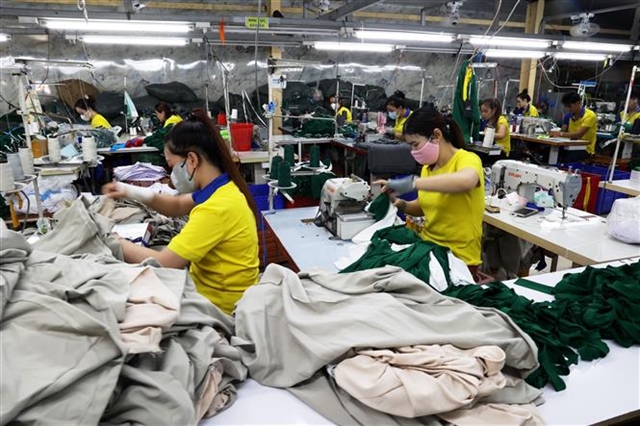
Garment processing workshop at HCM City-based Dony Garment Co Ltd. — VNA/VNS Photo
HÀ NỘI — Việt Nam, the world’s second largest garment-textile exporter, is betting on green fabric to cement its place in the global supply chain.
According to Chairman of the Việt Nam Textile and Apparel Association (VITAS) Vũ Đức Giang, many Vietnamese enterprises are already weaving eco-friendly materials like organic cotton, recycled polyester, and Tencel. This aligns with global trend as major global brands operating in Việt Nam have committed to achieving net-zero carbon emissions by 2050 under the Fashion Industry Charter for Climate Action.
Beyond sustainability, the sector is harnessing advanced technology in design and production. Investors are working to optimise production capacity, streamline supply chains, and improve product quality to stay competitive in both domestic and global markets.
Between now and 2030, the focus will gradually shift from rapid growth to a sustainability-driven, circular business model. By 2031-35, the goal is to fully integrate Việt Nam into a circular economy, strengthen its domestic value chain, and secure a high-value position in the global supply chain.
To such end, Việt Nam is investing in sci-tech, upskilling the workforce, and developing hi-tech textile and dyeing projects in industrial zones. Plans also include expanding the production of natural, eco-friendly materials, accelerating digital transformation, and building a robust fashion ecosystem with globally and regionally recognised brands.
With over 7,000 apparel companies employing more than three million workers, Việt Nam’s garment-textile industry is a true powerhouse. Up to 80 per cent of its production capacity is dedicated to exports, while the remainder serves domestic consumption.
Last year alone, Việt Nam’s apparel exports reached nearly US$44 billion, up 11.3 per cent annually. This achievement solidifies Việt Nam’s position as the world’s second largest garment-textile exporter, behind only China.
Supported by 17 next-generation free trade agreements (FTAs) already in effect, the industry is poised for further growth, targeting $48 billion in export revenue this year. — VNS
Source: VNS
Related News

INFRASTRUCTURE / CONSTRUCTION / LOGISTIC / PORT
VIỆT NAM-CAMBODIA TRADE GATHERS PACE TOWARDS $20 BILLION TARGET
Trade between Việt Nam and Cambodia continues to grow, remaining a bright spot and a key pillar of bilateral cooperation as the two countries aim to raise two-way trade to US$20 billion in the coming years. After setting a record of more than $11.3 billion last year, bilateral trade reached about $8.7 billion in the first eight months of this year, up 8.3 per cent year on year.
TECHNOLOGY
AI BEGINNING TO RESHAPE RECRUITMENT CRITERIA
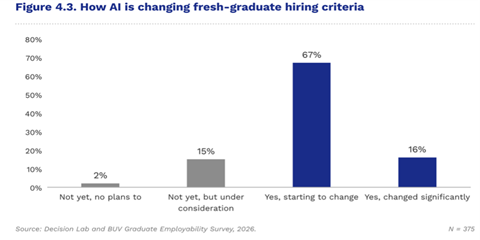
Digital literacy is the only capability area in which fresh graduates meet employers’ expectations, according to a new report. Yet, it is also the standard rising fastest, as businesses increasingly expect new hires to use AI effectively in the workplace. Some 83 per cent of employers say AI has changed, or is beginning to change, their hiring criteria, while 94 per cent report higher expectations for digital and AI capabilities than they had two to three years ago.

INFRASTRUCTURE / CONSTRUCTION / LOGISTIC / PORT
ĐÀ NẴNG GREEN-LIGHTS US$105 MILLION THAI DEVELOPMENT DEAL
The central city has approved an investment proposal by Thailand’s WHA Group to develop infrastructure for the 400ha WHA Đà Nẵng Industrial Park project on two communes of Thăng Bình and Đồng Dương, with an investment of more than VNĐ2.7 trillion (US$105 million). The city said it approved WHA Industrial Development International's status as an investor in the project, which is expected to take place between 2027 and 2034.

VIETNAM ECONOMY INVESTMENT
MOBILE PHONE EXPORTS RISE 20% TO $51.8 BILLION IN FIRST NINE MONTHS
Exports of mobile phones and components rose 20 per cent year-on-year to nearly US$51.8 billion in the first nine months of 2026, with China, the US and Republic of Korea accounting for more than half of the total. Shipments to the three markets reached a combined $26.18 billion, or 50.6 per cent of total exports of the product group during the period, according to data from the Vietnam Department of Customs under the Ministry of Finance.

VIETNAM ECONOMY INVESTMENT
FRUIT AND VEGETABLE EXPORTS POISED TO HIT $10 BILLION IN 2026
Fruit and vegetable exports are on track to reach nearly US$10 billion in 2026, after rising 19.9 per cent year on year to nearly US$7.4 billion in the first nine months, driven by strong seasonal demand and abundant tropical fruit supplies. The Ministry of Agriculture and Environment said the growth reflected stronger international demand for fresh produce and processed agricultural products.
GARMENT / TEXTILE
TEXTILE EXPORTS FACE DUAL CHALLENGES OF SUSTAINING ORDERS AND BOOSTING EFFICIENCY AMID GROWING COMPETITION
Data shows that the textile and garment sector maintained its growth momentum in the first nine months of this year. The industry's total export turnover reached an estimated US$35.721 billion in the first nine months of this year, up 3.3 per cent year-on-year. Despite posting encouraging export figures, Vietnamese textile and garment enterprises continue to navigate unpredictable market variables.
Events Sponsors






















