Want to be in the loop?
subscribe to
our notification
Business News
VIỆT NAM’S PEPPER EXPORTS GROW STRONGLY, SPICE INDUSTRY EYES HIGHER VALUE
During January-July, the country exported 168,429 tonnes of pepper worth US$1.087 billion, a 16.1 per cent surge in volume and a 10.1 per cent climb in value compared to the same period last year.
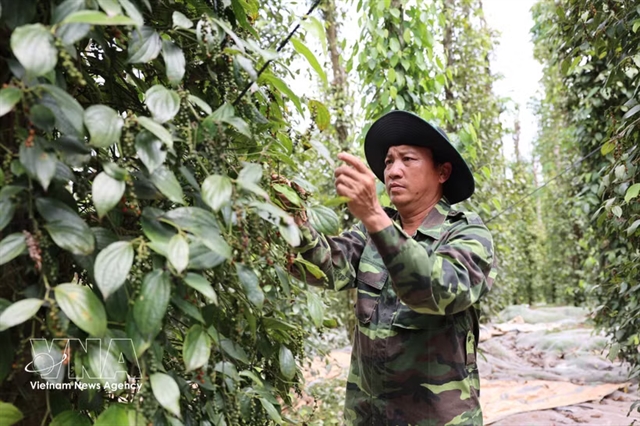
Harvesting pepper in HCM City. — VNA/VNS Photo
HCM CITY — Việt Nam shipped 22,743 tonnes of pepper last month, raking in US$147.3 million, marking a modest 1.6 per cent drop in volume and 2.6 per cent slide in value from June, but an 8.8 per cent year-over-year volume jump, according to the Vietnam Pepper and Spice Association (VPSA).
During January-July, the country exported 168,429 tonnes of pepper worth $1.087 billion, a 16.1 per cent surge in volume and a 10.1 per cent climb in value compared to the same period last year.
Asia remained the top buyer, soaking up 76,845 tonnes, a 12.3 per cent year-over-year rise that grabbed 45.6 per cent of total exports. The America took 45,470 tonnes, rocketing 34 per cent higher for a 27 per cent share. Europe imported 36,140 tonnes, up 7.5 per cent and claiming 21.5 per cent, while shipments to Africa rose 10 per cent to 9,964 tonnes.
Zooming in, the US held firm as the single biggest market, buying 40,712 tonnes and notching a 31.8 per cent year-over-year gain. China followed with 17,110 tonnes, up 55.8 per cent, the Netherlands with 6,136 tonnes, up 48.8 per cent, and Thailand with 6,913 tonnes, soaring 88.7 per cent. On the flip side, exports to Germany tumbled 18.1 per cent, while those to India slid 26.4 per cent.
On the import front, Vietnamese companies brought in 3,614 tonnes of pepper valued at $21.6 million last month, a steep decline from June but still a 13.8 per cent year-over-year volume hike. Over the first seven months, pepper imports totalled 48,812 tonnes valued at $279.3 million, leaping 55.1 per cent in volume and 43 per cent in value from the same period last year. Cambodia dominated as the top supplier, shipping 25,413 tonnes, up a staggering 256.9 per cent and accounting for 52.1 per cent of all inbound pepper.
The numbers confirm that beyond just growing pepper, Việt Nam is rapidly cementing its role as a processing and trading hub for value-added products in the global supply chain.
While pepper roared ahead, cinnamon showed signs of cooling. July saw 11,788 tonnes of cinnamon exported for $30.3 million, down 6.5 per cent in volume and 5.1 per cent in value from the previous month, though still up 13.6 per cent in volume year-over-year. Over January-July, cinnamon exports reached 73,085 tonnes worth $186.5 million, slipping a slight 1 per cent in volume and 0.6 per cent in value compared to a year earlier.
Asia continued to dominate cinnamon purchases with 50,085 tonnes, or 68.5 per cent of all exports, but that figure fell 9.1 per cent year-over-year. In contrast, shipments to the America hit 15,108 tonnes, surging 32.8 per cent; Europe bought 5,644 tonnes, up 1.6 per cent; and Africa absorbed 2,248 tonnes, a 28.3 per cent leap.
India stood as the top individual cinnamon buyer, taking 29,530 tonnes, or 40.4 per cent of total exports though that was down by 0.9 per cent. The data signals clear room to grow cinnamon sales in the America and Africa, especially as Asian demand softens.
Star anise faced a bumpier road. Việt Nam exported 1,191 tonnes worth $4.8 million last month, down 19.2 per cent in volume and 19 per cent in value from June, but up a blistering 97.8 per cent in volume year-over-year. For the first seven months, star anise exports totaled 8,434 tonnes valued at $33.4 million, declining 9.1 per cent in volume and 6.2 per cent in value from the same period a year ago.
Asia remained star anise’s main outlet with 6,474 tonnes, or 76.8 per cent of exports, though that represented an 18.4 per cent drop. India alone imported 5,220 tonnes, equivalent to 61.9 per cent of the total but that was a 25.2 per cent contraction.
In a sharp contrast, star anise shipments to the America climbed 33.2 per cent to 1,280 tonnes, and exports to Europe soared 81.9 per cent to 633 tonnes. The trend pointed to swelling demand outside traditional Asian markets, offering companies a clear lane to diversify and cut their reliance on traditional buyers.
VPSA Chairman Lê Việt Anh said pepper prices should hold steady in the near term barring any major geopolitical shocks. US-bound pepper exports are expected to remain stable over the medium and long haul.
A bright spot emerged on the regulatory front as EU warnings tied to Vietnamese pepper and spices fell from 34 cases in the first half of 2025 to 22 in the same period of this year. For pepper alone, alerts dropped from five to three. That progress underscores real improvements in quality control, pesticide residue management, and compliance awareness among farmers and exporters.
Longer-term, Anh stressed that the industry’s core challenge has shifted. After more than two decades as the world’s top pepper exporter, Việt Nam has almost no room left to expand planted acreage. Land is increasingly scarce, other crops compete for space, and new rules, especially the European Union Deforestation Regulation (EUDR), are piling on tougher requirements.
The pepper sector can no longer bet on higher output or low pricing. Instead, it must pivot to a growth engine fuelled by quality, branding, and deeper value addition.
The same pivot applies to cinnamon, star anise, and other spices. The VPSA urged companies to ramp up investment in certified raw material zones, tighten partnerships with farmers, enforce stricter pesticide residue controls, build out traceability systems, and hit every technical standard demanded by importing markets.
At the same time, the industry should get ahead of the green consumption wave by embracing regenerative agriculture, circular economy models, lower carbon emissions, and smarter water use. — VNA/VNS
Source: VNS
Related News

INFRASTRUCTURE / CONSTRUCTION / LOGISTIC / PORT
VIỆT NAM-CAMBODIA TRADE GATHERS PACE TOWARDS $20 BILLION TARGET
Trade between Việt Nam and Cambodia continues to grow, remaining a bright spot and a key pillar of bilateral cooperation as the two countries aim to raise two-way trade to US$20 billion in the coming years. After setting a record of more than $11.3 billion last year, bilateral trade reached about $8.7 billion in the first eight months of this year, up 8.3 per cent year on year.

TECHNOLOGY
AI BEGINNING TO RESHAPE RECRUITMENT CRITERIA
Digital literacy is the only capability area in which fresh graduates meet employers’ expectations, according to a new report. Yet, it is also the standard rising fastest, as businesses increasingly expect new hires to use AI effectively in the workplace. Some 83 per cent of employers say AI has changed, or is beginning to change, their hiring criteria, while 94 per cent report higher expectations for digital and AI capabilities than they had two to three years ago.

INFRASTRUCTURE / CONSTRUCTION / LOGISTIC / PORT
ĐÀ NẴNG GREEN-LIGHTS US$105 MILLION THAI DEVELOPMENT DEAL
The central city has approved an investment proposal by Thailand’s WHA Group to develop infrastructure for the 400ha WHA Đà Nẵng Industrial Park project on two communes of Thăng Bình and Đồng Dương, with an investment of more than VNĐ2.7 trillion (US$105 million). The city said it approved WHA Industrial Development International's status as an investor in the project, which is expected to take place between 2027 and 2034.

VIETNAM ECONOMY INVESTMENT
MOBILE PHONE EXPORTS RISE 20% TO $51.8 BILLION IN FIRST NINE MONTHS
Exports of mobile phones and components rose 20 per cent year-on-year to nearly US$51.8 billion in the first nine months of 2026, with China, the US and Republic of Korea accounting for more than half of the total. Shipments to the three markets reached a combined $26.18 billion, or 50.6 per cent of total exports of the product group during the period, according to data from the Vietnam Department of Customs under the Ministry of Finance.

VIETNAM ECONOMY INVESTMENT
FRUIT AND VEGETABLE EXPORTS POISED TO HIT $10 BILLION IN 2026
Fruit and vegetable exports are on track to reach nearly US$10 billion in 2026, after rising 19.9 per cent year on year to nearly US$7.4 billion in the first nine months, driven by strong seasonal demand and abundant tropical fruit supplies. The Ministry of Agriculture and Environment said the growth reflected stronger international demand for fresh produce and processed agricultural products.

GARMENT / TEXTILE
TEXTILE EXPORTS FACE DUAL CHALLENGES OF SUSTAINING ORDERS AND BOOSTING EFFICIENCY AMID GROWING COMPETITION
Data shows that the textile and garment sector maintained its growth momentum in the first nine months of this year. The industry's total export turnover reached an estimated US$35.721 billion in the first nine months of this year, up 3.3 per cent year-on-year. Despite posting encouraging export figures, Vietnamese textile and garment enterprises continue to navigate unpredictable market variables.
Events Sponsors






















