Want to be in the loop?
subscribe to
our notification
Business News
VIỆT NAM’S STOCK MARKET LOOKS TO STRONG 2025, LED BY BANKS
Recent financial disclosures from over 900 listed enterprises reveal a 20.9 per cent year-on-year growth in profits after tax for the fourth quarter (Q4) of 2024.

A customer conducts a transaction at an office of a bank in Hà Nội. — VNA/VNS Photo
HÀ NỘI — As Việt Nam’s economy strides confidently into 2025, the outlook for listed companies appears increasingly robust, with the banking sector positioned as a key driver of stock market growth.
Recent financial disclosures from over 900 listed enterprises reveal a 20.9 per cent year-over-year growth in profits after tax for the fourth quarter (Q4) of 2024. This marks the fourth consecutive quarter of stable gain, reinforcing optimism for 2025.
Several industries have played a pivotal role in this upward trajectory, particularly real estate, retail, aviation, consumer goods, telecommunications and information technology.
The non-financial sector continues to be a primary growth engine, boasting a 25.7 per cent profit expansion in Q4 2024, but slightly below the 29 per cent recorded in the previous quarter.
Meanwhile, the financial sector has also seen improved momentum, registering a 16.7 per cent profit increase year-on-year, up from 14.9 per cent in Q3 2024.
Notably, the real estate sector saw a significant surge in profit after tax (101.3 per cent), primarily driven by Vinhomes’s exceptional growth (1,482.3 per cent).
This remarkable increase was fuelled by the company’s accelerated handover of homes at the Royal Island mega-project in Hải Phòng City, along with contributions from other key players such as Khang Điền House, Phát Điều Real Estate, Đất Xanh Group, NLG Corp and Văn PHú - Invest.
These figures indicate a broad-based recovery across multiple sectors, creating a favourable environment for sustained market expansion.
In 2024, the total profit after tax of the market grew by 22.3 per cent year-on-year, primarily driven by the non-financial sector, which saw a strong increase of 28.7 per cent.
While the financial sector posted more modest growth at 17.5 per cent, several industries experienced exceptional surges, including retail (479.3 per cent), tourism and entertainment (319.6 per cent) and telecommunications (144.1 per cent).
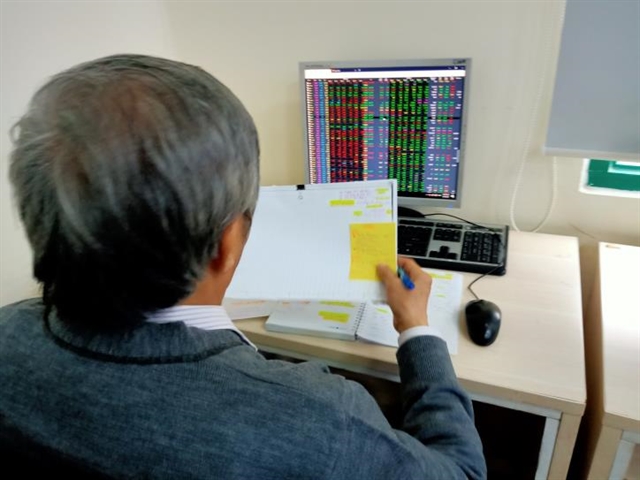
An investor tracks the market's movements. — VNA/VNS Photo
Market’s driving force
Among the key contributors to the market’s rallies, the banking industry stands out as the front runner.
By the end of 2024, the total market capitalisation of banks stood at over VNĐ578.1 trillion (US$22.6 million), accounting for 8.1 per cent of the combined capitalisation across Việt Nam’s three stock exchanges.
Preliminary financial reports indicate that banks achieved a profit after tax of VNĐ67.1 trillion in Q4 2024, reflecting a significant 27.3 per cent rise over the previous year.
This growth rate substantially surpasses the average profit increase of 9.1 per cent among 33 major stocks in other sectors.
The banking sector’s impressive performance can be attributed to several key factors.
First, credit expansion has been a crucial driver, with lending activities picking up as the economy regains momentum.
Meanwhile, digital transformation efforts by banks have yielded positive results, improving operational efficiency and boosting revenue streams.
Additionally, favourable interest rate policies and proactive monetary measures by the State Bank of Việt (SBV) have provided an enabling environment for banks to thrive.
Market analysts are increasingly optimistic about the role of banking stocks in shaping Vietnam’s stock market performance in 2025.
Đào Hồng Dương from VPBank Securities said that the VN-Index would likely be propelled by sectors demonstrating high-profit growth and attractive valuations, with banks leading the charge.
Looking ahead, projections suggest a 17.7 per cent profit growth for banks this year.
Given expectations of double-digit GDP growth, credit expansion in the banking sector could reach 16-18 per cent in 2025.
This optimistic outlook is further bolstered by proactive public investment and infrastructure development initiatives, which will drive demand for banking services.
Given that the banking sector comprises about 25-30 per cent of the total capitalisation on the Hồ Chi Minh Stock Exchange (HoSE), its performance will have a ripple effect on the broader market.
Bank stocks, characterised by their liquidity, market capitalisation and favourable valuations, are attracting significant attention from both domestic and foreign investors.
In particular, the prospect of increased foreign ownership levels in the country’s banking sector could further enhance investor sentiment and capital inflows.
Despite the positive outlook, certain risks could impact the market’s performance.
Global economic uncertainties, geopolitical tensions and potential fluctuations in interest rates could pose challenges for Việt Nam’s financial markets. Additionally, the real estate sector, while showing signs of recovery, remains an area of concern due to lingering structural issues. — VNS
Source: VNS
Related News

CHARITY / EXHIBITION / OTHER EVENTS
INVESTMENT OPPORTUNITIES IN CA MAU PROVINCE: 96 PROJECTS AND 20 STRATEGIC PROJECTS
We are pleased to share with you information on investment projects currently seeking investors in Ca Mau Province. Should your esteemed company or association be interested, we kindly invite you to review the project information and complete the registration form via the links provided. The Ho Chi Minh City Investment and Trade Promotion Centre (ITPC) will consolidate the expressions of interest and facilitate connections with the leadership of Ca Mau Province at a meeting tentatively scheduled for 13 November 2026 in Ho Chi Minh City.

MEMBER CORNER / PROMOTIONS
BẰNG KIỀU LIVESHOW - A SYMPHONY OF LOVE UNDER THE GOLDEN GLOW
A masterclass in live music that takes the audience on a soulful journey through immortal love songs, guided by the peerless artistry and emotive storytelling of renowned singer Bằng Kiều. The highlight of the night is his seamless musical chemistry with special guest Triệu Hồng Ngọc, promising passionate and deeply resonant duets inside the magnificent Grand Ballroom.

INFRASTRUCTURE / CONSTRUCTION / LOGISTIC / PORT
ĐÀ NẴNG GREEN-LIGHTS US$105 MILLION THAI DEVELOPMENT DEAL
The central city has approved an investment proposal by Thailand’s WHA Group to develop infrastructure for the 400ha WHA Đà Nẵng Industrial Park project on two communes of Thăng Bình and Đồng Dương, with an investment of more than VNĐ2.7 trillion (US$105 million). The city said it approved WHA Industrial Development International's status as an investor in the project, which is expected to take place between 2027 and 2034.

VIETNAM ECONOMY INVESTMENT
MOBILE PHONE EXPORTS RISE 20% TO $51.8 BILLION IN FIRST NINE MONTHS
Exports of mobile phones and components rose 20 per cent year-on-year to nearly US$51.8 billion in the first nine months of 2026, with China, the US and Republic of Korea accounting for more than half of the total. Shipments to the three markets reached a combined $26.18 billion, or 50.6 per cent of total exports of the product group during the period, according to data from the Vietnam Department of Customs under the Ministry of Finance.

INFRASTRUCTURE / CONSTRUCTION / LOGISTIC / PORT
VIỆT NAM-CAMBODIA TRADE GATHERS PACE TOWARDS $20 BILLION TARGET
Trade between Việt Nam and Cambodia continues to grow, remaining a bright spot and a key pillar of bilateral cooperation as the two countries aim to raise two-way trade to US$20 billion in the coming years. After setting a record of more than $11.3 billion last year, bilateral trade reached about $8.7 billion in the first eight months of this year, up 8.3 per cent year on year.

VIETNAM ECONOMY INVESTMENT
FRUIT AND VEGETABLE EXPORTS POISED TO HIT $10 BILLION IN 2026
Fruit and vegetable exports are on track to reach nearly US$10 billion in 2026, after rising 19.9 per cent year on year to nearly US$7.4 billion in the first nine months, driven by strong seasonal demand and abundant tropical fruit supplies. The Ministry of Agriculture and Environment said the growth reflected stronger international demand for fresh produce and processed agricultural products.
Events Sponsors






















