Want to be in the loop?
subscribe to
our notification
Business News
VIỆT NAM TAPS HALAL MARKET TO BOOST AGRICULTURAL EXPORTS
Vietnamese seafood processing and export enterprises are completing required procedures and adopting necessary technologies to bring their products into the halal market.
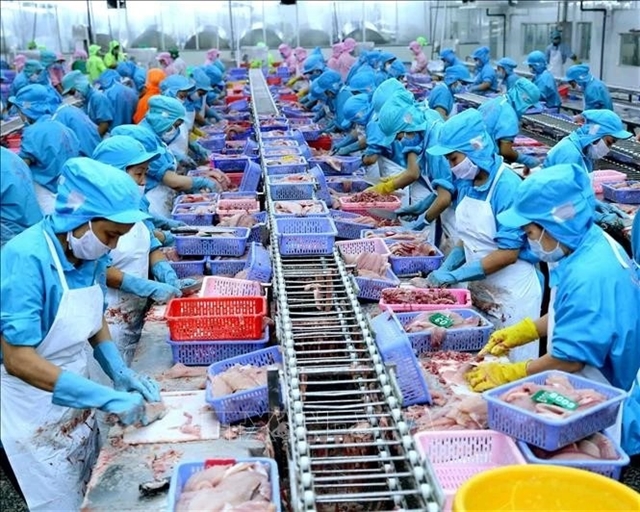
Processing tra fish for export. — VNA/VNS Photo
HCM CITY — The signing of multiple trade cooperation agreements between Việt Nam and Middle Eastern countries late last year has opened up new opportunities for Vietnamese goods to enter the halal market, creating strong momentum and prospects for Vietnamese businesses, particularly those operating in agriculture.
According to Deputy Minister of Agriculture and Environment Phùng Đức Tiến, products entering the halal market — which serves a quarter of the world’s population — must comply with Islamic laws, particularly for items such as food and cosmetics. The growing demand for imported food in Muslim countries presents significant opportunities for Việt Nam’s agricultural and aquatic products as well as its food processing industry.
Local seafood processing and export enterprises are completing required procedures and adopting necessary technologies to bring their products into the halal market.
According to Tô Thị Tường Lan, Deputy Secretary General of the Vietnam Association of Seafood Exporters and Producers (VASEP), Vietnamese seafood companies are actively pursuing strategies to expand into new markets to mitigate risks associated with overreliance on one or a few traditional markets.
Among these firms, Minh Phú Group has obtained halal certification and is boosting shrimp exports to the halal market. Other companies, such as Vĩnh Hoàn Corporation and Biển Đông Seafood Co., Ltd., are also expanding their presence in this market in addition to their traditional markets.
Lan said Việt Nam’s production standards, such as VietGAP, GlobalGAP and HACCP, are largely aligned with halal requirements, providing a solid foundation for the halal certification process.
Việt Nam has also strengthened partnerships with halal certification bodies in the member states of the Organisation of Islamic Cooperation (OIC), she noted, adding that recent agreements between halal management agencies in Việt Nam, Malaysia and Indonesia aim to promote mutual recognition of halal certificates and facilitate smoother market access.
In addition to agricultural producers, many other food companies in Việt Nam have also obtained halal certification and are exporting their products to the halal market. According to the Food and Foodstuff Association of HCM City, major food enterprises such as Vinamilk, Bibica and Cholimex Food JSC have been exporting to Muslim markets for several years. Notably, Vinamilk has successfully won over consumers in the Middle East with high-quality halal-certified products that fully meet the region's stringent standards and requirements.
According to Lê Châu Hải Vũ, a consultant and improvement specialist at the Ministry of Industry and Trade (MoIT), halal certification is a mandatory “entry pass” that food processing and export businesses must obtain in order to access markets in Muslim countries. He said that once certified, halal products gain key advantages such as meeting the regulatory requirements for export to Muslim countries and earning the trust of Muslim consumers.
Given the potential of the halal market, many Vietnamese agricultural exporters see it as both a driving force and a challenge in their strategy to penetrate new markets and boost the country’s export revenue.
General Director of Vietnam Agriculture Joint Stock Company Nguyễn Văn Hà said that the halal market is indeed a highly promising one for the future. To successfully tap into it, businesses must work together to establish a closed value chain model, ranging from product procurement and quality standardisation to the application of traceability technology, exports and market development.
According to Hà, investing in international standard systems such as halal, GlobalGAP or ISO is an essential path for enhancing the competitiveness of Vietnamese agricultural products. — VNS
Source: VNS
Related News

CHARITY / EXHIBITION / OTHER EVENTS
INVESTMENT OPPORTUNITIES IN CA MAU PROVINCE: 96 PROJECTS AND 20 STRATEGIC PROJECTS
We are pleased to share with you information on investment projects currently seeking investors in Ca Mau Province. Should your esteemed company or association be interested, we kindly invite you to review the project information and complete the registration form via the links provided. The Ho Chi Minh City Investment and Trade Promotion Centre (ITPC) will consolidate the expressions of interest and facilitate connections with the leadership of Ca Mau Province at a meeting tentatively scheduled for 13 November 2026 in Ho Chi Minh City.
MEMBER CORNER / PROMOTIONS
BẰNG KIỀU LIVESHOW - A SYMPHONY OF LOVE UNDER THE GOLDEN GLOW
A masterclass in live music that takes the audience on a soulful journey through immortal love songs, guided by the peerless artistry and emotive storytelling of renowned singer Bằng Kiều. The highlight of the night is his seamless musical chemistry with special guest Triệu Hồng Ngọc, promising passionate and deeply resonant duets inside the magnificent Grand Ballroom.

INFRASTRUCTURE / CONSTRUCTION / LOGISTIC / PORT
ĐÀ NẴNG GREEN-LIGHTS US$105 MILLION THAI DEVELOPMENT DEAL
The central city has approved an investment proposal by Thailand’s WHA Group to develop infrastructure for the 400ha WHA Đà Nẵng Industrial Park project on two communes of Thăng Bình and Đồng Dương, with an investment of more than VNĐ2.7 trillion (US$105 million). The city said it approved WHA Industrial Development International's status as an investor in the project, which is expected to take place between 2027 and 2034.

VIETNAM ECONOMY INVESTMENT
MOBILE PHONE EXPORTS RISE 20% TO $51.8 BILLION IN FIRST NINE MONTHS
Exports of mobile phones and components rose 20 per cent year-on-year to nearly US$51.8 billion in the first nine months of 2026, with China, the US and Republic of Korea accounting for more than half of the total. Shipments to the three markets reached a combined $26.18 billion, or 50.6 per cent of total exports of the product group during the period, according to data from the Vietnam Department of Customs under the Ministry of Finance.

INFRASTRUCTURE / CONSTRUCTION / LOGISTIC / PORT
VIỆT NAM-CAMBODIA TRADE GATHERS PACE TOWARDS $20 BILLION TARGET
Trade between Việt Nam and Cambodia continues to grow, remaining a bright spot and a key pillar of bilateral cooperation as the two countries aim to raise two-way trade to US$20 billion in the coming years. After setting a record of more than $11.3 billion last year, bilateral trade reached about $8.7 billion in the first eight months of this year, up 8.3 per cent year on year.

VIETNAM ECONOMY INVESTMENT
FRUIT AND VEGETABLE EXPORTS POISED TO HIT $10 BILLION IN 2026
Fruit and vegetable exports are on track to reach nearly US$10 billion in 2026, after rising 19.9 per cent year on year to nearly US$7.4 billion in the first nine months, driven by strong seasonal demand and abundant tropical fruit supplies. The Ministry of Agriculture and Environment said the growth reflected stronger international demand for fresh produce and processed agricultural products.
Events Sponsors






















