Want to be in the loop?
subscribe to
our notification
Business News
VIỆT NAM TARGETS DURIAN EXPORTS OF AROUND $4 BILLION IN 2026
In the first eight months, durian export revenue was estimated at $1.95 billion, of which exports to China alone fetched $1.85 billion or 95 per cent.
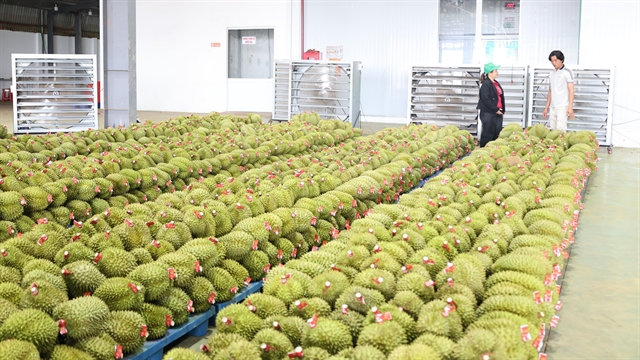
Durians for export at a warehouse in Đồng Nai. Việt Nam aims to earn $4 billion from selling durians this year. — VNA/VNS Photo Nhật Bình
HÀ NỘI — The Ministry of Agriculture and Environment is completing the remaining procedures in an effort to raise durian export revenue in 2026 to at least the level recorded last year, at US$3.85 billion, or potentially higher, around $4 billion, Deputy Minister Đặng Ngọc Diệp said.
Speaking at the Government's regular press conference for August on the afternoon of September 3, Diệp said durian is one of the agricultural products with relatively high value, with a cultivation area of about 200,000 ha and output of approximately 2.08 million tonnes. It is a key crop of the sector, accounting for about 40 per cent of its total export turnover.
In the first eight months, durian export revenue was estimated at $1.95 billion, of which exports to China alone fetched $1.85 billion or 95 per cent.
According to him, in response to difficulties facing the fruit’s exports, the ministry has sent working delegations led by deputy ministers to work directly with localities, particularly high-output growing areas in the Central Highlands, the southeastern and southwestern regions, and Đồng Nai province, to remove bottlenecks.
On July 1, the ministry launched origin tracing through its electronic system.
“We met with the trade counsellors of the US and China. They highly appreciated the ministry's implementation of origin tracing for the first time and its efforts to promote Vietnamese agricultural products as reputable brands domestically and internationally,” Diệp said, noting that this is one of the solutions to boost exports and increase the value of durian.
The ministry has also worked to address difficulties and obstacles related to the issuance of growing-area codes.
“All durian growing areas are now decentralised, allowing ward- and commune-level authorities to issue growing-area and packing-facility codes, making the process more convenient,” he said.
Following a meeting between ministry leaders and the Chinese side on August 14, the General Administration of Customs of China granted 567 growing-area codes for Vietnamese durian, bringing the total number to more than 1,800.
The Deputy Minister went on to point out several limitations in the durian sector, including rapid growth that has not yet been matched by the organisation of value chains. In addition, technical and market requirements are becoming increasingly stringent.
He also highlighted challenges from international competition, noting that countries such as Malaysia and Thailand have introduced policies to promote durian exports to China.
Regarding measures to be implemented, the ministry will step up trade promotion and diversify export markets, including continuing negotiations to expand access and increase share in promising markets such as India, Australia and New Zealand.
In July, India agreed to allow Việt Nam to export durian to its market. This is a market of more than 1 billion people with very strong demand in the coming period. We are working to expand export promotion activities in India, he said.
The second measure is to reorganise production and develop sustainable raw-material areas, while reviewing production-area planning to ensure compatibility with land, water resources, climate and infrastructure conditions.
The third is to standardise quality, food safety and origin tracing, while improving research, application and transfer of science and technology, as well as digital transformation. The two other measures are developing storage, processing and logistics infrastructure; and expanding and strengthening the capacity of the laboratory system. — VNA/VNS
Source: VNS
Related News

INFRASTRUCTURE / CONSTRUCTION / LOGISTIC / PORT
VIỆT NAM-CAMBODIA TRADE GATHERS PACE TOWARDS $20 BILLION TARGET
Trade between Việt Nam and Cambodia continues to grow, remaining a bright spot and a key pillar of bilateral cooperation as the two countries aim to raise two-way trade to US$20 billion in the coming years. After setting a record of more than $11.3 billion last year, bilateral trade reached about $8.7 billion in the first eight months of this year, up 8.3 per cent year on year.
TECHNOLOGY
AI BEGINNING TO RESHAPE RECRUITMENT CRITERIA
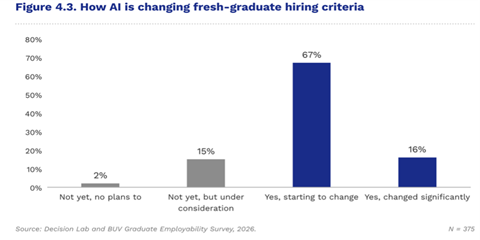
Digital literacy is the only capability area in which fresh graduates meet employers’ expectations, according to a new report. Yet, it is also the standard rising fastest, as businesses increasingly expect new hires to use AI effectively in the workplace. Some 83 per cent of employers say AI has changed, or is beginning to change, their hiring criteria, while 94 per cent report higher expectations for digital and AI capabilities than they had two to three years ago.

INFRASTRUCTURE / CONSTRUCTION / LOGISTIC / PORT
ĐÀ NẴNG GREEN-LIGHTS US$105 MILLION THAI DEVELOPMENT DEAL
The central city has approved an investment proposal by Thailand’s WHA Group to develop infrastructure for the 400ha WHA Đà Nẵng Industrial Park project on two communes of Thăng Bình and Đồng Dương, with an investment of more than VNĐ2.7 trillion (US$105 million). The city said it approved WHA Industrial Development International's status as an investor in the project, which is expected to take place between 2027 and 2034.

VIETNAM ECONOMY INVESTMENT
MOBILE PHONE EXPORTS RISE 20% TO $51.8 BILLION IN FIRST NINE MONTHS
Exports of mobile phones and components rose 20 per cent year-on-year to nearly US$51.8 billion in the first nine months of 2026, with China, the US and Republic of Korea accounting for more than half of the total. Shipments to the three markets reached a combined $26.18 billion, or 50.6 per cent of total exports of the product group during the period, according to data from the Vietnam Department of Customs under the Ministry of Finance.

VIETNAM ECONOMY INVESTMENT
FRUIT AND VEGETABLE EXPORTS POISED TO HIT $10 BILLION IN 2026
Fruit and vegetable exports are on track to reach nearly US$10 billion in 2026, after rising 19.9 per cent year on year to nearly US$7.4 billion in the first nine months, driven by strong seasonal demand and abundant tropical fruit supplies. The Ministry of Agriculture and Environment said the growth reflected stronger international demand for fresh produce and processed agricultural products.
GARMENT / TEXTILE
TEXTILE EXPORTS FACE DUAL CHALLENGES OF SUSTAINING ORDERS AND BOOSTING EFFICIENCY AMID GROWING COMPETITION
Data shows that the textile and garment sector maintained its growth momentum in the first nine months of this year. The industry's total export turnover reached an estimated US$35.721 billion in the first nine months of this year, up 3.3 per cent year-on-year. Despite posting encouraging export figures, Vietnamese textile and garment enterprises continue to navigate unpredictable market variables.
Events Sponsors






















