Want to be in the loop?
subscribe to
our notification
Business News
VIETNAM AND CHINA DISCUSS POLICIES TO SUPPORT PRIVATE-SECTOR GROWTH
On September 21, at the Ministry of Finance headquarters in Hanoi, Deputy Minister Nguyen Duc Chi held talks with a delegation from the Central Social Work Department of the Communist Party of China Central Committee, led by Zhao Shitang, Deputy Minister of the department.
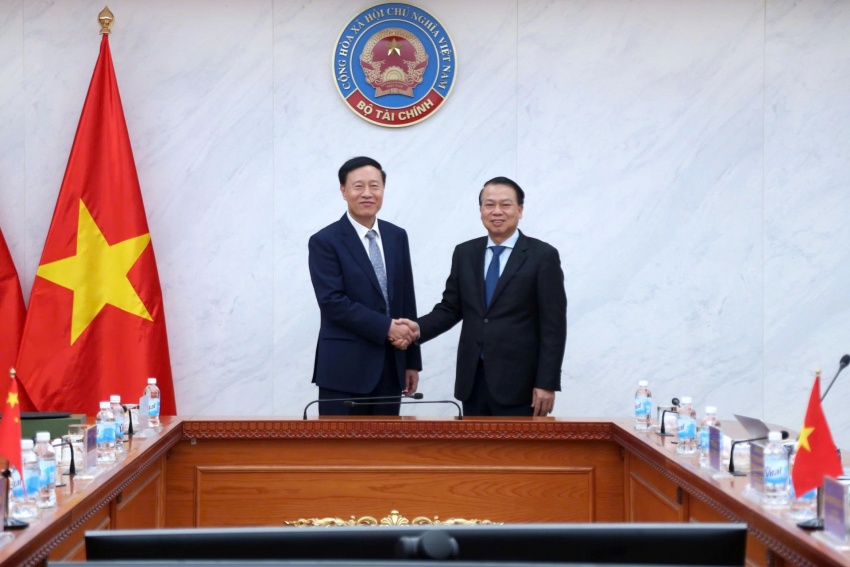
Deputy Minister of Finance Nguyen Duc Chi and Zhao Shitang, Deputy Minister of CPC Central Committee's Central Social Work Department. Photo: Duc Minh
Deputy Minister Chi warmly welcomed the delegation and highlighted the significance of the visit in learning about Vietnam’s management of the non-state business sector, particularly the registration, management, and operation of private enterprises.
Providing an overview of Vietnam’s domestic economy, the deputy minister said that after nearly 40 years of economic reforms, the business sector has established itself as one of the strategic pillars of the economy.
The private sector currently contributes more than 50 per cent of Vietnam’s GDP, accounts for over 30 per cent of total state budget revenue, and provides employment for more than 82 per cent of the country’s total workforce.
Resolution No.68-NQ/TW of the Politburo on private-sector development identifies the private economy as the most important driving force of the national economy. As of the end of August , Vietnam had more than one million active businesses.
By 2030, Vietnam aims to have two million operating private enterprises nationwide, with the sector’s contribution rising to 55-58 per cent of GDP and around 35-40 per cent of total state budget revenue.
To realise these objectives, the National Assembly and government have moved to institutionalise the policies through key documents, while also revising and supplementing relevant legislation.
The policies focus on creating a more open and transparent investment and business environment, enabling the non-state sector to participate in major national projects, and mobilising financial resources, particularly to support the stronger development of small and medium-sized enterprises.
At the meeting, representatives of MoF's Department of Private Enterprise and Collective Economy Development provided a detailed presentation on the legal framework, state management, and policy orientations aimed at encouraging Vietnam’s private sector.

Photo: Duc Minh
Deputy Minister Shitang said the delegation had studied Vietnam’s development plans for 2026-2030, giving it a deeper understanding of the workload and important tasks being undertaken by Vietnam’s finance sector.
The Chinese delegation particularly highlighted the important role of foreign-invested enterprises, including Chinese businesses, in Vietnam’s economy. Chinese investors regard Vietnam as a key strategic destination, with their presence extending from southern areas around Ho Chi Minh City to northern provinces such as Bac Giang and Bac Ninh.
The Chinese side expressed confidence that, with the investment environment continuing to improve and with practical support from the Vietnamese government and the MoF, investment flows from China would continue to increase strongly in the coming period.
Deputy Minister Chi wished China success in hosting the APEC Economic Leaders’ Meeting scheduled for November. The two sides also acknowledged the traditional friendship and effective cooperation between Vietnam and China across the political, economic, and trade spheres. Given the two countries’ geographical proximity, bilateral economic ties are expected to become increasingly close and supportive.
He agreed with the proposal to establish a closer channel for exchanges and cooperation between CPC Central Committee's Social Work Department and Vietnam’s MoF.
He added that the period leading up to 2030 would bring significant challenges. Vietnam is determined to make every effort to achieve its targets, while viewing greater sharing of experience in managing social organisations and businesses as a practical step towards strengthening the comprehensive strategic cooperative partnership.
Source: VIR
Related News

INFRASTRUCTURE / CONSTRUCTION / LOGISTIC / PORT
VIỆT NAM-CAMBODIA TRADE GATHERS PACE TOWARDS $20 BILLION TARGET
Trade between Việt Nam and Cambodia continues to grow, remaining a bright spot and a key pillar of bilateral cooperation as the two countries aim to raise two-way trade to US$20 billion in the coming years. After setting a record of more than $11.3 billion last year, bilateral trade reached about $8.7 billion in the first eight months of this year, up 8.3 per cent year on year.

TECHNOLOGY
AI BEGINNING TO RESHAPE RECRUITMENT CRITERIA
Digital literacy is the only capability area in which fresh graduates meet employers’ expectations, according to a new report. Yet, it is also the standard rising fastest, as businesses increasingly expect new hires to use AI effectively in the workplace. Some 83 per cent of employers say AI has changed, or is beginning to change, their hiring criteria, while 94 per cent report higher expectations for digital and AI capabilities than they had two to three years ago.

INFRASTRUCTURE / CONSTRUCTION / LOGISTIC / PORT
ĐÀ NẴNG GREEN-LIGHTS US$105 MILLION THAI DEVELOPMENT DEAL
The central city has approved an investment proposal by Thailand’s WHA Group to develop infrastructure for the 400ha WHA Đà Nẵng Industrial Park project on two communes of Thăng Bình and Đồng Dương, with an investment of more than VNĐ2.7 trillion (US$105 million). The city said it approved WHA Industrial Development International's status as an investor in the project, which is expected to take place between 2027 and 2034.

VIETNAM ECONOMY INVESTMENT
MOBILE PHONE EXPORTS RISE 20% TO $51.8 BILLION IN FIRST NINE MONTHS
Exports of mobile phones and components rose 20 per cent year-on-year to nearly US$51.8 billion in the first nine months of 2026, with China, the US and Republic of Korea accounting for more than half of the total. Shipments to the three markets reached a combined $26.18 billion, or 50.6 per cent of total exports of the product group during the period, according to data from the Vietnam Department of Customs under the Ministry of Finance.

VIETNAM ECONOMY INVESTMENT
FRUIT AND VEGETABLE EXPORTS POISED TO HIT $10 BILLION IN 2026
Fruit and vegetable exports are on track to reach nearly US$10 billion in 2026, after rising 19.9 per cent year on year to nearly US$7.4 billion in the first nine months, driven by strong seasonal demand and abundant tropical fruit supplies. The Ministry of Agriculture and Environment said the growth reflected stronger international demand for fresh produce and processed agricultural products.

GARMENT / TEXTILE
TEXTILE EXPORTS FACE DUAL CHALLENGES OF SUSTAINING ORDERS AND BOOSTING EFFICIENCY AMID GROWING COMPETITION
Data shows that the textile and garment sector maintained its growth momentum in the first nine months of this year. The industry's total export turnover reached an estimated US$35.721 billion in the first nine months of this year, up 3.3 per cent year-on-year. Despite posting encouraging export figures, Vietnamese textile and garment enterprises continue to navigate unpredictable market variables.
Events Sponsors






















