Want to be in the loop?
subscribe to
our notification
Business News
VIETNAM CHARTS NEW COURSE FOR MARITIME INDUSTRIAL ECOSYSTEM
Vietnam is moving to develop a fully integrated maritime industrial ecosystem under a new strategic direction that elevates shipbuilding beyond manufacturing into a broader driver of economic and national development.
The conclusion of Party General Secretary and State President To Lam, set out in Notice No.125-TB/VPTW dated July 18, marks a new approach to the development of Vietnam’s maritime industry, with the aim of building a comprehensive maritime industrial ecosystem, strengthening national self-reliance, and supporting the country’s ambition to become a strong maritime nation.
“We have just received instructions from the Ministry of Construction (MoC) to study the implementation of Party General Secretary and State President To Lam’s conclusion on the development of the national maritime industry. This can be regarded as a turning point, opening a new phase of development for Vietnam’s maritime industry,” said Le Do Muoi, director general of the Vietnam Maritime and Waterway Administration.
In addition to overseeing the maritime sector, Muoi has spent many years researching transport development strategies, having previously served as director of the Institute of Transport Strategy and Development.
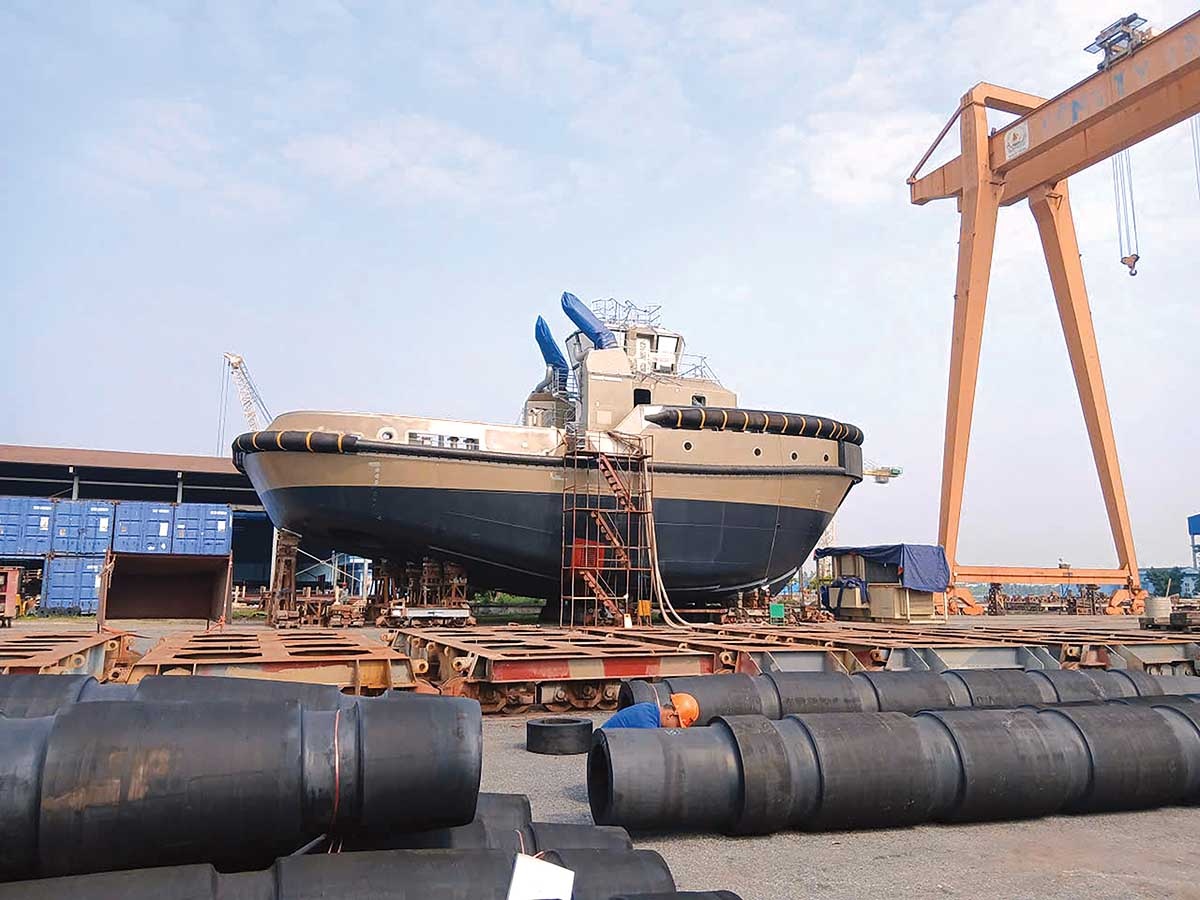
Final assembly of an export tugboat at Song Cam Shipyard
The Vietnam Maritime and Waterway Administration has also been assigned by the MoC to lead the preparation of a scheme to strengthen the capacity of domestic shipbuilding enterprises through 2030, with a vision to 2050.
The implementation of Notice 125 is expected to provide the basis to review and update the scheme in line with the new direction for developing the national maritime industry.
Under Official Letter No.11299/BXD-QLDN, issued on July 21, the MoC assigned the Vietnam Maritime and Waterway Administration to coordinate with relevant agencies in conducting a comprehensive review of Notice 125, developing an implementation plan, and advising the MoC on directives to put the conclusion into practice.
According to Muoi, the most significant aspect of Notice 125 is that, for the first time, the maritime industry has been elevated to the level of a national strategic mission.
Accordingly, the development of the maritime industry, with shipbuilding as one of its core pillars, is intended to support economic growth while strengthening national defence, security, logistics, and supply chain resilience.
Another fundamental shift is the requirement to develop the shipbuilding industry as part of an integrated maritime ecosystem, linking oceangoing vessels, inland waterway craft, seaports, logistics, supporting industries, technical services, training, research, ship registration, finance, and insurance.
“The conclusion emphasises that development should not focus on individual shipyards, localities or products in isolation. Instead, it calls for an integrated value chain that creates a stable market and enhances the overall efficiency of the entire industry. Based on this direction, we will review and update the scheme on strengthening the capacity of domestic shipbuilding enterprises through 2030, with a vision to 2050, to ensure it fully reflects the new policy orientation,” Muoi said.
In the draft scheme submitted to the MoC in mid-July, the drafting agency identified the development of the shipbuilding industry as an essential requirement for implementing Vietnam’s Strategy for the Sustainable Development of the Marine Economy, safeguarding national defense and security, and enhancing the competitiveness of the country’s marine economy.
Under the draft, Vietnam aims to account for 0.8–0.9 per cent of global shipbuilding output by 2030, meeting domestic demand for the construction and replacement of merchant vessels with a total capacity of around 4–5 million tonnes, while gradually enhancing the industry's production capacity.
Looking ahead to 2050, the scheme targets raising Vietnam’s share of global shipbuilding output to around 2 per cent, while increasing the localisation rate to more than 50 per cent.
However, the current draft remains largely focused on enhancing the capacity of the shipbuilding sector, whereas Notice No.125 envisions the creation of a comprehensive national maritime industrial ecosystem, in which shipbuilding forms one component of a broader value chain linked with seaports, shipping fleets, logistics, supporting industries, and emerging marine economic sectors.
This requires the scheme to be reviewed and updated to support the development of a complete maritime industrial ecosystem, aligning demand for oceangoing vessels, inland waterway craft, public service vessels, offshore technical services, and defence and security with domestic industrial capabilities based on the principles of competitiveness, quality and efficiency.
“This is no longer solely a matter for the shipbuilding industry. It is a national maritime industry development agenda that requires the participation of ministries, sectors, local authorities and the business community,” Muoi stressed.
Another key feature of Notice No.125 is its requirement for a comprehensive review of the shipbuilding industry's capabilities.
Party General Secretary and State President To Lam called for a full assessment and classification of the industry's capabilities based on a unified data system, clearly identifying capacities that should be preserved, upgraded, integrated, transformed, or restructured.
The review should also identify strategically valuable enterprises, assets, technologies, data, and skilled technical workforces to ensure they are utilised and developed effectively.
The findings of the review shall provide an important basis for policymaking, resource allocation, and evaluating implementation outcomes.
Source: VIR
Related News

MEMBER CORNER / PROMOTIONS
HCMC | CERTIFIED SUSTAINABILITY PROFESSIONAL (CSP) TRAINING | REGISTRATION OPEN
As sustainability becomes deeply embedded in corporate strategy and supply-chain operations across Vietnam, Hong Kong Business Association Vietnam is pleased to endorse the upcoming Certified Sustainability Professional (CSP) training program by the Asia Institute for Sustainability (AIS) - a premier internationally recognized ESG credential in Vietnam.
VIETNAM ECONOMY INVESTMENT
HCM CITY SAYS HOW IT PLANS TO ACHIEVE 10-11% ANNUAL EXPORT GROWTH FOR REST OF DECADE
The southern economic hub aims to strengthen its role as the country’s largest import-export centre while developing into a regional transhipment centre in Southeast Asia, supported by green and digital transformation and a circular economy. HCM City has outlined measures to expand production capacity, cut logistics costs, diversify export markets, and help businesses meet increasingly stringent international standards as it targets average annual export growth of 10-11 per cent through 2030.
VIETNAM ECONOMY INVESTMENT
HCM CITY LEADS ECONOMIC RESTRUCTURING IN SOUTHEAST REGION
According to Associate Professor, Dr Vũ Tuấn Hưng, director of the Institute of Social Sciences of the Southern Region, the Southeast is a strategically important socio-economic space in Việt Nam’s development given its advantages in location, industry, trade, services, logistics, science and technology, urbanisation and human resources.
TECHNOLOGY
DIGITAL TRANSFORMATION TURNED INTO PRACTICAL TOOLS FOR PEOPLE, BUSINESSES
Việt Nam is moving its digital transformation agenda beyond policy frameworks and individual technology platforms towards practical applications that address everyday needs, as authorities seek measurable outcomes from science, technology and innovation. Under Politburo Resolution No. 57-NQ/TW issued on December 22, 2024, the implementation is increasingly shifting from simply completing assigned tasks towards developing concrete products and services for citizens and businesses.
TECHNOLOGY
APPLYING TECHNOLOGY FOR ECONOMIC TRANSFORMATION
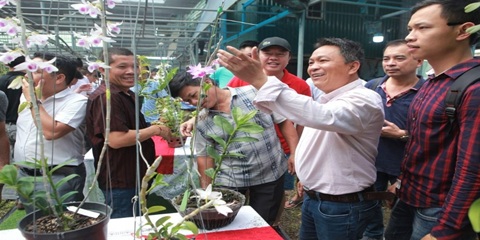
Having completed its new rural development program, Hanoi is shifting its focus toward improving development quality and building smart, sustainable rural areas. The transformation of Dong La orchid-growing village in An Khanh, a western commune of Hanoi, shows how digital technology is becoming a driver of production, market expansion, and higher incomes for local residents.

MEMBER CORNER / PROMOTIONS
VIGLACERA HONORED AS THE "LEADING GREEN INDUSTRIAL REAL ESTATE DEVELOPER 2026"
Organized by the Vietnam Investment Review, this prestigious awards program recognizes industry pioneers advancing eco-industrial parks, clean energy transition, and rigorous ESG standards. Outperforming competitors through a rigorous evaluation, Viglacera Corporation – JSC proudly ranked among the Top 5 highest-positioned enterprises in the Leading Green Industrial Real Estate Developers 2026 category, reinforcing its premier position in Vietnam’s industrial real estate sector.
Events Sponsors






















