Want to be in the loop?
subscribe to
our notification
Business News
VIETNAM MANUFACTURING GAINS MOMENTUM ON STRONGER FDI
Vietnam’s manufacturing sector continued to improve in August 2026, with output growing at its fastest pace in more than two years and new orders recording their strongest increase since October 2025. This improvement came as foreign direct investment (FDI) inflows into manufacturing continued to grow strongly, showing that the industrial sector’s recovery is being supported by both short-term orders and long-term investment flows.
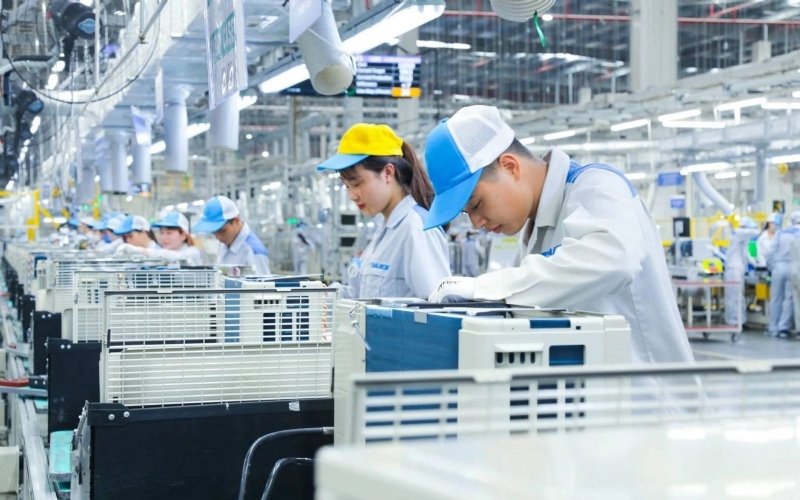
Vietnam has successfully attracted significant foreign investment in high-tech industries
Manufacturing Sector Shows Stronger Growth
According to S&P Global, Vietnam’s manufacturing Purchasing Managers’ Index (PMI) reached 53.3 points in August 2026, up from 52.9 points in July and its highest level since February. Output increased for the 16th consecutive month, recording its fastest growth in more than two years, while new orders rose at their strongest pace since October 2025.
Surveyed businesses attributed the improvement to the development and launch of new products, greater availability of raw materials and easing price pressures. As a result, manufacturers received more orders and increased production to meet demand.
Total new orders increased in August, but growth was driven mainly by the domestic market, while export orders declined slightly. This marked the first time in four months that new orders from overseas had returned to a downward trend.
Output increased, but employment in the sector continued to decline, marking the fifth contraction in the workforce in six months. Businesses attributed this mainly to resignations, retirements and reduced use of temporary contract workers. To meet higher production demand, manufacturers also increased purchasing activity in August. Finished goods inventories declined as products were delivered to customers, recording their sharpest decrease since April.
On the supply side, supplier delivery times continued to lengthen, but transportation disruptions became less severe in the middle of the third quarter. As a result, delivery times lengthened only slightly, remaining at a level similar to April 2025.
Andrew Harker, Economics Director at S&P Global Market Intelligence, said Vietnam’s manufacturing sector was strengthening in the middle of the third quarter of 2026. This shows that businesses have been able to improve operational efficiency and increase production without yet expanding their workforces.
Cost pressures remained as oil prices continued to push up fuel, plastics and transportation costs. However, the rate of increase in input costs slowed to its lowest level in 11 months, while selling prices also increased at a slower pace for the fourth consecutive month.
FDI Inflows Support Manufacturing Recovery
The positive development came as FDI inflows into Vietnam continued to increase. In the first eight months of 2026, total registered foreign investment reached US$40.63 billion, up 55.4% year on year, while disbursed FDI reached US$17.25 billion, up 12% and the highest level for the first eight months in five years. Capital continued to concentrate heavily in processing and manufacturing, with an increasing shift toward larger-scale projects with higher technology content.
According to an analysis by Savills Vietnam, the first half of 2026 saw a trend toward fewer new manufacturing projects but larger investment amounts. The computers, electronics and optical products sector accounted for a very large share of new manufacturing FDI. Savills also said Vietnam is attracting higher-value projects that are more closely linked to technology.
John Campbell, Director and Head of Industrial Services at Savills Vietnam, said Vietnam is currently attracting fewer new manufacturing projects, but these projects have higher investment values, greater technology content and a more important role in regional supply chains.
This trend is particularly evident in high-tech sectors. The market is also seeing an increasing number of very large-scale projects, including those by Samsung Semiconductor Asia Holdings, Samsung Electro-Mechanics Vietnam and LG Innotek Vietnam. While electronics and semiconductors are key growth drivers, the investment structure remains relatively diverse, with mechanical engineering, electrical equipment, metal products, rubber, plastics, food and automotive industries also attracting active investment.
“We are witnessing a shift from broad-based manufacturing expansion toward more specialized investments focused on technology, scale and production capabilities. Investors are not simply seeking factory locations but are building important links in their long-term supply chain strategies in Vietnam,” said Campbell.
Infrastructure and Industrial Real Estate Expand Capacity
The shift in manufacturing investment is also changing demand for industrial real estate. Alongside manufacturing, logistics is becoming an increasingly important part of the real estate ecosystem serving supply chains, as e-commerce, faster delivery requirements and increasingly complex production networks create additional demand for modern logistics facilities and locations connected to seaports, airports, expressways and consumer centers.
The shift toward high-tech sectors is also changing real estate requirements. Sectors such as electronics, semiconductors, data centers and high-tech manufacturing often require higher standards for power supply, data connectivity, technical infrastructure and operational capabilities, rather than simply larger industrial real estate areas.
Data centers are one example. According to Savills Vietnam’s Industrial Outlook 2026, the total operational design capacity of data centers in Vietnam reached approximately 524.7 MW in 2025 and could rise to 950 MW by 2030, an increase of about 81%.
The development of these sectors is taking place as Vietnam’s infrastructure network expands. Expressways, deep-water ports, airports and logistics networks are improving connectivity between production centers and consumer markets. In the North, Hai Phong, Bac Ninh, Hung Yen, Quang Ninh and surrounding areas are forming a more interconnected manufacturing and logistics network. In the South, the expanded Ho Chi Minh City, Dong Nai and areas around Long Thanh continue to benefit from large-scale infrastructure projects.
According to Matthew Powell, Director of Savills Hanoi, infrastructure development is creating more room for real estate supply while expanding the geographic scope of investment activity. “Vietnam now has the infrastructure in place, opening up large areas of land and connecting different provinces and cities by making full use of these infrastructure investments,” he said.
Source: VCCI
Related News

INFRASTRUCTURE / CONSTRUCTION / LOGISTIC / PORT
VIỆT NAM-CAMBODIA TRADE GATHERS PACE TOWARDS $20 BILLION TARGET
Trade between Việt Nam and Cambodia continues to grow, remaining a bright spot and a key pillar of bilateral cooperation as the two countries aim to raise two-way trade to US$20 billion in the coming years. After setting a record of more than $11.3 billion last year, bilateral trade reached about $8.7 billion in the first eight months of this year, up 8.3 per cent year on year.

TECHNOLOGY
AI BEGINNING TO RESHAPE RECRUITMENT CRITERIA
Digital literacy is the only capability area in which fresh graduates meet employers’ expectations, according to a new report. Yet, it is also the standard rising fastest, as businesses increasingly expect new hires to use AI effectively in the workplace. Some 83 per cent of employers say AI has changed, or is beginning to change, their hiring criteria, while 94 per cent report higher expectations for digital and AI capabilities than they had two to three years ago.

INFRASTRUCTURE / CONSTRUCTION / LOGISTIC / PORT
ĐÀ NẴNG GREEN-LIGHTS US$105 MILLION THAI DEVELOPMENT DEAL
The central city has approved an investment proposal by Thailand’s WHA Group to develop infrastructure for the 400ha WHA Đà Nẵng Industrial Park project on two communes of Thăng Bình and Đồng Dương, with an investment of more than VNĐ2.7 trillion (US$105 million). The city said it approved WHA Industrial Development International's status as an investor in the project, which is expected to take place between 2027 and 2034.

VIETNAM ECONOMY INVESTMENT
MOBILE PHONE EXPORTS RISE 20% TO $51.8 BILLION IN FIRST NINE MONTHS
Exports of mobile phones and components rose 20 per cent year-on-year to nearly US$51.8 billion in the first nine months of 2026, with China, the US and Republic of Korea accounting for more than half of the total. Shipments to the three markets reached a combined $26.18 billion, or 50.6 per cent of total exports of the product group during the period, according to data from the Vietnam Department of Customs under the Ministry of Finance.

VIETNAM ECONOMY INVESTMENT
FRUIT AND VEGETABLE EXPORTS POISED TO HIT $10 BILLION IN 2026
Fruit and vegetable exports are on track to reach nearly US$10 billion in 2026, after rising 19.9 per cent year on year to nearly US$7.4 billion in the first nine months, driven by strong seasonal demand and abundant tropical fruit supplies. The Ministry of Agriculture and Environment said the growth reflected stronger international demand for fresh produce and processed agricultural products.

GARMENT / TEXTILE
TEXTILE EXPORTS FACE DUAL CHALLENGES OF SUSTAINING ORDERS AND BOOSTING EFFICIENCY AMID GROWING COMPETITION
Data shows that the textile and garment sector maintained its growth momentum in the first nine months of this year. The industry's total export turnover reached an estimated US$35.721 billion in the first nine months of this year, up 3.3 per cent year-on-year. Despite posting encouraging export figures, Vietnamese textile and garment enterprises continue to navigate unpredictable market variables.
Events Sponsors






















