Want to be in the loop?
subscribe to
our notification
Business News
VIETNAM NEEDS HUGE CAPITAL FOR SEAPORT DEVELOPMENT
As of October 2022, Vietnam had 296 ports about 107 km in length (five times that of 2000). International gateway ports have been established in the northern and southern regions, with Lach Huyen wharf area (Hai Phong) and Cai Mep wharf area (Ba Ria-Vung Tau) capable of accommodating container ships up to 145,000 tons and 214,000 tons, respectively. However, for Vietnam's seaport system to develop in line with the country's economic development, there is still a lot of work to be done, including capital to upgrade it.
Synchronous development planning
According to the "Detailed plan for seaports, ports, wharves, floating terminals, water zones and water areas in the 2021-2030 period, with a vision to 2050" of the Ministry of Transport, by 2025, Vietnam will focus on upgrading the Cai Mep-Thi Vai channel to serve ships up to 200,000 tons; project of building channels for 20,000-ton ships entering the Hau River - phase 2; project of building the Van Uc River channel to accommodate ships of up to 10,000 tons, project of building the Chanh River channel to accommodate ships up to 50,000 tons. Vietnam will prioritize investment in sea lights in islands and archipelagos under Vietnam's sovereignty, infrastructure for maritime safety; building the Coastal Information Station, the Search and Rescue Center, the representative of Nha Trang Maritime Authority in Truong Sa district.
By 2030, Vietnam will invest in the construction of breakwaters at Vung Ang Port, (Ha Tinh province), and at the same time renovate and upgrade the system of sand breakwaters of Cua Viet and Cua Gianh channels as well as renovate and upgrade Cam Pha channel, Ba Ngoi channel, Hon La channel, the navigational channel through Tran De estuary and correct Diem Dien and Van Uc navigational channels.
The vessel traffic system will also be prioritized for investment in the Hon Gai-Cai Lan channel and the channel for large vessels entering the Hau River.
According to the Ministry of Transport, the implementation of the plan will be focused on six main port clusters. In particular, port cluster 1 will focus on upgrading Hai Phong seaport system, turning Lach Huyen Port into a port serving only container cargo. Dinh Vu Port - Cam River will continue to be maintained, serving the industrial park in the area. Bulk cargo, liquid cargo and gas cargo will be moved to Nam Do Son, Van Uc area.
Along with upgrading Thanh Hoa and Da Nang port clusters, Khanh Hoa seaport cluster with Van Phong area which has extremely favorable natural advantages with a channel depth of up to -18 m can be the largest gateway port in Vietnam. Cai Mep-Thi Vai port cluster is a very expected port cluster when a series of highway projects are being considered for implementation such as Bien Hoa-Vung Tau; Ring Road 3, Ring Road 4 of Ho Chi Minh City, Ben Luc-Long Thanh Expressway, Ho Chi Minh City-Chon Thanh Expressway through Binh Duong, Binh Phuoc, Ho Chi Minh City - Moc Bai Expressway.
Vietnam will study and build Tran De Port along with Can Tho-Tran De, Can Tho-Chau Doc, Can Tho-Ca Mau highways and Can Tho international airport. The Mekong Delta region will be industrialized and modernized.
Huge capital needed
According to the plan, by 2030, it is expected that the total investment demand for the seaport system will be about VND312,625 billion (US$13.4 billion). In which, the investment capital demand for public maritime infrastructure is about more than VND70 trillion and the need for investment capital for the port is more than VND242 trillion.
In the period 2011-2020, the total investment capital for the development of seaport infrastructure is about VND202 trillion, accounting for about 20.6% of the total investment capital for transport infrastructure. Notably, the investment capital mobilized for the maritime industry outside the state budget accounts for a large proportion, reaching more than VND173 trillion, approximately 86% of the total investment capital.
Many of the world's leading corporations in the field of transport and port operation have been present in Vietnam to form joint ventures to invest in the construction and operation of seaports such as MOL and NYK shipping lines investing in Lach Huyen Port (Hai Phong); DP World-UAE Group (the world's number 5 port operator) investing in SPCT Port-Ho Chi Minh City; SSA Marine Corporation (the 9th port operator in the world) investing in exploiting SSIT port in Ba Ria-Vung Tau province; APMT-Danish Group (the world's No.2 port operator) investing in CMIT Port in Ba Ria-Vung Tau province.
Thanks to attracting investment capital, Vietnam's seaport system has recorded outstanding growth. The total volume of cargo through the seaport system in 2020 reached 692.2 million tons, compared with the planned target of 640-680 million tons (about 8.4 times higher than in 2000), achieving a growth rate of 13.3% per year for the period 2015-2020.
Notably, Vietnam also established 32 shipping routes including 25 international transport routes and 7 domestic transport routes. In addition to intra-Asia routes, the Northern region also operates two routes to North America; the Southern region forms 16 long-distance routes to North America and Europe.
Currently, specialized ports are developed and receive many large vessels. Large-scale specialized wharfs associated with industrial parks, metallurgical complexes, petrochemical refineries, coal-fired power centers receiving ships up to 200,000 tons, liquid cargo up to 150,000 tons (product ships) and crude oil up to 320,000 tons, basically have achieved the planning targets by 2020.
According to experts, given that such a large capital is needed for investment in the near future, in addition to developing an open policy on investment, the implementation of technical and specialized plans to realize the "master plan on development of seaport system" is essential for the synchronous and continuous development of the seaport system in the master plan to meet the requirements of industrialization and modernization of the country.
Source: VCCI
Related News
MEMBER CORNER / PROMOTIONS
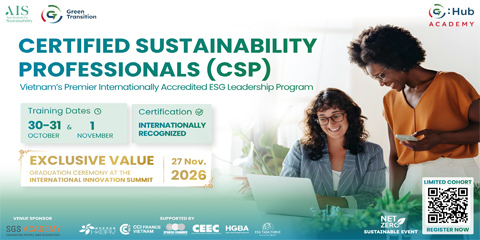
HCMC | CERTIFIED SUSTAINABILITY PROFESSIONAL (CSP) TRAINING | REGISTRATION OPEN
As sustainability becomes deeply embedded in corporate strategy and supply-chain operations across Vietnam, Hong Kong Business Association Vietnam is pleased to endorse the upcoming Certified Sustainability Professional (CSP) training program by the Asia Institute for Sustainability (AIS) - a premier internationally recognized ESG credential in Vietnam.
VIETNAM ECONOMY INVESTMENT
HCM CITY SAYS HOW IT PLANS TO ACHIEVE 10-11% ANNUAL EXPORT GROWTH FOR REST OF DECADE
The southern economic hub aims to strengthen its role as the country’s largest import-export centre while developing into a regional transhipment centre in Southeast Asia, supported by green and digital transformation and a circular economy. HCM City has outlined measures to expand production capacity, cut logistics costs, diversify export markets, and help businesses meet increasingly stringent international standards as it targets average annual export growth of 10-11 per cent through 2030.
VIETNAM ECONOMY INVESTMENT
HCM CITY LEADS ECONOMIC RESTRUCTURING IN SOUTHEAST REGION
According to Associate Professor, Dr Vũ Tuấn Hưng, director of the Institute of Social Sciences of the Southern Region, the Southeast is a strategically important socio-economic space in Việt Nam’s development given its advantages in location, industry, trade, services, logistics, science and technology, urbanisation and human resources.
TECHNOLOGY
DIGITAL TRANSFORMATION TURNED INTO PRACTICAL TOOLS FOR PEOPLE, BUSINESSES
Việt Nam is moving its digital transformation agenda beyond policy frameworks and individual technology platforms towards practical applications that address everyday needs, as authorities seek measurable outcomes from science, technology and innovation. Under Politburo Resolution No. 57-NQ/TW issued on December 22, 2024, the implementation is increasingly shifting from simply completing assigned tasks towards developing concrete products and services for citizens and businesses.
TECHNOLOGY
APPLYING TECHNOLOGY FOR ECONOMIC TRANSFORMATION
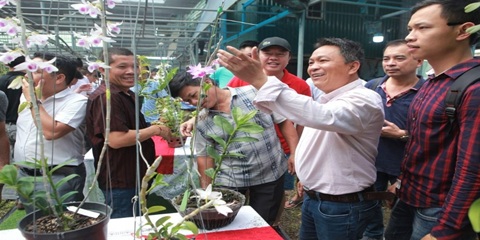
Having completed its new rural development program, Hanoi is shifting its focus toward improving development quality and building smart, sustainable rural areas. The transformation of Dong La orchid-growing village in An Khanh, a western commune of Hanoi, shows how digital technology is becoming a driver of production, market expansion, and higher incomes for local residents.
MEMBER CORNER / PROMOTIONS
VIGLACERA HONORED AS THE "LEADING GREEN INDUSTRIAL REAL ESTATE DEVELOPER 2026"
Organized by the Vietnam Investment Review, this prestigious awards program recognizes industry pioneers advancing eco-industrial parks, clean energy transition, and rigorous ESG standards. Outperforming competitors through a rigorous evaluation, Viglacera Corporation – JSC proudly ranked among the Top 5 highest-positioned enterprises in the Leading Green Industrial Real Estate Developers 2026 category, reinforcing its premier position in Vietnam’s industrial real estate sector.
Events Sponsors






















