Want to be in the loop?
subscribe to
our notification
Business News
VIETNAM’S DRAFT E-TRANSACTION LAW AND THE HIGHLIGHTS WITHIN
The current Vietnamese Law on E-transactions 2005 is based upon the model Law on E-Commerce, which is outdated, and its terms are difficult to apply in practice. Meanwhile, e-commerce transactions are increasingly developing due to changing user demands and habits since the COVID-19 pandemic.
In 2021, the government implemented policies on the development of digital government, economy, society, and citizens, including the amendment of the Law on E-transactions. The law has been revised to include the following points:
- Expanding scope of application;
- Supplementing the regulations allowing the conversion of data messages into a physical document and vice versa;
- Supplementing regulations on e-signature classification and recognising the use of foreign e-signature;
- Regulations on trusted services;
- Strengthened management of state authorities on digital platforms.
Compared with the Law on E-transactions 2005, the new draft has expanded the scope of application to the administrative field. The amendment is in line with new trends, such as by September 2021, Vietnam had 25 out of 63 provinces and cities allowing online marriage registration. Other complicated judicial, and administrative procedures, such as registration for a certificate of land use and ownership of houses and other land-attached assets, are likely to apply for electronic documentation going forward. Unlike the existing Law on E-transactions, the draft has not regulated the formats, conditions, and methods to prove the legitimacy of data messages. However, there is a supplement on regulations to ensure the legitimacy of the physical document, admin procedure results, certificates, and physical documents converted from data messages and vice versa. However, the criteria for determining reliability are still difficult in practice, especially for individuals. Thus, the draft needs to be further amended.
However, the new adjustments should solve problems related to the legitimacy of data messages when digitalising, partially reducing the document duplication and authentication of document procedures, and enhance the potential of e-transactions in many fields.
Trusted services have been researched and developed based on experiences in the development of foreign law. Accordingly, the three key types of trusted services are timestamp granting services, certification of data message services, and public e-signature services.
Although trusted services are a conditional business line, current regulations empower service providers to build business plans, infrastructure systems, and service delivery standards. Therefore, legislators in Vietnam should research and evaluate further before issuing decrees and circulars guiding the licensing of trusted services.
The draft has supplemented regulations on the management of digital platforms of state authorities, such as regulations on registration of such platforms, not disseminating prohibited information and documents, complying with the principle of fair competition in business, and fully fulfilling tax obligations.
At the same time, the draft regulates the classification of digital platforms according to their specific size and nature. This regulation binds individuals and enterprises doing business on such platforms to meet business conditions and comply with obligations to protect public interests as the number of users on digital platforms increases.
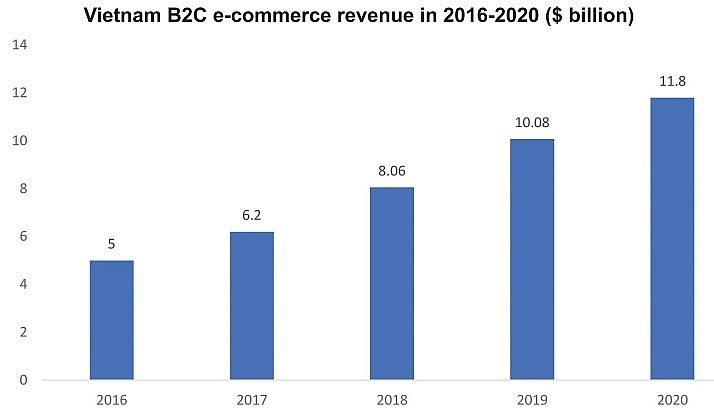
E-transactions help parties to enter transactions without the worries of geographical barriers, saving time, effort, and money. From 2006 to 2020, Vietnam’s e-commerce market grew from nearly zero to an estimated $12 billion (estimated). In 2018, Vietnam’s e-commerce had a growth rate of over 30 per cent. The buying habits of Vietnamese consumers have also changed dramatically.
The new highlights in the draft are expected to impact Vietnamese enterprises significantly. According to the Department of Informatics under the Ministry of Information and Communications, expanding the draft’s scope is expected to save a minimum of 288 million working hours, equivalent to over VND9 trillion ($391 million) per year. At the same time, the rollout of public services can help raise the rate of electronic administrative procedures being performed by up to 80 per cent, with estimated cost savings for enterprises to be VND2 trillion ($87 million) per year.
Expanding the scope of the draft across many fields is a premise for developing e-governments and digital citizenship. Building a synchronous, unified, and mutually compatible database will require coordinated guidance from several ministries. However, this can be considered a market-building move by the government, bringing many business opportunities in the IT field and for enterprises that have been and will move to provide trusted services.
In practice, the draft will require updating the existing information system and database to comply with the provisions of the law, in which enterprises operating in e-commerce or those regularly applying e-transactions will have to arrange a time and costs of personnel training, technology deployment, and application.
At the same time, this will pose challenges for traditional enterprises that must innovate to apply e-transactions in their activities to align with national policies on developing e-government, digital economy, digital culture, and digital citizens.
Source: VIR
Related News

CHARITY / EXHIBITION / OTHER EVENTS
INVESTMENT OPPORTUNITIES IN CA MAU PROVINCE: 96 PROJECTS AND 20 STRATEGIC PROJECTS
We are pleased to share with you information on investment projects currently seeking investors in Ca Mau Province. Should your esteemed company or association be interested, we kindly invite you to review the project information and complete the registration form via the links provided. The Ho Chi Minh City Investment and Trade Promotion Centre (ITPC) will consolidate the expressions of interest and facilitate connections with the leadership of Ca Mau Province at a meeting tentatively scheduled for 13 November 2026 in Ho Chi Minh City.

MEMBER CORNER / PROMOTIONS
BẰNG KIỀU LIVESHOW - A SYMPHONY OF LOVE UNDER THE GOLDEN GLOW
A masterclass in live music that takes the audience on a soulful journey through immortal love songs, guided by the peerless artistry and emotive storytelling of renowned singer Bằng Kiều. The highlight of the night is his seamless musical chemistry with special guest Triệu Hồng Ngọc, promising passionate and deeply resonant duets inside the magnificent Grand Ballroom.

INFRASTRUCTURE / CONSTRUCTION / LOGISTIC / PORT
ĐÀ NẴNG GREEN-LIGHTS US$105 MILLION THAI DEVELOPMENT DEAL
The central city has approved an investment proposal by Thailand’s WHA Group to develop infrastructure for the 400ha WHA Đà Nẵng Industrial Park project on two communes of Thăng Bình and Đồng Dương, with an investment of more than VNĐ2.7 trillion (US$105 million). The city said it approved WHA Industrial Development International's status as an investor in the project, which is expected to take place between 2027 and 2034.

VIETNAM ECONOMY INVESTMENT
MOBILE PHONE EXPORTS RISE 20% TO $51.8 BILLION IN FIRST NINE MONTHS
Exports of mobile phones and components rose 20 per cent year-on-year to nearly US$51.8 billion in the first nine months of 2026, with China, the US and Republic of Korea accounting for more than half of the total. Shipments to the three markets reached a combined $26.18 billion, or 50.6 per cent of total exports of the product group during the period, according to data from the Vietnam Department of Customs under the Ministry of Finance.

INFRASTRUCTURE / CONSTRUCTION / LOGISTIC / PORT
VIỆT NAM-CAMBODIA TRADE GATHERS PACE TOWARDS $20 BILLION TARGET
Trade between Việt Nam and Cambodia continues to grow, remaining a bright spot and a key pillar of bilateral cooperation as the two countries aim to raise two-way trade to US$20 billion in the coming years. After setting a record of more than $11.3 billion last year, bilateral trade reached about $8.7 billion in the first eight months of this year, up 8.3 per cent year on year.

VIETNAM ECONOMY INVESTMENT
FRUIT AND VEGETABLE EXPORTS POISED TO HIT $10 BILLION IN 2026
Fruit and vegetable exports are on track to reach nearly US$10 billion in 2026, after rising 19.9 per cent year on year to nearly US$7.4 billion in the first nine months, driven by strong seasonal demand and abundant tropical fruit supplies. The Ministry of Agriculture and Environment said the growth reflected stronger international demand for fresh produce and processed agricultural products.
Events Sponsors






















