Want to be in the loop?
subscribe to
our notification
Business News
VIETNAM SEES RECORD CAPITAL INFLOWS ALONGSIDE SHARP RISE IN BUSINESS CLOSURES
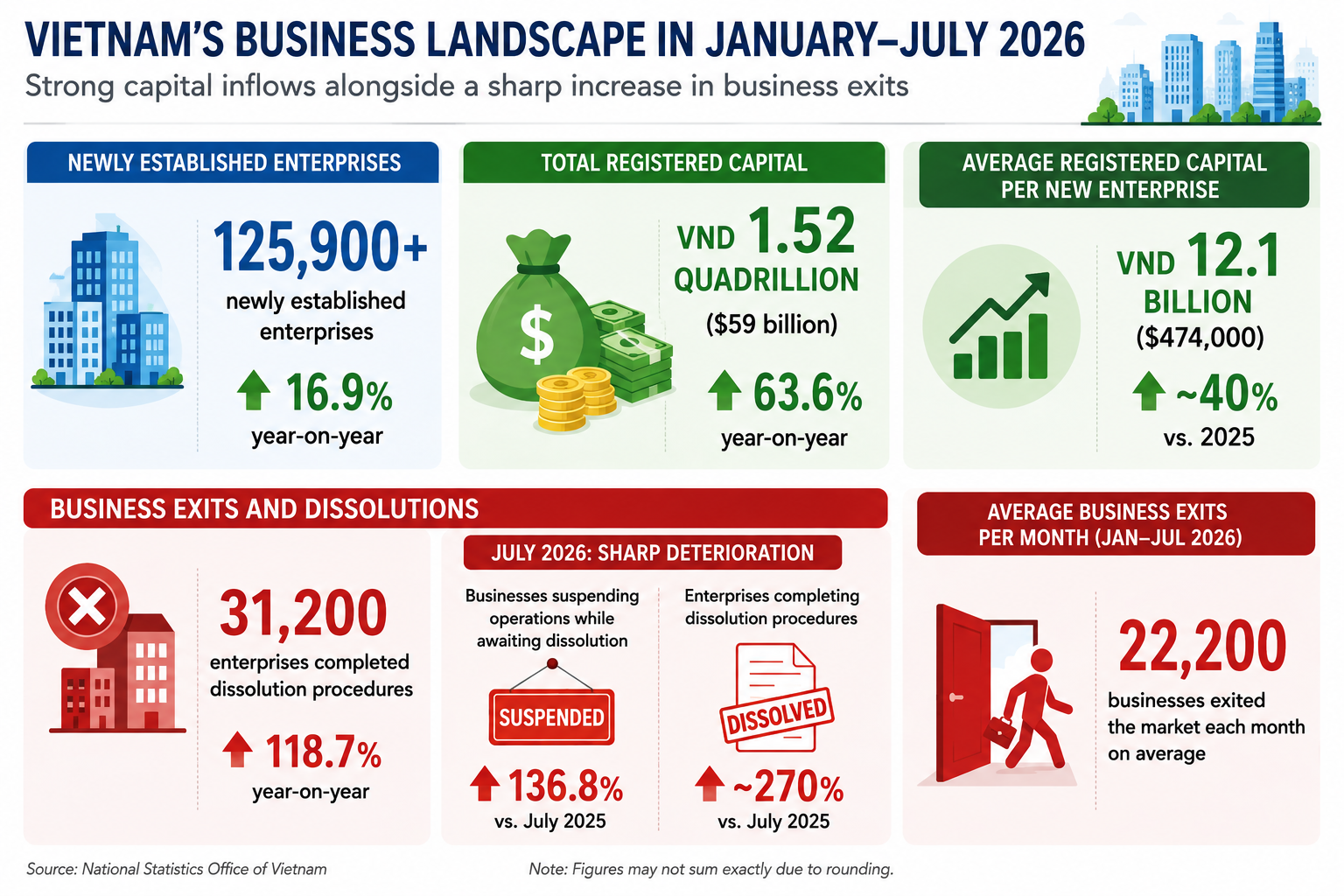
Vietnam's business sector presented a striking tale of two contrasting trends during the first seven months of 2026. While newly registered capital surged by more than 63 per cent, the market also underwent an unprecedented wave of consolidation, with the number of dissolved businesses jumping nearly 119 per cent.
The divergence suggests the economy is undergoing a significant structural reshuffle, with weaker businesses exiting the market while capital increasingly flows into enterprises and sectors with stronger long-term growth prospects.
According to the National Statistics Office's socioeconomic report for the first seven months of 2026, released on August 3, Vietnam recorded more than 125,900 newly established enterprises, up 16.9 per cent from the same period last year.
More notably, total registered capital reached nearly VND1.52 quadrillion ($59 billion), representing a 63.6 per cent on-year increase. As a result, the average registered capital of a newly established enterprise rose to $474,000, almost 40 per cent higher than in 2025.
Including additional capital injected by existing businesses, total capital flowing into the economy reached $141 billion during the seven-month period, up 7.3 per cent on-year.
The figures suggest investors are shifting away from establishing small-scale businesses and instead favouring companies with stronger financial foundations that are better positioned to withstand macroeconomic uncertainties.
On average, 26,700 enterprises entered or re-entered the market each month during the first seven months of the year.
The surge in investment was accompanied by an equally striking increase in business exits. Nearly 31,200 enterprises completed dissolution procedures during the January-July, up 118.7 per cent compared with a year earlier.
July alone saw a particularly sharp deterioration. The number of businesses suspending operations while awaiting dissolution rose 136.8 per cent on-year, while the number completing dissolution procedures surged by nearly 270 per cent.
Overall, an average of 22,200 businesses exited the market each month. The figures point to an accelerating market shakeout, with financially weaker businesses unable to adapt to changing market conditions or recover from prolonged cash-flow pressures leaving the market, creating room for more competitive and better-capitalised enterprises.
Another notable trend was the growing disconnect between rising investment and labour demand. Although newly registered capital increased by 63.6 per cent, the number of registered employees fell 10.9 per cent on-year to around 597,300. The divergence reflects Vietnam's ongoing transition from a labour-intensive economy towards one driven increasingly by capital investment and technology.
New businesses appear to be building leaner operating models, investing more heavily in machinery, digitalisation, and automation to improve productivity rather than relying on large-scale hiring.
The same pattern is evident in business closures. Traditional labour-intensive sectors, including construction and wholesale and retail trade, continued to record large numbers of new business registrations but also faced particularly intense competitive pressures.
Business dissolutions in the construction sector jumped 128.5 per cent, reflecting persistent cash-flow constraints, while more than 11,700 wholesale and retail businesses closed, up 125.1 per cent, amid weak consumer demand.
The property sector experienced the most severe contraction, with the number of dissolved businesses soaring 135.3 per cent, a pace six times faster than the growth in newly established real estate firms.
The large-scale exit of businesses from these traditionally employment-intensive industries has been a key factor behind the decline in registered employment despite continued growth in new business formation.
By contrast, investment is increasingly concentrated in capital- and technology-intensive industries. One notable example is the electricity, gas, and water supply sector, where the number of newly established enterprises increased 74.5 per cent on-year.
The shift in capital towards energy and utility infrastructure underscores the economy's broader structural transformation. As newly established businesses adopt more automation and advanced technologies, they require significantly larger upfront investment but fewer workers, explaining why record capital inflows have not translated into stronger employment growth.
Source: VIR
Related News

INFRASTRUCTURE / CONSTRUCTION / LOGISTIC / PORT
VIỆT NAM-CAMBODIA TRADE GATHERS PACE TOWARDS $20 BILLION TARGET
Trade between Việt Nam and Cambodia continues to grow, remaining a bright spot and a key pillar of bilateral cooperation as the two countries aim to raise two-way trade to US$20 billion in the coming years. After setting a record of more than $11.3 billion last year, bilateral trade reached about $8.7 billion in the first eight months of this year, up 8.3 per cent year on year.
TECHNOLOGY
AI BEGINNING TO RESHAPE RECRUITMENT CRITERIA
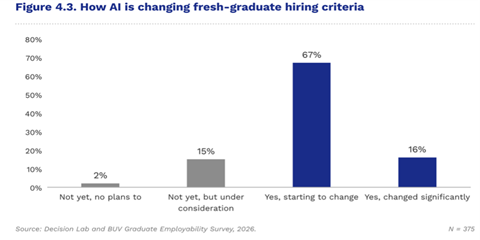
Digital literacy is the only capability area in which fresh graduates meet employers’ expectations, according to a new report. Yet, it is also the standard rising fastest, as businesses increasingly expect new hires to use AI effectively in the workplace. Some 83 per cent of employers say AI has changed, or is beginning to change, their hiring criteria, while 94 per cent report higher expectations for digital and AI capabilities than they had two to three years ago.

INFRASTRUCTURE / CONSTRUCTION / LOGISTIC / PORT
ĐÀ NẴNG GREEN-LIGHTS US$105 MILLION THAI DEVELOPMENT DEAL
The central city has approved an investment proposal by Thailand’s WHA Group to develop infrastructure for the 400ha WHA Đà Nẵng Industrial Park project on two communes of Thăng Bình and Đồng Dương, with an investment of more than VNĐ2.7 trillion (US$105 million). The city said it approved WHA Industrial Development International's status as an investor in the project, which is expected to take place between 2027 and 2034.

VIETNAM ECONOMY INVESTMENT
MOBILE PHONE EXPORTS RISE 20% TO $51.8 BILLION IN FIRST NINE MONTHS
Exports of mobile phones and components rose 20 per cent year-on-year to nearly US$51.8 billion in the first nine months of 2026, with China, the US and Republic of Korea accounting for more than half of the total. Shipments to the three markets reached a combined $26.18 billion, or 50.6 per cent of total exports of the product group during the period, according to data from the Vietnam Department of Customs under the Ministry of Finance.

VIETNAM ECONOMY INVESTMENT
FRUIT AND VEGETABLE EXPORTS POISED TO HIT $10 BILLION IN 2026
Fruit and vegetable exports are on track to reach nearly US$10 billion in 2026, after rising 19.9 per cent year on year to nearly US$7.4 billion in the first nine months, driven by strong seasonal demand and abundant tropical fruit supplies. The Ministry of Agriculture and Environment said the growth reflected stronger international demand for fresh produce and processed agricultural products.
GARMENT / TEXTILE
TEXTILE EXPORTS FACE DUAL CHALLENGES OF SUSTAINING ORDERS AND BOOSTING EFFICIENCY AMID GROWING COMPETITION
Data shows that the textile and garment sector maintained its growth momentum in the first nine months of this year. The industry's total export turnover reached an estimated US$35.721 billion in the first nine months of this year, up 3.3 per cent year-on-year. Despite posting encouraging export figures, Vietnamese textile and garment enterprises continue to navigate unpredictable market variables.
Events Sponsors






















