Want to be in the loop?
subscribe to
our notification
Business News
WOOD AND WOOD PRODUCT EXPORTS CONTINUE TO GROW AMID TARIFF UNCERTAINTY
In the face of global trade turbulence caused by sudden tariff changes in the US and shifts in global supply chains, Việt Nam’s wood and wood product exports have managed to maintain positive momentum.
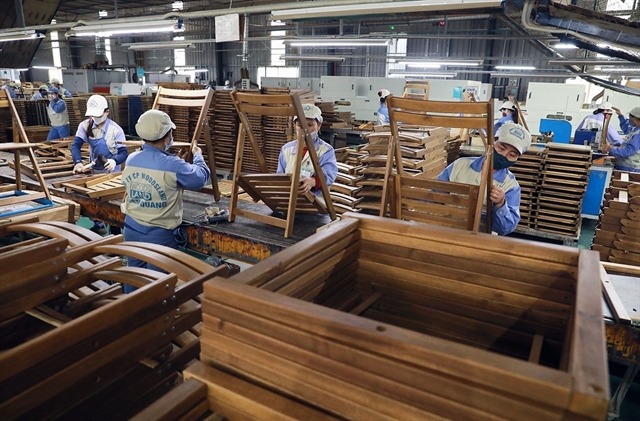
Wooden furniture products are being finalised for export to key markets such as the US and EU. VNA/VNS Photo
HCM CITY — In the face of global trade turbulence caused by sudden tariff changes in the US and shifts in global supply chains, Việt Nam’s wood and wood product exports have managed to maintain positive momentum.
However, the industry is still confronting mounting challenges that demand adaptability and proactive efforts to build domestic resilience.
According to the Ministry of Agriculture and Environment, the export value of wood and wood products in the first six months of 2025 reached US$8.21 billion, representing an increase of 8.9 per cent compared to the same period in 2024.
The US remained Việt Nam’s largest export market, accounting for 55.6 per cent of the total export turnover.
Japan and China followed with market shares of 12.6 per cent and 10.4 per cent, respectively.
Despite the persistent pressure of tariffs in its key market, the sector continued to demonstrate its strength, remaining among the top five agricultural groups with the largest trade surplus.
The trade surplus for wood and wood products reached VNĐ169.5 trillion ($6.69 billion), a rise of 6.7 per cent year-on-year.
US market adapts
Phùng Quốc Mẫn, Chairman of the Members’ Council of Bảo Hưng Co., Ltd. and President of the Handicraft and Wood Industry Association of HCM City, said that although the US market was affected by new minimum and countervailing tax regimes, Việt Nam’s export performance in the first half of 2025 exceeded expectations.
Exports to the US still managed to grow by roughly 6 per cent, partly due to clients boosting inventory levels ahead of expected tax enforcement.
Mẫn noted that the countervailing tax policy imposed by the US, though unexpected, was applied broadly to many exporting nations, not exclusively Việt Nam.
As a result, even though the cost of goods increased, US importers were compelled to continue placing orders to maintain their supply chains and meet demand from loyal customers.
In response, many Vietnamese exporters worked closely with their clients to temporarily share increased costs, ensuring continuity across the supply chain and maintaining mutually beneficial relationships.
To mitigate the impact of tariffs, several businesses have shifted towards market diversification and e-commerce.
Trần Lam Sơn, Deputy General Director of Thiên Minh Co., shared that e-commerce provides the shortest path from producer to consumer.
While traditional Business-to-Business (B2B) transactions are significantly affected by cumulative cost increases due to tariffs, direct-to-consumer sales via online platforms remain less price sensitive.
Interior furniture products sold online typically carry lower value and post-tax price differences that remain within acceptable levels for end-users.
This has resulted in a growing and stable stream of online orders.
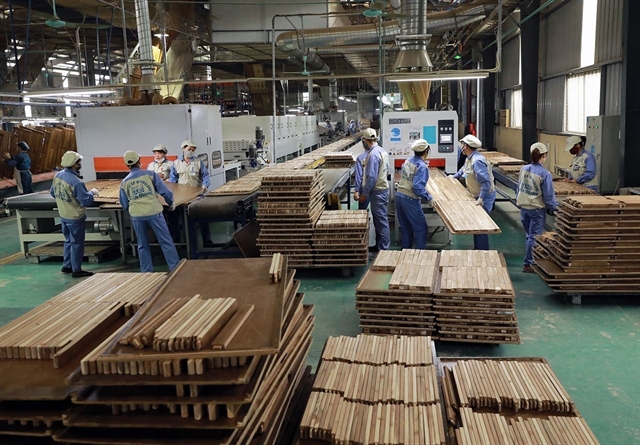
The US remains the key export market for Việt Nam’s wood and wood products. VNA/VNS Photo
New risks emerge
Yet, behind the positive export figures lies a growing list of challenges threatening the sustainable development of the sector.
Trần Việt Tiến, Director of Gia Long Co., warned that the wood processing industry now faces increasingly stringent trade barriers.
In the US, the most pressing concern is the countervailing tax, which undermines the competitive advantage of Vietnamese wooden goods.
Additionally, Vietnamese exporters are grappling with anti-dumping investigations and accusations of origin fraud.
In the European Union, the upcoming EU Deforestation Regulation (EUDR), scheduled to take effect at the end of 2025, will require all wood products to prove legal origin and show no link to deforestation—raising the compliance bar even higher for exporters.
The evolving global supply chain landscape presents both opportunities and risks.
Leading multinational corporations from the US, EU, and Japan are shifting sourcing strategies, preferring supply chains located nearer to end-markets to reduce logistical risks and transportation costs.
This new direction is fragmenting the once-globalised structure into a multipolar system.
Without transparent operations and added value, Vietnamese wood exporters risk being excluded from these emerging supply chains.
Tiến stressed that a complete and modernised domestic ecosystem for wooden furniture must include sustainably sourced raw materials, advanced processing technologies, large-scale manufacturing capacity, creative product design, competitive branding, extensive distribution networks, and professional logistics systems.
Việt Nam already has a solid base: over 2 million hectares of planted forests, a skilled workforce, and strong production capacity.
However, gaps remain in supporting industries such as precision mechanics and component manufacturing, flexible product design to meet diverse market needs, and global distribution systems.
Most notably, there is still no Vietnamese furniture brand with regional or global recognition.
“Actively controlling a sustainable and transparent domestic supply chain offers dual benefits,” Tiến explained. “It reduces dependence on imported raw materials and fulfils traceability requirements in export markets. These attributes act as a passport for Vietnamese products to confidently access the world’s most demanding markets.”
Experts agree that Việt Nam’s wood processing and furniture sector must move beyond its longstanding role as the “world’s workshop.”
To thrive in the new global context, the industry must evolve into a production hub with a distinct identity, built on design innovation, brand development, and a resilient domestic ecosystem.
For this transformation to take root, a long-term vision and strategic alignment across the industry is vital.
Enterprises must take the initiative in investing in modern technology, creative design, and transparent supply chains.
At the same time, each business must take full responsibility for preventing transshipment and origin fraud.
Failing to do so could jeopardise the sector’s hard-won reputation and trigger prolonged trade sanctions, ultimately leading to a loss of global market share. — VNS
Source: VNS
Related News

CHARITY / EXHIBITION / OTHER EVENTS
INVESTMENT OPPORTUNITIES IN CA MAU PROVINCE: 96 PROJECTS AND 20 STRATEGIC PROJECTS
We are pleased to share with you information on investment projects currently seeking investors in Ca Mau Province. Should your esteemed company or association be interested, we kindly invite you to review the project information and complete the registration form via the links provided. The Ho Chi Minh City Investment and Trade Promotion Centre (ITPC) will consolidate the expressions of interest and facilitate connections with the leadership of Ca Mau Province at a meeting tentatively scheduled for 13 November 2026 in Ho Chi Minh City.

MEMBER CORNER / PROMOTIONS
BẰNG KIỀU LIVESHOW - A SYMPHONY OF LOVE UNDER THE GOLDEN GLOW
A masterclass in live music that takes the audience on a soulful journey through immortal love songs, guided by the peerless artistry and emotive storytelling of renowned singer Bằng Kiều. The highlight of the night is his seamless musical chemistry with special guest Triệu Hồng Ngọc, promising passionate and deeply resonant duets inside the magnificent Grand Ballroom.

INFRASTRUCTURE / CONSTRUCTION / LOGISTIC / PORT
ĐÀ NẴNG GREEN-LIGHTS US$105 MILLION THAI DEVELOPMENT DEAL
The central city has approved an investment proposal by Thailand’s WHA Group to develop infrastructure for the 400ha WHA Đà Nẵng Industrial Park project on two communes of Thăng Bình and Đồng Dương, with an investment of more than VNĐ2.7 trillion (US$105 million). The city said it approved WHA Industrial Development International's status as an investor in the project, which is expected to take place between 2027 and 2034.

VIETNAM ECONOMY INVESTMENT
MOBILE PHONE EXPORTS RISE 20% TO $51.8 BILLION IN FIRST NINE MONTHS
Exports of mobile phones and components rose 20 per cent year-on-year to nearly US$51.8 billion in the first nine months of 2026, with China, the US and Republic of Korea accounting for more than half of the total. Shipments to the three markets reached a combined $26.18 billion, or 50.6 per cent of total exports of the product group during the period, according to data from the Vietnam Department of Customs under the Ministry of Finance.

INFRASTRUCTURE / CONSTRUCTION / LOGISTIC / PORT
VIỆT NAM-CAMBODIA TRADE GATHERS PACE TOWARDS $20 BILLION TARGET
Trade between Việt Nam and Cambodia continues to grow, remaining a bright spot and a key pillar of bilateral cooperation as the two countries aim to raise two-way trade to US$20 billion in the coming years. After setting a record of more than $11.3 billion last year, bilateral trade reached about $8.7 billion in the first eight months of this year, up 8.3 per cent year on year.

VIETNAM ECONOMY INVESTMENT
FRUIT AND VEGETABLE EXPORTS POISED TO HIT $10 BILLION IN 2026
Fruit and vegetable exports are on track to reach nearly US$10 billion in 2026, after rising 19.9 per cent year on year to nearly US$7.4 billion in the first nine months, driven by strong seasonal demand and abundant tropical fruit supplies. The Ministry of Agriculture and Environment said the growth reflected stronger international demand for fresh produce and processed agricultural products.
Events Sponsors






















