Want to be in the loop?
subscribe to
our notification
Business News
WOOD EXPORTERS TURNING CHALLENGES INTO OPPORTUNITIES
The industry is undergoing a positive transition. If pursued decisively, Việt Nam could establish a lasting competitive advantage in the global plywood market, according to experts.
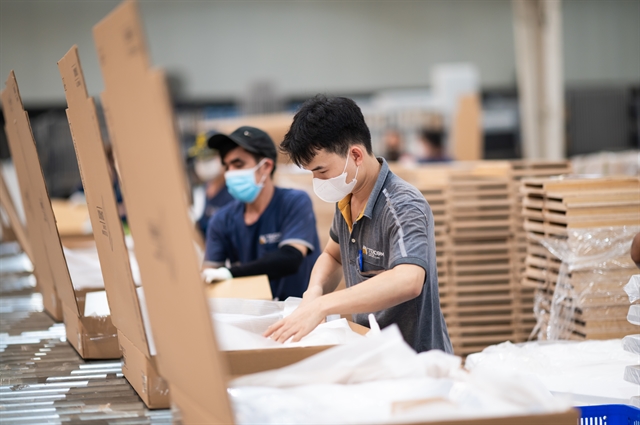
Workers package kitchen cabinets for export. — Photo courtesy of the company
HCM CITY — The increasing tariff and non-tariff trade barriers in major markets such as the US and Europe are not fazing Vietnamese wood exporters, who are turning them into opportunities by accelerating transformation, strengthening compliance and moving up the value chain to build long-term competitiveness.
Speaking to the media during a factory visit at Nam Tân Uyên Expansion Industrial Park, Vũ Quang Huy, chairman and CEO of TEKCOM Corporation, which exports plywood and associated products to more than 50 markets including the EU, US, India and Southeast Asia, said businesses faced numerous trade barriers.
“These are largely beyond our control. What matters is how we adapt and transform."
Asked about the impact of the US’s 25 per cent tariff on kitchen cabinets, he said TEKCOM’s orders and operations remained steady due to careful planning.
“The US does not have a production advantage in the wood sector and will continue to import. The key question is how tariffs are applied to countries competing with Việt Nam and what solutions local companies take to adapt swiftly.”
In the kitchen cabinet segment, his company develops product lines tailored to specific customer groups in each market.
“By working closely with tier-one customers, we co-design products that meet demand," he said, adding that prices are kept competitive through optimised materials, ensuring a long-term advantage.
The company is also exploring new partnerships to participate more deeply in the value chain, develop brands, and build future distribution channels.
Speaking about non-tariff barriers, he said each market would have its own standards for plywood – like BIS (India), IMANOR (Morocco) and EUDR (Europe), along with the requirement to use legally-sourced and traceable wood.
His company is one of the first plywood manufacturers in Việt Nam to meet IMANOR standards and is working with partners to ensure full compliance with EUDR requirements.
“In a fast-changing world, tariffs and trade barriers can become opportunities. Businesses able to adapt quickly will move ahead.”
Opportunities from plywood
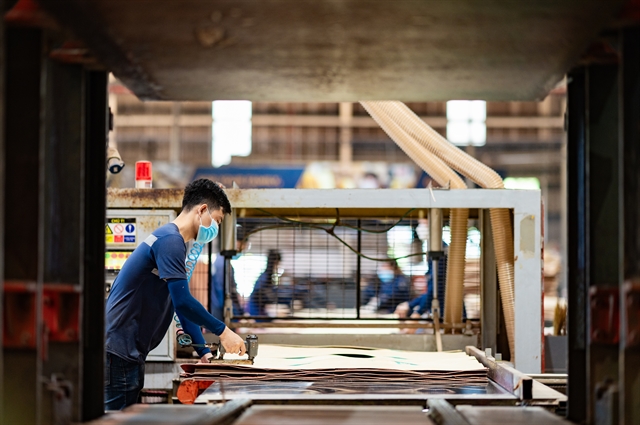
Workers at the factory package kitchen cabinets before delivery. — Photo courtesy of the company
Việt Nam produces more than 3.7 million cubic metres of plywood annually.
With China’s output declining from 90 per cent to 60 per cent of global production and continuing to fall, opportunities are increasing for countries such as Việt Nam.
“Producing plywood requires both planted forests and a complete supply chain, areas where Việt Nam has a competitive edge thanks to its robust supply chain and competitive costs," Vũ said.
However, he also noted some limitations facing the sector.
Việt Nam has around five million hectares of planted forests, primarily acacia, rubber, and eucalyptus, but they mostly supply base plywood rather than high-quality veneer, requiring some imports.
Another challenge is that the country has yet to establish a distinct wood brand or high-value plywood products, unlike its competitors. Russia and Europe have birch, China has poplar, Indonesia and Malaysia have meranti and falcata, and Brazil and Chile have eucalyptus and pine.
Việt Nam’s acacia remains largely used for low-value segments such as construction and packaging.
To increase the value of the plywood sector, it is essential to focus on rubberwood, gaining a deep understanding of market needs and investing in technology and R&D for product development, and this is what many companies are doing, according to Vũ.
While rubberwood has long been used in the furniture, there remains significant untapped potential in the plywood sector. Rubberwood plywood can serve as a substitute for Russian birch plywood in Europe, as it is comparable in quality and decorative use. Importantly, all rubberwood plantations have legal and fully traceable origins.
“The industry is undergoing a positive transition. If pursued decisively, Việt Nam could establish a lasting competitive advantage in the global plywood market,” he said.
According to Phùng Quốc Mẫn, chairman of the Handicraft and Wood Industry Association of HCM City, the wood industry has become one of Việt Nam’s most remarkable export success stories.
In 1999 exports were under US$200 million and this year they are projected to reach $20 billion.
The industry has built a relatively complete supply chain, from raw materials to production and distribution, creating a strong global competitive advantage.
Việt Nam is the world’s second largest furniture exporter after China, and ships its wood products to 166 countries and territories.
In 2024 the industry recorded a trade surplus of $14.5 billion. — VNS
Source: VNS
Related News

INFRASTRUCTURE / CONSTRUCTION / LOGISTIC / PORT
VIỆT NAM-CAMBODIA TRADE GATHERS PACE TOWARDS $20 BILLION TARGET
Trade between Việt Nam and Cambodia continues to grow, remaining a bright spot and a key pillar of bilateral cooperation as the two countries aim to raise two-way trade to US$20 billion in the coming years. After setting a record of more than $11.3 billion last year, bilateral trade reached about $8.7 billion in the first eight months of this year, up 8.3 per cent year on year.
TECHNOLOGY
AI BEGINNING TO RESHAPE RECRUITMENT CRITERIA
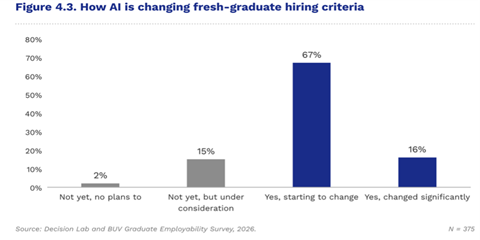
Digital literacy is the only capability area in which fresh graduates meet employers’ expectations, according to a new report. Yet, it is also the standard rising fastest, as businesses increasingly expect new hires to use AI effectively in the workplace. Some 83 per cent of employers say AI has changed, or is beginning to change, their hiring criteria, while 94 per cent report higher expectations for digital and AI capabilities than they had two to three years ago.

INFRASTRUCTURE / CONSTRUCTION / LOGISTIC / PORT
ĐÀ NẴNG GREEN-LIGHTS US$105 MILLION THAI DEVELOPMENT DEAL
The central city has approved an investment proposal by Thailand’s WHA Group to develop infrastructure for the 400ha WHA Đà Nẵng Industrial Park project on two communes of Thăng Bình and Đồng Dương, with an investment of more than VNĐ2.7 trillion (US$105 million). The city said it approved WHA Industrial Development International's status as an investor in the project, which is expected to take place between 2027 and 2034.

VIETNAM ECONOMY INVESTMENT
MOBILE PHONE EXPORTS RISE 20% TO $51.8 BILLION IN FIRST NINE MONTHS
Exports of mobile phones and components rose 20 per cent year-on-year to nearly US$51.8 billion in the first nine months of 2026, with China, the US and Republic of Korea accounting for more than half of the total. Shipments to the three markets reached a combined $26.18 billion, or 50.6 per cent of total exports of the product group during the period, according to data from the Vietnam Department of Customs under the Ministry of Finance.

VIETNAM ECONOMY INVESTMENT
FRUIT AND VEGETABLE EXPORTS POISED TO HIT $10 BILLION IN 2026
Fruit and vegetable exports are on track to reach nearly US$10 billion in 2026, after rising 19.9 per cent year on year to nearly US$7.4 billion in the first nine months, driven by strong seasonal demand and abundant tropical fruit supplies. The Ministry of Agriculture and Environment said the growth reflected stronger international demand for fresh produce and processed agricultural products.
GARMENT / TEXTILE
TEXTILE EXPORTS FACE DUAL CHALLENGES OF SUSTAINING ORDERS AND BOOSTING EFFICIENCY AMID GROWING COMPETITION
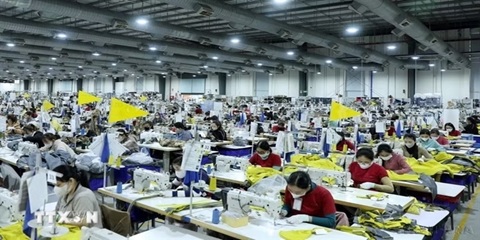
Data shows that the textile and garment sector maintained its growth momentum in the first nine months of this year. The industry's total export turnover reached an estimated US$35.721 billion in the first nine months of this year, up 3.3 per cent year-on-year. Despite posting encouraging export figures, Vietnamese textile and garment enterprises continue to navigate unpredictable market variables.
Events Sponsors






















