Want to be in the loop?
subscribe to
our notification
Business News
DEVELOPMENT OF LOGISTICS COMPETITIVE INDEX AIMS TO DEVELOP LOGISTICS INDUSTRY
The launch of the Vietnam Provincial Logistics Competitiveness Index (LCI) is expected to help reduce logistics costs, support production and export development, and attract foreign investment more effectively in the future, said Lê Duy Hiệp, the Việt Nam Logistics Business Association (VLA) chairman.
According to the VLA, the LCI Index is an index that evaluates the development speed, quality, infrastructure, and policies of municipal and provincial authorities for logistics service businesses in Việt Nam.
Trần Phương Trà, director of the Economic Policy Network at AVSE Global, said that provinces and cities lack systems in logistics infrastructure to link among localities effectively.
Meanwhile, logistics is a very important factor to help agricultural, industrial and service value chains in Việt Nam develop.
In addition, according to this expert, in the planning of provinces and cities, the role of the logistics industry has not been highlighted enough as a factor connecting and supporting economic sectors, and ensuring the transport of goods.
The reason for this is probably at the organisation stage. This is one sector that needs close coordination among production sectors, such as agriculture and industry, with infrastructure, transport and construction sectors, Trà said.
In addition, provinces and cities in Việt Nam are always up to date on the trends of international logistics, such as Closed Loop Supply Chain and circular economy.
At the kick-off ceremony of the Vietnam Provincial Logistics Competitiveness Index (LCI) Project 2022 on August 11, she emphasised that logistics is the "heart" connecting all stages in the value chain, from production, transportation and storage to the supplier and the end user. Without logistics, the value chain will operate ineffectively.
For example, organising logistics activities at the municipal or provincial level needs to pay attention to strategy and orientation. That means having specific activities and goals to connect related industries. This also requires local management agencies to organise effectively the logistics stages.
“Therefore, the implementation of the LCI project is very useful. This will encourage localities to set up logistics development strategies well,” Trà was quoted by the Vietnam Economic Times as saying.
The LCI Index will be used to evaluate policies with local authorities to improve and develop the logistics service industry.
This index is implemented by VLA in collaboration with Việt Nam Chamber of Commerce and Industry (VCCI)'s and research units, Dream Incubator (DI) and the Việt Nam Logistics Research and Development Institute (VLI).
The statistics and assessments in the index will be important for domestic and foreign businesses in choosing locations and expanding business.
For the provincial LCI Index, experts said that the important factors of this index include organisation, infrastructure, technology in logistics and supply chain management. They are also macroeconomic conditions, skills, product market, labour market, financial system, market scale, dynamism in the business environment, and innovation.
The competitiveness index of Việt Nam’s logistics ranks 77th in the world. If each locality has good logistics activities, it will certainly raise Việt Nam's logistics competitiveness rank in the future.
Regarding the logistics infrastructure in localities, experts said that they need to improve roads, the efficiency of ships, ports and air services, and even power supply systems for logistics.
One more important factor in the provincial LCI is the human factor. The localities have a lack of skilled human resources that can meet the requirements of connecting parts in a value chain.
Source: VNS
Related News
MEMBER CORNER / PROMOTIONS
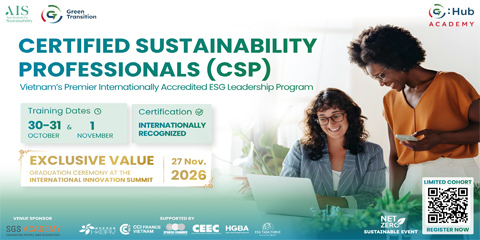
HCMC | CERTIFIED SUSTAINABILITY PROFESSIONAL (CSP) TRAINING | REGISTRATION OPEN
As sustainability becomes deeply embedded in corporate strategy and supply-chain operations across Vietnam, Hong Kong Business Association Vietnam is pleased to endorse the upcoming Certified Sustainability Professional (CSP) training program by the Asia Institute for Sustainability (AIS) - a premier internationally recognized ESG credential in Vietnam.
VIETNAM ECONOMY INVESTMENT
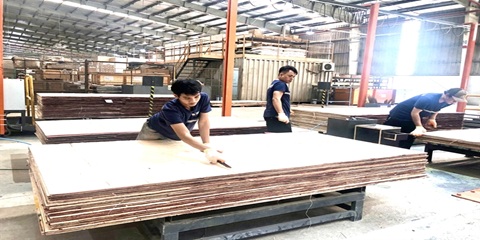
HCM CITY SAYS HOW IT PLANS TO ACHIEVE 10-11% ANNUAL EXPORT GROWTH FOR REST OF DECADE
The southern economic hub aims to strengthen its role as the country’s largest import-export centre while developing into a regional transhipment centre in Southeast Asia, supported by green and digital transformation and a circular economy. HCM City has outlined measures to expand production capacity, cut logistics costs, diversify export markets, and help businesses meet increasingly stringent international standards as it targets average annual export growth of 10-11 per cent through 2030.
VIETNAM ECONOMY INVESTMENT
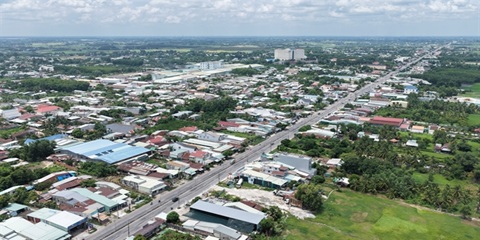
HCM CITY LEADS ECONOMIC RESTRUCTURING IN SOUTHEAST REGION
According to Associate Professor, Dr Vũ Tuấn Hưng, director of the Institute of Social Sciences of the Southern Region, the Southeast is a strategically important socio-economic space in Việt Nam’s development given its advantages in location, industry, trade, services, logistics, science and technology, urbanisation and human resources.
TECHNOLOGY
DIGITAL TRANSFORMATION TURNED INTO PRACTICAL TOOLS FOR PEOPLE, BUSINESSES
Việt Nam is moving its digital transformation agenda beyond policy frameworks and individual technology platforms towards practical applications that address everyday needs, as authorities seek measurable outcomes from science, technology and innovation. Under Politburo Resolution No. 57-NQ/TW issued on December 22, 2024, the implementation is increasingly shifting from simply completing assigned tasks towards developing concrete products and services for citizens and businesses.
TECHNOLOGY
APPLYING TECHNOLOGY FOR ECONOMIC TRANSFORMATION
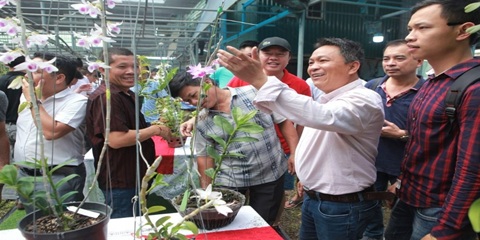
Having completed its new rural development program, Hanoi is shifting its focus toward improving development quality and building smart, sustainable rural areas. The transformation of Dong La orchid-growing village in An Khanh, a western commune of Hanoi, shows how digital technology is becoming a driver of production, market expansion, and higher incomes for local residents.

MEMBER CORNER / PROMOTIONS
VIGLACERA HONORED AS THE "LEADING GREEN INDUSTRIAL REAL ESTATE DEVELOPER 2026"
Organized by the Vietnam Investment Review, this prestigious awards program recognizes industry pioneers advancing eco-industrial parks, clean energy transition, and rigorous ESG standards. Outperforming competitors through a rigorous evaluation, Viglacera Corporation – JSC proudly ranked among the Top 5 highest-positioned enterprises in the Leading Green Industrial Real Estate Developers 2026 category, reinforcing its premier position in Vietnam’s industrial real estate sector.
Events Sponsors






















