Want to be in the loop?
subscribe to
our notification
Business News
ECONOMIC GROWTH AND GREEN ENERGY FROM VIETNAM’S EV TRANSITION
Vietnam aims to fully decarbonize its economy by 2050. Following the Prime Minister of Vietnam's commitment to net-zero emissions at the United Nations Climate Change Conference in Glasgow in November 2021 (COP26), the country has developed and begun implementing plans to reduce carbon emissions in the transportation sector.
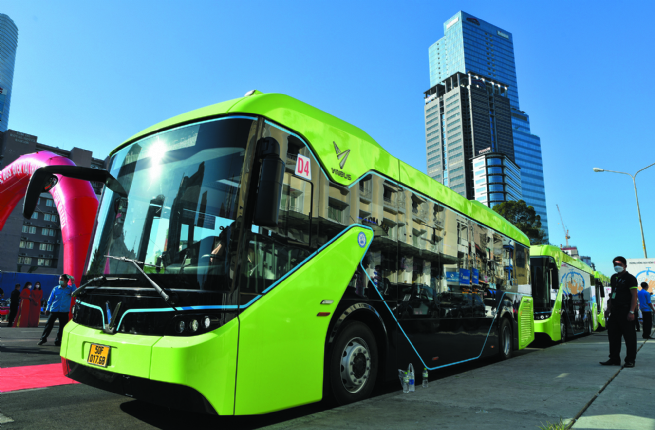
The EV transition is expected to create up to 6.5 million new jobs across the EV value chain by 2050
Reducing greenhouse gas emissions
Energy is the largest source of greenhouse gas emissions, with transportation being a significant contributor to this rise. Without decarbonization, this share will continue to grow due to the rapid increase in car usage. A World Bank report on Vietnam's transition to electric vehicles highlights that the transportation sector emitted approximately 32.9 million tons of carbon dioxide equivalent (MtCO2eq) in 2021, making up 7.2% of the country's total greenhouse gas emissions, with road transport as the primary contributor. While car ownership remains a luxury for most Vietnamese, the growing middle class has fueled an average annual car sales growth of 15% from 2010 to 2022 - one of the highest rates in the region. This surge in vehicle demand presents Vietnam with a prime opportunity to transition directly from traditional vehicles to electric vehicles (EVs).
Vietnam's transition to EVs must also include the shift to electric two-wheelers, as they will remain the dominant mode of transport until at least 2035. In 2022, two-wheeler registrations reached 72.16 million, accounting for 94% of all registered vehicles. This translates to a motorized vehicle usage rate of 518 two-wheelers per 1,000 people, far exceeding the car usage rate of just 22 cars per 1,000 people. The adoption of electric two-wheelers is expected to drive the country's EV transition, a trend that has been gaining momentum since 2014.
Economic development opportunities
The shift to EVs offers economic opportunities. To achieve the EV adoption goals, Vietnam's vehicle sales need to grow from 500,000 units in 2022 to around 1.5 million by 2030 and 7.3 million by 2050. Cumulatively, this indicates a market demand of over 7 million EVs during 2024–2030 and 71 million EVs during 2031–2050. The development of the EV market is expected to boost the entire EV value chain, including vehicle manufacturing, battery production and charging infrastructure. Demand in areas like EV maintenance and recycling will also rise, creating opportunities for skilled labor. The EV transition is projected to generate up to 6.5 million new jobs across the EV value chain by 2050, with 61% in the EV charging infrastructure sector.
Infrastructure preparedness
Decision 876/QD-TTg on green transformation in road transportation has set targets for transitioning to electric-powered vehicles, including aiming for 50% of urban transportation vehicles and 100% of inner-city buses and taxis to use electric or green energy by 2030, and 100% adoption for all road vehicles by 2050.
To accelerate EV adoption, the World Bank recommended that Vietnam establish an inter-ministerial government agency to oversee electric transportation across the EV ecosystem during the transition period. Encouragement of EV adoption requires addressing existing issues while creating future incentives, including through the development of charging infrastructure.
Particularly, Vietnam needs to prepare its power sector to handle the impact of EV charging demand by integrating forecast impacts into updates for power development planning, increasing investment in power generation, and expanding the capacity of transmission and distribution grids. Additionally, smart charging should be promoted through differential electricity pricing, installation of smart charging stations for off-peak charging, and development of rooftop solar power beyond the electricity meter at public charging stations.
Importantly, Vietnam must encourage modal shifts in transportation demand, transitioning from personal vehicle use to public passenger transport, from interprovincial commercial passenger vehicles to rail, and from trucks to rail and waterways for interprovincial freight transport.
Source: VCCI
Related News

CHARITY / EXHIBITION / OTHER EVENTS
INVESTMENT OPPORTUNITIES IN CA MAU PROVINCE: 96 PROJECTS AND 20 STRATEGIC PROJECTS
We are pleased to share with you information on investment projects currently seeking investors in Ca Mau Province. Should your esteemed company or association be interested, we kindly invite you to review the project information and complete the registration form via the links provided. The Ho Chi Minh City Investment and Trade Promotion Centre (ITPC) will consolidate the expressions of interest and facilitate connections with the leadership of Ca Mau Province at a meeting tentatively scheduled for 13 November 2026 in Ho Chi Minh City.

MEMBER CORNER / PROMOTIONS
BẰNG KIỀU LIVESHOW - A SYMPHONY OF LOVE UNDER THE GOLDEN GLOW
A masterclass in live music that takes the audience on a soulful journey through immortal love songs, guided by the peerless artistry and emotive storytelling of renowned singer Bằng Kiều. The highlight of the night is his seamless musical chemistry with special guest Triệu Hồng Ngọc, promising passionate and deeply resonant duets inside the magnificent Grand Ballroom.

INFRASTRUCTURE / CONSTRUCTION / LOGISTIC / PORT
ĐÀ NẴNG GREEN-LIGHTS US$105 MILLION THAI DEVELOPMENT DEAL
The central city has approved an investment proposal by Thailand’s WHA Group to develop infrastructure for the 400ha WHA Đà Nẵng Industrial Park project on two communes of Thăng Bình and Đồng Dương, with an investment of more than VNĐ2.7 trillion (US$105 million). The city said it approved WHA Industrial Development International's status as an investor in the project, which is expected to take place between 2027 and 2034.

VIETNAM ECONOMY INVESTMENT
MOBILE PHONE EXPORTS RISE 20% TO $51.8 BILLION IN FIRST NINE MONTHS
Exports of mobile phones and components rose 20 per cent year-on-year to nearly US$51.8 billion in the first nine months of 2026, with China, the US and Republic of Korea accounting for more than half of the total. Shipments to the three markets reached a combined $26.18 billion, or 50.6 per cent of total exports of the product group during the period, according to data from the Vietnam Department of Customs under the Ministry of Finance.

INFRASTRUCTURE / CONSTRUCTION / LOGISTIC / PORT
VIỆT NAM-CAMBODIA TRADE GATHERS PACE TOWARDS $20 BILLION TARGET
Trade between Việt Nam and Cambodia continues to grow, remaining a bright spot and a key pillar of bilateral cooperation as the two countries aim to raise two-way trade to US$20 billion in the coming years. After setting a record of more than $11.3 billion last year, bilateral trade reached about $8.7 billion in the first eight months of this year, up 8.3 per cent year on year.

VIETNAM ECONOMY INVESTMENT
FRUIT AND VEGETABLE EXPORTS POISED TO HIT $10 BILLION IN 2026
Fruit and vegetable exports are on track to reach nearly US$10 billion in 2026, after rising 19.9 per cent year on year to nearly US$7.4 billion in the first nine months, driven by strong seasonal demand and abundant tropical fruit supplies. The Ministry of Agriculture and Environment said the growth reflected stronger international demand for fresh produce and processed agricultural products.
Events Sponsors






















