Want to be in the loop?
subscribe to
our notification
Business News
ELECTRONICS INDUSTRY SEIZES RESTRUCTURING OPPORTUNITIES
The export turnover of electronics reached US$134.5 billion last year.
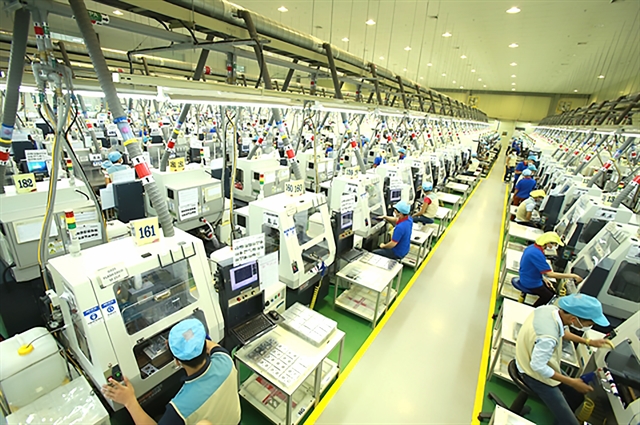
Workers at an electronic parts ensemble in Thái Nguyên Province. — VNA/VNS Photo
HÀ NỘI — Việt Nam is gradually transforming from a manufacturing hub into a regional centre for high-tech innovation.
The country currently ranks fifth in the world for electronics, computers and components exports, and second globally for mobile phones and components exports.
The export turnover of electronics reached US$134.5 billion last year.
The electronics industry continued its strong growth momentum with exports reaching $60.8 billion as of the end of May this year, a year-over-year increase of 39 per cent, reinforcing its role as a key driver in the country's export economy.
The Tài chính (Finance) online newspaper quoted Trần Hồng Quân, chief commercial director of RX Tradex Vietnam, as saying that major technology corporations such as Samsung, Apple, LG and Pegatron, were continuing to expand their large-scale investments in Việt Nam.
Notably, Qualcomm has launched its R&D centre in the country, while NVIDIA recently signed a strategic partnership with the Government to establish a data centre and an AI R&D centre.
A significant highlight is the Government’s adoption of the semiconductor industry development strategy to 2030, with a vision toward 2050, marking a decisive move to strengthen domestic capabilities, from workforce training and localisation capacity to active participation in core technology research and production.
However, Quân pointed out that Việt Nam’s electronics industry still faced several challenges.
He said: “100 per cent of mobile phone export value comes from FDI enterprises, 80 per cent of phone components are imported, and over 90 per cent of Tier-1 suppliers are foreign companies. R&D within domestic firms remains limited, mainly focused on assembly.”
Quân emphasised that these challenges marked a turning point to evolve from a centre of assembly into a country with advanced, value-added manufacturing capabilities.
Experts highlighted three core issues that were shaping the future of the electronics industry.
First, the country is emerging as a strategic destination in the global supply chain. Second, the government is making strong efforts to promote the development of the semiconductor industry and R&D.
Third, the rapid advancement of artificial intelligence (AI) and automation is fundamentally transforming the nature of manufacturing, requiring both technological standardisation and investment in human resources.
Regarding the export market of the electronics industry, Đỗ Thị Thúy Hương, vice president of the Vietnam Association for Supporting Industries (VASI), stated that the US was Việt Nam’s largest export market, accounting for approximately 29 per cent of the country’s total export turnover.
In particular, the electronics industry accounts for more than 40 per cent of exports to the US in certain segments.
Việt Nam’s exports of electronic machinery, equipment and audio devices to the US reached $41.7 billion last year alone, making up 34.9 per cent of the country’s total export turnover to the US.
High tariffs from the US could increase production costs for Vietnamese enterprises, affecting both profit and competitiveness, said Hương.
In this context, experts believed that Việt Nam’s electronics industry had an opportunity to restructure its supply chain, accelerate digital transformation, and expand markets through free trade agreements (FTAs) and cross-border e-commerce.
A representative of IPC, an association connecting electronics industries based in Chicago, US, said that with its mission to strengthen the electronics supply chain and promote sustainable growth across the industry, the association had implemented several important initiatives to support the global electronics sector, including in Việt Nam.
These efforts include updating IPC standards for electronics companies, advocating for public policy and providing training and certification.
Among these, IPC standards play a crucial role in ensuring the quality, reliability and consistency of electronic manufacturing.
Their implementation has helped improve production processes and contributed to the creation of higher-quality electronic products.
Adherence to international standards has opened up access to new markets for Vietnamese electronics manufacturers.
The association’s training programmes have helped build a highly skilled workforce capable of meeting the demands of advanced manufacturing technologies, enhancing the reputation and international recognition of Vietnamese enterprises. —VNS
Source: VNS
Related News

CHARITY / EXHIBITION / OTHER EVENTS
INVESTMENT OPPORTUNITIES IN CA MAU PROVINCE: 96 PROJECTS AND 20 STRATEGIC PROJECTS
We are pleased to share with you information on investment projects currently seeking investors in Ca Mau Province. Should your esteemed company or association be interested, we kindly invite you to review the project information and complete the registration form via the links provided. The Ho Chi Minh City Investment and Trade Promotion Centre (ITPC) will consolidate the expressions of interest and facilitate connections with the leadership of Ca Mau Province at a meeting tentatively scheduled for 13 November 2026 in Ho Chi Minh City.

MEMBER CORNER / PROMOTIONS
BẰNG KIỀU LIVESHOW - A SYMPHONY OF LOVE UNDER THE GOLDEN GLOW
A masterclass in live music that takes the audience on a soulful journey through immortal love songs, guided by the peerless artistry and emotive storytelling of renowned singer Bằng Kiều. The highlight of the night is his seamless musical chemistry with special guest Triệu Hồng Ngọc, promising passionate and deeply resonant duets inside the magnificent Grand Ballroom.

INFRASTRUCTURE / CONSTRUCTION / LOGISTIC / PORT
ĐÀ NẴNG GREEN-LIGHTS US$105 MILLION THAI DEVELOPMENT DEAL
The central city has approved an investment proposal by Thailand’s WHA Group to develop infrastructure for the 400ha WHA Đà Nẵng Industrial Park project on two communes of Thăng Bình and Đồng Dương, with an investment of more than VNĐ2.7 trillion (US$105 million). The city said it approved WHA Industrial Development International's status as an investor in the project, which is expected to take place between 2027 and 2034.

VIETNAM ECONOMY INVESTMENT
MOBILE PHONE EXPORTS RISE 20% TO $51.8 BILLION IN FIRST NINE MONTHS
Exports of mobile phones and components rose 20 per cent year-on-year to nearly US$51.8 billion in the first nine months of 2026, with China, the US and Republic of Korea accounting for more than half of the total. Shipments to the three markets reached a combined $26.18 billion, or 50.6 per cent of total exports of the product group during the period, according to data from the Vietnam Department of Customs under the Ministry of Finance.

INFRASTRUCTURE / CONSTRUCTION / LOGISTIC / PORT
VIỆT NAM-CAMBODIA TRADE GATHERS PACE TOWARDS $20 BILLION TARGET
Trade between Việt Nam and Cambodia continues to grow, remaining a bright spot and a key pillar of bilateral cooperation as the two countries aim to raise two-way trade to US$20 billion in the coming years. After setting a record of more than $11.3 billion last year, bilateral trade reached about $8.7 billion in the first eight months of this year, up 8.3 per cent year on year.

VIETNAM ECONOMY INVESTMENT
FRUIT AND VEGETABLE EXPORTS POISED TO HIT $10 BILLION IN 2026
Fruit and vegetable exports are on track to reach nearly US$10 billion in 2026, after rising 19.9 per cent year on year to nearly US$7.4 billion in the first nine months, driven by strong seasonal demand and abundant tropical fruit supplies. The Ministry of Agriculture and Environment said the growth reflected stronger international demand for fresh produce and processed agricultural products.
Events Sponsors






















