Want to be in the loop?
subscribe to
our notification
Business News
EVFTA WIDENS HORIZON FOR LOGISTICS EXPANSION
The forthcoming official entry of the EU-Vietnam Free Trade Agreement and the EU-Vietnam Investment Protection Agreem ent is set to offer a new horizon of development to Vietnam’s logistics industry.
Russell Reed, managing director of UPS Vietnam and Thailand, said that the agreements represent a breakthrough in Vietnam’s progress as a trading powerhouse, and will help to further unlock the country’s vast economic potential in the coming years. Vietnamese exports to the EU have grown consistently in recent years, hitting a total of $41.7 billion in 2019, representing annual average growth of 13 per cent since 2014.
As a global provider of logistics services, UPS sees these agreements as providing a great deal more latitude for their customers to expand their key imports, as well as helping to simplify processes while encouraging more long-term investment and strategic business partnerships.
According to Reed, Vietnam is an exceptionally competitive manufacturing market, which has been one of the major contributors to the country’s economic growth. This growth has created a rapidly expanding middle class – one that is increasingly international in its outlook and interested in purchasing imported products, such as those coming out of the EU.
“At the same time, we continue to see sustained volume in Vietnamese exports to the bloc, and have made enhancements to our network to help Vietnamese businesses, particularly in high-tech and retail, maintain their competitive edge,” he added. “With the upcoming official entry of the EU-Vietnam Free Trade Agreement (EVFTA) in 2020, we look forward to working with more small- and medium-sized enterprises and large multinationals across a range of industries to help them enter and succeed in the EU – a market which now has even greater accessibility for Vietnamese businesses of all.”
On the same note, Tran Viet Huy, managing director of Tracimexco - Supply Chains and Agency Services J.S Company (TRA-SAS), told VIR that Vietnam has committed to open the logistics market under the World Trade Organization (WTO) and the Comprehensive and Progressive Agreement for Trans-Pacific Partnership (CPTPP). However, the EVFTA is expected to create a new driving force for Vietnam’s logistics industry.
According to Huy, the EVFTA may affect the development of logistics industry in three aspects including stronger commitment to open markets of Vietnam and EU in the field of transport and transport services; creating added-value services for freight brokerage, sampling, inspections; and stronger commitments in areas improving logistics service market such as scale, service quality, open demand, wide capacity, and service performance.
Meanwhile, the EU-Vietnam Investment Protection Agreement (EVIPA) shall provide a solid legal background for EU investors where they have more tools and inter-country commitments to protect and run EU businesses in Vietnam. “It is no doubt that those effects will make positive influences to EU investors in investment to Vietnam’s logistics industry in both expanding their current business and making new investment via either mergers and acquisitions activities or green-field investment,” Huy said.
Beside current segments which may be more interesting, EU logistics investors will have new opportunities to enter new segments of Vietnamese government procurement, such as some logistics services which require deep experience and techniques in storage/management of pharmaceuticals, warehousing of dangerous chemicals, and transportation of oversized equipment for government infrastructure projects.
Meanwhile, Vietnamese logistics providers have more chances in bidding on logistics services for official development assistance projects funded by the EU.
Research by the Ministry of Planning and Investment showed that Vietnam’s export turnover to the EU will increase by 20 per cent in 2020, 42.7 per cent by late 2025, and 44.37 per cent by late 2030. Thus, increasing trade as well as investment activities between Europe and Vietnam will create plenty of opportunities for the logistics industry.
Commenting on the prospect of Vietnam’s logistics industry after the EVFTA comes into force, Tobias Gruemmer, area head of operations of Denmark’s A.P. Moller-Maersk, said that manufacturing and logistics in Vietnam have changed but the situation is still not entirely clear. Similar to the EU with a population of about 500 million, Southeast Asia with a population of 600 million (of which Vietnam is nearly 100 million) is considered a consumer market of high potential.
Previously, Vietnam focused on exports with the establishment of many export processing zones, but imports and domestic production have increased significantly. The main reason is due to the rise of the middle class, causing consumer habits to change and leading to shifts in the supply chain.
“The demand for storage and transportation has increased sharply, resulting in diversified warehousing and delivery solutions and attracting many businesses to participate. Logistics will be considered a hotbed for investors in the near future,” he said.
Source: VIR
Related News
MEMBER CORNER / PROMOTIONS
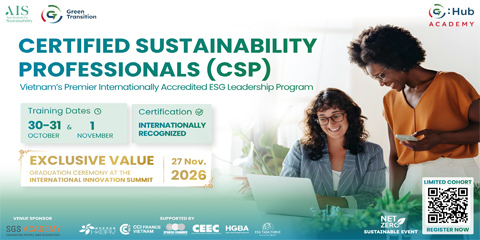
HCMC | CERTIFIED SUSTAINABILITY PROFESSIONAL (CSP) TRAINING | REGISTRATION OPEN
As sustainability becomes deeply embedded in corporate strategy and supply-chain operations across Vietnam, Hong Kong Business Association Vietnam is pleased to endorse the upcoming Certified Sustainability Professional (CSP) training program by the Asia Institute for Sustainability (AIS) - a premier internationally recognized ESG credential in Vietnam.
VIETNAM ECONOMY INVESTMENT
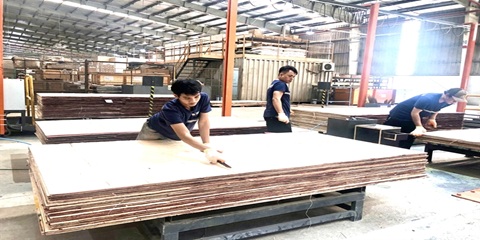
HCM CITY SAYS HOW IT PLANS TO ACHIEVE 10-11% ANNUAL EXPORT GROWTH FOR REST OF DECADE
The southern economic hub aims to strengthen its role as the country’s largest import-export centre while developing into a regional transhipment centre in Southeast Asia, supported by green and digital transformation and a circular economy. HCM City has outlined measures to expand production capacity, cut logistics costs, diversify export markets, and help businesses meet increasingly stringent international standards as it targets average annual export growth of 10-11 per cent through 2030.
VIETNAM ECONOMY INVESTMENT
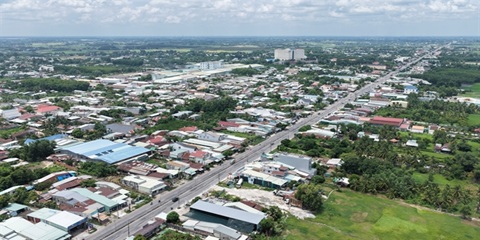
HCM CITY LEADS ECONOMIC RESTRUCTURING IN SOUTHEAST REGION
According to Associate Professor, Dr Vũ Tuấn Hưng, director of the Institute of Social Sciences of the Southern Region, the Southeast is a strategically important socio-economic space in Việt Nam’s development given its advantages in location, industry, trade, services, logistics, science and technology, urbanisation and human resources.
TECHNOLOGY
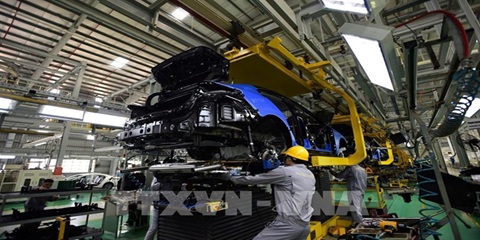
DIGITAL TRANSFORMATION TURNED INTO PRACTICAL TOOLS FOR PEOPLE, BUSINESSES
Việt Nam is moving its digital transformation agenda beyond policy frameworks and individual technology platforms towards practical applications that address everyday needs, as authorities seek measurable outcomes from science, technology and innovation. Under Politburo Resolution No. 57-NQ/TW issued on December 22, 2024, the implementation is increasingly shifting from simply completing assigned tasks towards developing concrete products and services for citizens and businesses.
TECHNOLOGY
APPLYING TECHNOLOGY FOR ECONOMIC TRANSFORMATION
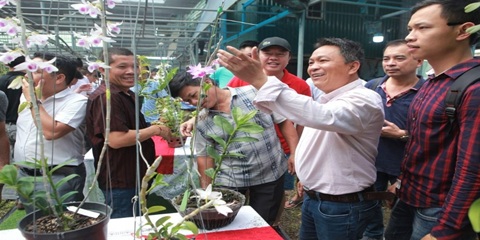
Having completed its new rural development program, Hanoi is shifting its focus toward improving development quality and building smart, sustainable rural areas. The transformation of Dong La orchid-growing village in An Khanh, a western commune of Hanoi, shows how digital technology is becoming a driver of production, market expansion, and higher incomes for local residents.

MEMBER CORNER / PROMOTIONS
VIGLACERA HONORED AS THE "LEADING GREEN INDUSTRIAL REAL ESTATE DEVELOPER 2026"
Organized by the Vietnam Investment Review, this prestigious awards program recognizes industry pioneers advancing eco-industrial parks, clean energy transition, and rigorous ESG standards. Outperforming competitors through a rigorous evaluation, Viglacera Corporation – JSC proudly ranked among the Top 5 highest-positioned enterprises in the Leading Green Industrial Real Estate Developers 2026 category, reinforcing its premier position in Vietnam’s industrial real estate sector.
Events Sponsors






















