Want to be in the loop?
subscribe to
our notification
Business News
LARGE BANKS FORECAST TO GAIN HIGHER PROFITABILITY IN H2 2026
Sector ROAA will likely remain stable at around 1.5 per cent, as rising credit costs across the sector offset NIM improvement at selected large banks.

VCB maintained stable overdue loan ratios, supported by diversified lending portfolios and prudent underwriting practice with lower exposure to higher-risk real estate sectors. — VNA/VNS Photo
HÀ NỘI — The return on average assets (ROAA) of the banking sector will likely remain stable at around 1.5 per cent in the second half of 2026, but profitability divergence among banks will increase, with large banks outperforming peers on stronger margins and diversified earnings, analysts forecast.
In a recent report on the banking sector, analysts from the Vietnam Investors Service Rating said the sector’s ROAA rose by 10 basis points quarter-on-quarter to 1.51 per cent in the first half of this year, driven by net interest margin (NIM) improvements at some State-owned banks and large private banks.
According to the analysts, these banks offset rising deposit costs through higher lending yields, supported by rapid growth in long-term, higher-yielding real estate (such as MBB and HDB) and unsecured retail lending (such as TCB), and faster loan repricing at State-owned banks (such as VCB and CTG). Profits at large private banks (such as TCB and HDB) were further supported by investment banking-related fee income at their securities subsidiaries.
In contrast, smaller banks’ ROAA declined by 20 basis points on average from the prior year, reflecting margin compression from higher deposit competition and deposit costs (such as MSB and SSB), and higher credit costs (such as SGB, VAB, PGB, BAB and STB).
“We expect sector ROAA to be stable at around 1.5 per cent, as rising credit costs across the sector offset NIM improvement at selected large banks,” the analysts said.
In the report, the analysts noted that credit divergence widened across Vietnamese banks in the first half of this year as elevated interest rates and tight operating conditions stemming from prolonged geopolitical tensions further increased funding pressures and asset risks.
Large banks and State-owned banks outperformed their peers, supported by stronger funding profiles and improving profitability, while smaller banks remained constrained by rising credit costs and weaker margins amid intense deposit competition.
“We expect these credit gaps to persist in the second half of 2026, with asset, funding and liquidity risks remaining key credit challenges for banks. In addition, rapid loan growth and ongoing cash dividend payouts will keep sector loss absorption buffers modest,” the analysts forecast.
According to the report, asset risks broadened across banks, as higher borrowing costs and tight operating conditions weakened borrower repayment capacity.
Specifically, sector overdue loan ratios increased to 3.8 per cent in the first half of 2026 from 3.3 per cent in 2025, reflecting broader stress across retail and corporate borrowers.
Retail loan delinquencies also expanded beyond small and mid-sized banks (such as OCB, LPB, SGB, VAB, KLB and ABB) to large banks (such as TCB), particularly in mortgage and/or household business loans, as elevated interest rates and rising household leverage strained borrowers’ debt serviceability.
Corporate credit risks also emerged at several large banks (such as HDB, STB and CTG), particularly among real estate, F&B and agricultural borrowers, as higher financial and logistics costs squeezed margins and cash flows.
In contrast, VCB and ACB maintained stable overdue loan ratios, supported by diversified lending portfolios and prudent underwriting practice with lower exposure to higher-risk real estate sectors.
“We expect sector asset risks to remain high through the second half of 2026 amid elevated interest rates, particularly at banks with significant retail exposure and rapid growth in higher-risk real estate lending,” the report noted.
According to the report, sector loss absorption buffers remained modest amid rising asset risks in the first half of this year, of which sector loan loss coverage ratio fell to 79 per cent, four percentage points lower than end-2025, amid rising loan delinquencies, particularly at some State-owned banks such as CTG and BID.
The analysts forecast that the sector loss absorption buffers will deteriorate in the second half of 2026, pressured by rapid loan growth and cash dividends at State-owned banks. — BIZHUB/VNS
Source: VNS
Related News

INFRASTRUCTURE / CONSTRUCTION / LOGISTIC / PORT
VIỆT NAM-CAMBODIA TRADE GATHERS PACE TOWARDS $20 BILLION TARGET
Trade between Việt Nam and Cambodia continues to grow, remaining a bright spot and a key pillar of bilateral cooperation as the two countries aim to raise two-way trade to US$20 billion in the coming years. After setting a record of more than $11.3 billion last year, bilateral trade reached about $8.7 billion in the first eight months of this year, up 8.3 per cent year on year.
TECHNOLOGY
AI BEGINNING TO RESHAPE RECRUITMENT CRITERIA
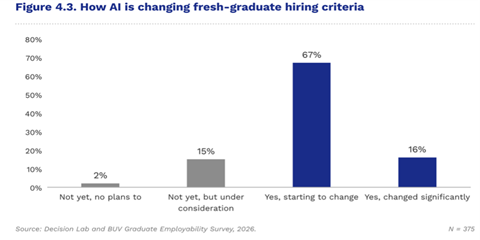
Digital literacy is the only capability area in which fresh graduates meet employers’ expectations, according to a new report. Yet, it is also the standard rising fastest, as businesses increasingly expect new hires to use AI effectively in the workplace. Some 83 per cent of employers say AI has changed, or is beginning to change, their hiring criteria, while 94 per cent report higher expectations for digital and AI capabilities than they had two to three years ago.

INFRASTRUCTURE / CONSTRUCTION / LOGISTIC / PORT
ĐÀ NẴNG GREEN-LIGHTS US$105 MILLION THAI DEVELOPMENT DEAL
The central city has approved an investment proposal by Thailand’s WHA Group to develop infrastructure for the 400ha WHA Đà Nẵng Industrial Park project on two communes of Thăng Bình and Đồng Dương, with an investment of more than VNĐ2.7 trillion (US$105 million). The city said it approved WHA Industrial Development International's status as an investor in the project, which is expected to take place between 2027 and 2034.

VIETNAM ECONOMY INVESTMENT
MOBILE PHONE EXPORTS RISE 20% TO $51.8 BILLION IN FIRST NINE MONTHS
Exports of mobile phones and components rose 20 per cent year-on-year to nearly US$51.8 billion in the first nine months of 2026, with China, the US and Republic of Korea accounting for more than half of the total. Shipments to the three markets reached a combined $26.18 billion, or 50.6 per cent of total exports of the product group during the period, according to data from the Vietnam Department of Customs under the Ministry of Finance.

VIETNAM ECONOMY INVESTMENT
FRUIT AND VEGETABLE EXPORTS POISED TO HIT $10 BILLION IN 2026
Fruit and vegetable exports are on track to reach nearly US$10 billion in 2026, after rising 19.9 per cent year on year to nearly US$7.4 billion in the first nine months, driven by strong seasonal demand and abundant tropical fruit supplies. The Ministry of Agriculture and Environment said the growth reflected stronger international demand for fresh produce and processed agricultural products.

GARMENT / TEXTILE
TEXTILE EXPORTS FACE DUAL CHALLENGES OF SUSTAINING ORDERS AND BOOSTING EFFICIENCY AMID GROWING COMPETITION
Data shows that the textile and garment sector maintained its growth momentum in the first nine months of this year. The industry's total export turnover reached an estimated US$35.721 billion in the first nine months of this year, up 3.3 per cent year-on-year. Despite posting encouraging export figures, Vietnamese textile and garment enterprises continue to navigate unpredictable market variables.
Events Sponsors






















