Want to be in the loop?
subscribe to
our notification
Business News
PHU QUOC MAKES UP OVER 80% OF AN GIANG’S TOURISM REVENUE
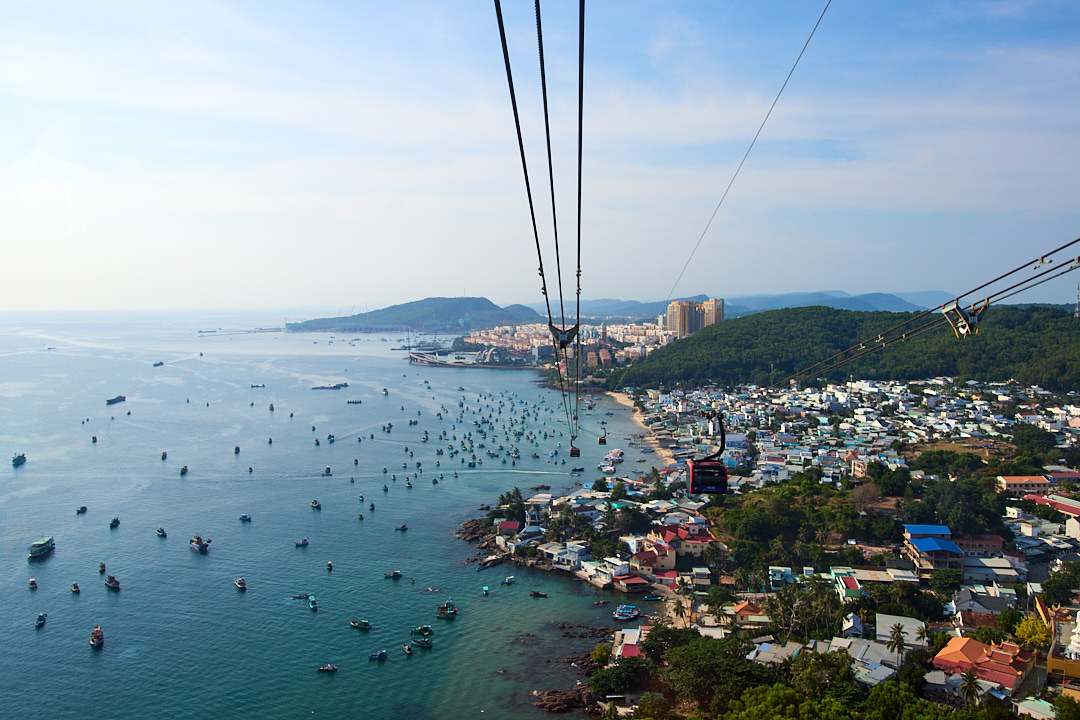
An aerial view of Phu Quoc Special Zone off the Mekong Delta province of An Giang - PHOTO: DAT THANH
HCMC – Phu Quoc Special Zone has accounted for more than 81% of An Giang Province’s tourism revenue so far this year, while attracting nearly all international visitors to the province.
Tourism revenue in An Giang has reached an estimated VND33.17 trillion in January-May, up 37.2% from a year earlier. The province has welcomed more than 13.3 million visitors, up 12.1%, while international arrivals have grown 48.4% to around 1.18 million, reported the Vietnam News Agency.
Phu Quoc has received an estimated 4.77 million visitors since early this year, up 34.2% year-on-year and equivalent to 56.1% of its annual target.
International arrivals to the island city total about 1.17 million, up 51% from a year earlier. Tourism revenue is up 50.4% to VND26.96 trillion.
In May alone, An Giang has welcomed an estimated 2.49 million visitors, up 4.3% year-on-year. International arrivals have increased 5.9% to around 166,000. Tourism revenue has expanded 2.9% to VND5.28 trillion.
Phu Quoc account for nearly 897,000 visitors in May, up 19.4% from a year earlier. International arrivals exceed 165,000, while tourism revenue totals VND4.14 trillion, up 12%.
Alongside tourism growth, An Giang has been developing policies and plans related to tourism and external relations.
The province has submitted a proposal to the prime minister, seeking approval to develop Phu Quoc into a high-quality eco-tourism and marine tourism center serving domestic and international markets.
Authorities are also preparing tourism development plans for 2025-2030 with a vision to 2035. The plans cover tourism management, investment support policies, tourism resource surveys, digital transformation, promotion activities, and international cooperation, along with preparations for APEC 2027.
Under An Giang’s 2021-2030 provincial plan with a vision to 2050, the province identified four economic corridors tied to border trade, coastal development, logistics, tourism, urban areas, and processing industries.
The province plans to divide development into five sub-regions. The eastern area centered on Long Xuyen is expected to focus on high-tech agriculture, biotechnology, and agricultural processing.
The northern area, covering Chau Doc, Cam Mountain, and Tra Su cajuput forest, is planned as a hub for eco-tourism, spiritual tourism, healthcare services, and border-gate economic activities.
The western area linked to Ha Tien is expected to develop the marine economy, renewable energy, cross-border trade, and international logistics. The remaining sub-regions cover the southern area and island groups such as Phu Quoc, Tho Chau, and Kien Hai.
Source: The Saigon Times
Related News
VIETNAM ECONOMY INVESTMENT
FOREIGN INVESTORS SEEKING A SYNCHRONISED MANUFACTURING ECOSYSTEM
Instead of focusing only on land costs and incentives as usual, foreign investors are seeking a synchronised manufacturing ecosystem, from stable power supply and logistics to shared infrastructure and the convenience of completing residence procedures for experts to serve their long-term investment in the country.
INFRASTRUCTURE / CONSTRUCTION / LOGISTIC / PORT
DONG THAP PROVINCE STEPS UP INDUSTRIAL EXPANSION AND INFRASTRUCTURE CONNECTIVITY
Accelerating public investment, strengthening inter-regional connectivity, and expanding industrial land are helping Dong Thap efficiently bolster competitiveness and drive economic growth. Following the 2025 merger of the former Dong Thap and Tien Giang provinces, the expanded Dong Thap province in the Mekong Delta faces mounting pressure to accelerate infrastructure development and strengthen connectivity among local economic zones, urban areas, industrial parks (IPs), and production centres.
PROPERTY / INDUSTRIAL ZONE
HCM CITY ATTRACTS US$5.7 BILLION INTO EXPORT PROCESSING AND INDUSTRIAL ZONES
HCM City attracted US$5.7 billion in domestic and foreign investment into its export processing and industrial zones during the first nine months of 2026. The figure exceeded the city's full-year target by 31 per cent, highlighting strong momentum in high-quality industrial investment under Resolution No.10-NQ/TW. Total investment reached 131 per cent of the 2026 target of $4.25 billion and represented a 29 per cent increase compared with the same period in 2025, according to the city's Export Processing and Industrial Zones Authority (HEPZA).

BANKING / FINANCE / INSURANCE / TAX
REMITTANCES TO HCM CITY RISE NEARLY 40% IN Q3
Remittances to HCM City reached more than US$2.83 billion in the third quarter of this year, up 39.5 per cent from the previous quarter and 3.6 per cent year-on-year. This was the first quarter showing positive annual growth this year, helping narrow the decline in remittance inflows over the first nine months. According to the State Bank of Vietnam (SBV)’s Regional Branch 2, remittances transferred to HCM City through credit institutions and economic organisations totalled $2.835 billion in Q3, an increase of more than $802 million from the previous quarter.
VIETNAM ECONOMY INVESTMENT
LOCALITIES REPORT BREAKTHROUGH RESULTS IN FDI IN FIRST NINE MONTHS
In Ho Chi Minh City, total registered capital reached $17.2 billion in the first nine months, up 4.2 times from the same period last year. The figure included more than $9.35 billion in newly registered capital and over $4.9 billion in additional capital for existing projects. Foreign investors also registered more than $2.9 billion through capital contributions and share purchases.

TECHNOLOGY
TECH SECTOR GROWTH OPENS UP OPPORTUNITIES FOR VIỆT NAM TO GO GLOBAL
The growth of the electronics, semiconductor and high-tech sectors worldwide is opening up a variety of opportunities for Vietnamese enterprises to integrate more deeply into the global supply chain. However, to become suppliers for these corporations, domestic enterprises must meet rigorous standards regarding quality, technology, productivity and order fulfilment capabilities.
Events Sponsors






















