Want to be in the loop?
subscribe to
our notification
Business News
SUSTAINABLE PRODUCTION ESSENTIAL FOR VIỆT NAM'S TEXTILE AND GARMENT INDUSTRY
Việt Nam's National Action Plan on Sustainable Production and Consumption for 2021-2030, approved under Prime Ministerial Decision 889/QD-TTg issued on June 24, 2020, targets a 7-10 per cent reduction in raw material, fuel and supply consumption from 2026 to 2030 across key manufacturing industries, including textiles and garments.
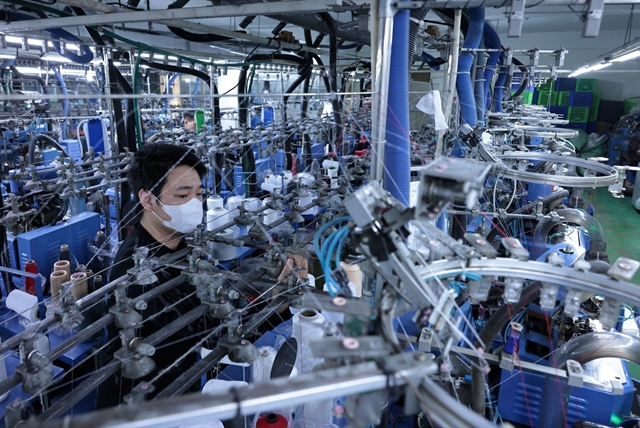
A worker at a Phú Vĩnh Hưng Co garment factory in Hà Nội. — VNA/VNS Photos
HÀ NỘI — Sustainable production is emerging as a key requirement for Việt Nam's textile and garment industry as major export markets tighten environmental standards, putting pressure on manufacturers to improve resource efficiency and reduce their environmental footprint, industry insiders have said.
The industry relies heavily on water, energy and chemicals across multiple production stages, making the shift towards sustainable practices increasingly important for controlling costs, improving productivity and maintaining access to global supply chains.
The country's textile and garment exports reached US$46.2 billion in 2025, while shipments in the first 10 months of 2026 rose 4 per cent year on year to approximately $39.8 billion, according to the Vietnam Textile and Apparel Association. Việt Nam remains among the world's three largest textile and garment exporters.
However, the EU and the US, two of the industry's main export markets, are imposing increasingly stringent requirements for product environmental data. This means manufacturers can no longer rely solely on production capacity, competitive prices and delivery times to secure orders.
The transition to sustainable production needs to extend beyond the use of environmentally friendly materials to cover resource efficiency, waste reduction and recyclability throughout the supply chain.
Việt Nam's National Action Plan on Sustainable Production and Consumption for 2021-2030, approved under Prime Ministerial Decision 889/QD-TTg issued on June 24, 2020, targets a 7-10 per cent reduction in raw material, fuel and supply consumption from 2026 to 2030 across key manufacturing industries, including textiles and garments.
The plan defines sustainable production as reducing material consumption and improving resource efficiency across the product life cycle, from raw material sourcing and fibre production to weaving, dyeing, finishing, end use and recycling.
For textile and garment manufacturers, this requires action in four main areas: controlling raw material consumption, developing renewable and recyclable materials, ensuring supply chain traceability and strengthening chemical management.
One option for reducing the industry's environmental footprint is the use of raw materials produced through lower-impact farming practices, including organic cotton.
Dương Huỳnh, manager of the Certification Department at Hohenstein Vietnam Co., Ltd., said organic cotton is grown without synthetic pesticides, chemical fertilisers or genetically modified seeds, relying instead on practices like crop rotation and organic compost.
However, the global supply of organic cotton remains limited, Huỳnh told vneconomy.vn.
Citing Textile Exchange data, Huỳnh said organic cotton accounts for about 3 per cent of the world's cotton-growing area, compared with 75-80 per cent for genetically modified cotton.
That highlights the challenges facing manufacturers seeking to switch to greener raw materials, including limited supply, strict cultivation and certification requirements, and the costs of monitoring compliance throughout the supply chain, she said.
Improving efficiency in processing
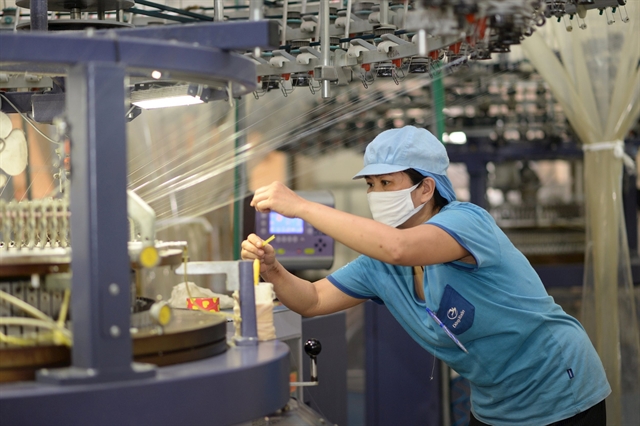
Việt Nam remains among the world's three largest textile and garment exporters.
Beyond raw material sourcing, washing, pre-treatment, dyeing and fabric finishing are among the most resource-intensive stages of textile production, consuming substantial amounts of water, energy and chemicals, experts said.
These processes also generate wastewater that requires treatment before discharge. Poorly managed equipment and production technologies can increase pollution risks while driving up costs through excessive resource consumption, inconsistent quality and higher defect rates.
Possible measures include upgrading machinery, tightening controls on water and chemical consumption, optimising dyeing processes and increasing the reuse of treated wastewater.
Manufacturers can also reduce their energy footprint by switching boiler fuels and installing rooftop solar power systems, according to experts.
The Vietnam Cotton and Spinning Association (VCOSA) said businesses do not necessarily need to invest in the most expensive technologies across all production stages.
Instead, investment decisions should target specific bottlenecks in manufacturing or business operations and deliver measurable gains in product quality, energy efficiency, waste reduction, production time or productivity.
The association also highlighted the role of information technology in collecting and managing production data, enabling manufacturers to track water, energy and chemical consumption at each stage and identify areas of resource inefficiency.
Environmental infrastructure needed
VCOSA Deputy Secretary-General Trần Hoài Thu said that Việt Nam’s textile and garment industry has reached a global scale. To advance to the next stage, the sector must deepen its production capabilities in the midstream segment — encompassing fabric manufacturing, dyeing and finishing — and strengthen domestic industrial links.
The midstream segment requires significant capital investment, specialised technology, technical expertise and appropriate environmental infrastructure, conditions that are difficult for individual factories to meet on their own.
According to VCOSA, the green transition and industrial development must be addressed in tandem. Environmental infrastructure should be integrated into the initial planning and project implementation phases, rather than treated as an afterthought once a factory is already operational. Without adequate treatment infrastructure, textile, dyeing and finishing projects will face immediate hurdles during the investment phase.
Thu noted that the greatest challenge in this process lies in execution. The goal of reducing resource consumption can only be effectively realised when Government policy translates into concrete support programmes, technological solutions and infrastructure conditions that are well-aligned with the realities of production.
This entails providing technical support, workforce training and access to capital for green investment projects and the development of environmental infrastructure within industrial zones. — VNS
Source: VNS
Related News

VIETNAM ECONOMY INVESTMENT
VIỆT NAM SEEKS INVESTMENT IN HIGH-QUALITY, LOW-EMISSION RICE VALUE CHAIN
Việt Nam is seeking to attract more foreign investment to develop high-quality, low-emission rice value chain which is expected to support the country’s transition towards greener and more sustainable agriculture. The push is highlighted at a forum on foreign direct investment (FDI) promotion in agriculture and rural development held in Cần Thơ City on November 23, as part of the second Vietnam International Rice Industry Festival 2026 organised by the Ministry of Agriculture and Environment and the Cần Thơ People's Committee.
VIETNAM ECONOMY INVESTMENT
RISING PANGASIUS PRICES BRING HIGHER PROFITS, BUT STABLE SUPPLY NEEDED
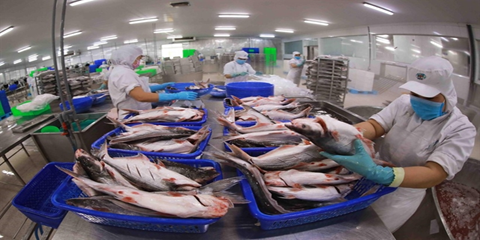
Prices of raw pangasius in the Mekong Delta are rising, bringing higher profits to fish farmers. To sustain growth and maintain its export market share in 2027, this billion-dollar industry needs to secure a stable supply of raw materials, strengthen disease control and increase the value of processed products. Pangasius farmers in several provinces across the Mekong Delta are welcoming record-high prices for market-ready fish, currently at around VNĐ38,000 (US$1.50) per kilogramme after recent periods of market volatility.
PROPERTY / INDUSTRIAL ZONE
HẢI PHÒNG EARMARKS 466 HECTARES OF INDUSTRIAL LAND FOR PRIORITY BUSINESSES
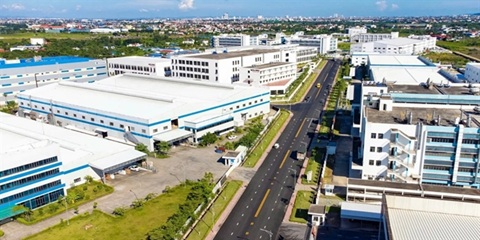
The northern port city of Hải Phòng has earmarked 465.89 hectares of industrial land for high-tech firms, small and medium-sized enterprises (SMEs) and innovative start-ups across 32 industrial parks, the city's Economic Zones Management Board said on Tuesday. The land allocation is intended to help priority business groups secure production sites and expand operations in the city.
PROPERTY / INDUSTRIAL ZONE
HCM CITY PROPERTY MARKET SEES MIXED SALES AND RENTAL TRENDS
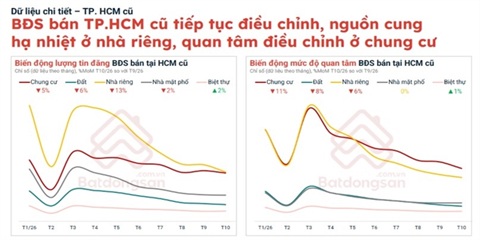
The HCM City residential property market saw subdued buying interest in October, with searches declining across most major segments, particularly apartments, land plots, and private houses, according to data from property technology platform Batdongsan.com.vn. In the former HCM City area, property sale listings fell across almost all segments.
VIETNAM ECONOMY INVESTMENT
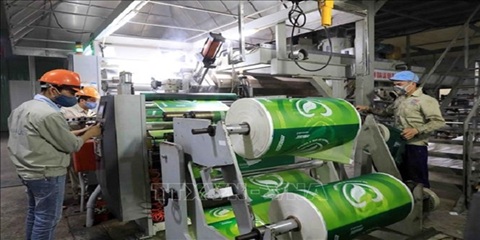
VIỆT NAM DISCUSSES OPPORTUNITIES TO PROMOTE PACKAGING EXPORTS
At a trade promotion conference organised by the Ministry of Industry and Trade on November 18, Lê Hoàng Tài, deputy director of the Vietnam Trade Promotion Agency, said packaging is an important supporting industry for manufacturing, processing and exports across sectors ranging from food and beverages to agriculture, textiles, electronics and consumer goods.
VIETNAM ECONOMY INVESTMENT
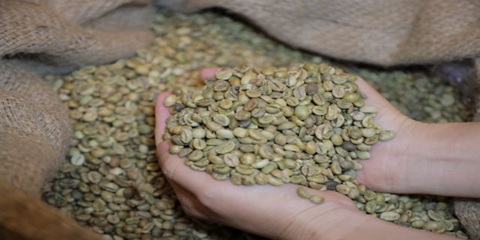
VIỆT NAM BUILDS DOMESTIC COMMODITY EXCHANGE TO BOOST FARM PRODUCE
In a bid to move from a major agricultural producer to a global price-setter, Việt Nam is laying the groundwork for a domestic commodity derivatives market. Robusta coffee will be the first physical commodity listed, helping local businesses hedge against price volatility while elevating Vietnamese farm produce on the world stage.
Events Sponsors